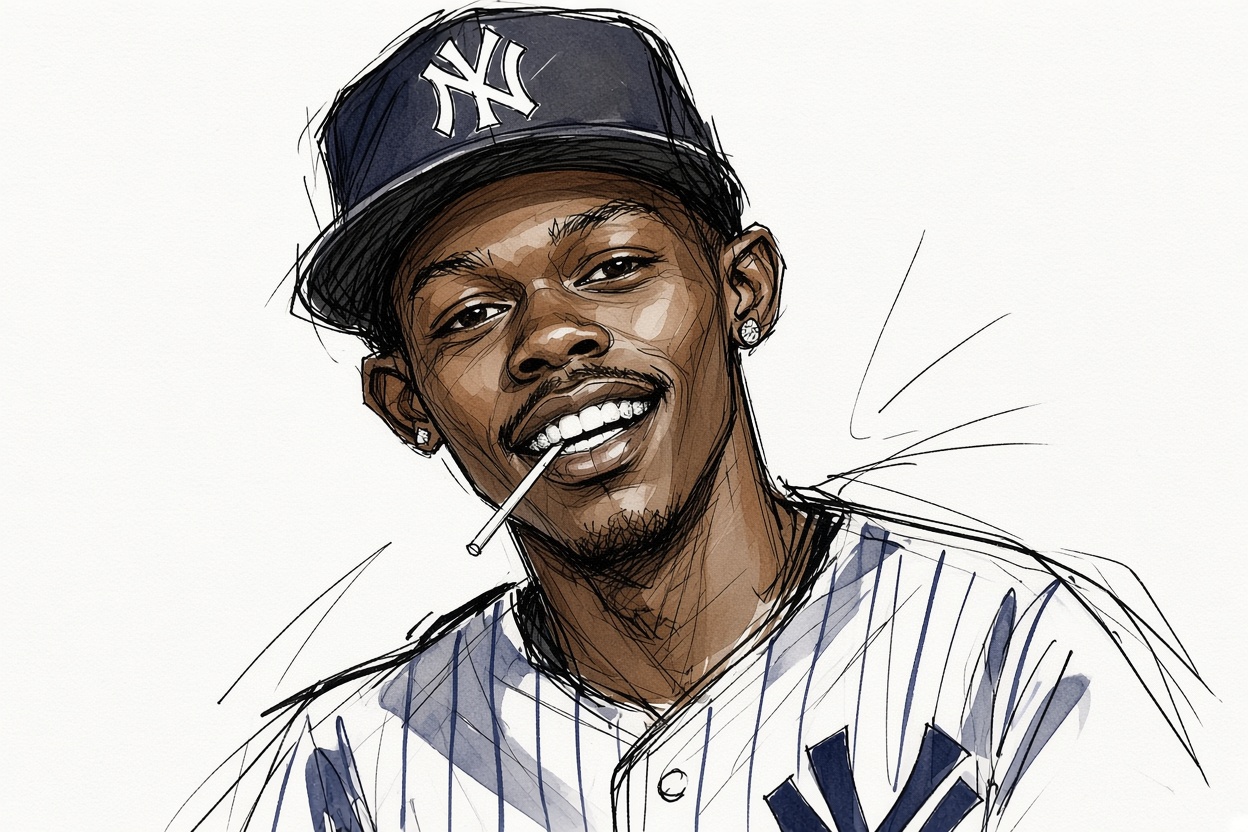
The idea that Jazz Chisholm Jr. is some clubhouse arsonist smart teams should run from doesn't hold up. He's a talented infielder who had a bad year and does dumb, visible stuff that nobody minds when he's hitting. The viral tale of Aaron Judge stepping in to keep him in line is thin and secondhand, and it gets the key quote backwards.
Start with where this actually comes from. The core reporting landed around November 5 and 6, and the whole "stern warning" storyline traces to one NJ.com roundtable, columnist Randy Miller talking with colleague Bob Klapisch. One conversation got repackaged across a dozen sites in a day or two until it reads like a wall of insiders all saying the same thing, when it's really one source, echoed.
Now the quote itself, the one the headlines are built on. Miller wrote: "I know Judge has sternly told Jazz to stop doing certain things, because Jazz told me it happened. But that didn't stop Jazz from getting out of line time and time again." That's a story about an intervention that failed. Judge talked, Jazz kept doing Jazz things. Anyone selling you "the captain kept him in line" is misreporting their own source material. Judge is the guy who got ignored.
The one honest, on-the-record voice in this blames the manager. Klapisch put the accountability squarely on the manager: "That's Aaron Boone's responsibility to sit a player, fine a player, call him into the office and get in his face if he's done something egregious." On the lollipop and the untucked pocket, he was even blunter: "They knew of his reputation when he was with the Marlins, but that experiment failed. That one is definitely not on Aaron Judge." The reporting blames Chisholm for the behavior and Boone for tolerating it. Judge, the name in every headline, is the one it clears.
The behavior is real. Chisholm took the field in the fifth inning of a loss to Detroit, down 4-1, with a lollipop in his mouth. Boone found out after the fact and hated it: "That pisses me off, I didn't know about it until after the game." Chisholm shrugged it off, saying he didn't think it was a "bad look" and that he's "playing a game, a kid's game, and having fun." He played a postseason game with his back pocket turned inside out. He got himself ejected arguing a checked-swing call against Boston in late June, and again in April against Tampa Bay after a full-count strikeout. It's all real. It's all immature. If Chisholm wants to be treated like a serious player, the fix is in his own mouth, pocket, and temper.
So why is it a national story now, in November, months after a candy wrapper? Because the bat went cold. He fell from 31 home runs and an .813 OPS in 2025 to 19 homers and a .711 OPS in 2026, and he managed two hits and two walks in eleven plate appearances across four playoff games. When a guy mashes, the lollipop is a personality quirk. When he slumps, the same lollipop becomes evidence he's a disease. The conduct didn't change. The slash line did. The pile-on is as much about a down year at the plate as it is about character, and everyone dunking on him knows it.
The Yankees declined to give him the qualifying offer, a $23.15 million number, and let him walk into free agency. He's an unrestricted free agent now, having come over in a 2024 trade from Miami. That's a baseball and money call on a player coming off a worse season. Don't let the clubhouse gossip launder a simple "he wasn't worth $23 million this winter" into "no one should sign him."
The team that does sign him is getting a player who steals bases by the dozen, stole a career-high 41 of them in 2026, and makes dumb headlines when he's not producing. That's a risk you price into the deal. The clubhouse-cancer label is the laziest thing a down year can buy you, and this one was bought on a single roundtable that half the internet couldn't even quote correctly.