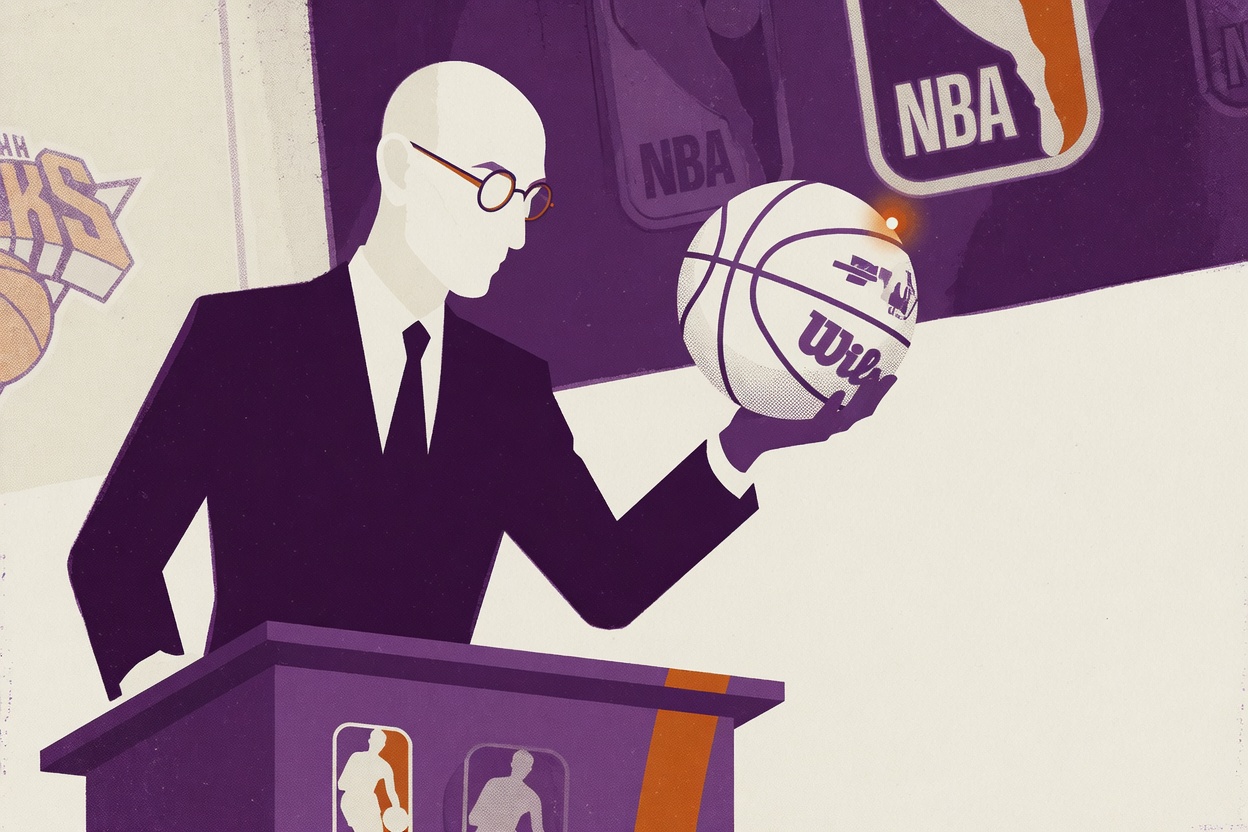
Adam Silver wants you excited about a one-gram chip. He should be embarrassed it took this long to find one.
The NBA is working with Wilson on what Silver calls a "smart ball," a game ball with a tiny Bluetooth chip inside that tracks movement, spin and trajectory. "We're experimenting with putting a small chip in the ball that weighs roughly a gram," he said. He added that "you could see as soon as next year us using it for officiating in our games," with a consumer version "a few years away." The league has already run chipped and standard balls side by side in the G League, Summer League and some preseason games. Players couldn't tell them apart. "Nobody could tell the difference. So that's a good sign," Silver said.
It is a good sign. A chip that improves out-of-bounds and possession calls, speeds up the replay center, and doesn't change how the ball feels is genuinely useful. If it trims thirty seconds off a late-game review that currently stalls the broadcast, fans win. The idea itself holds up.
The problem is the word "exciting." There's nothing exciting about arriving last.
The NFL put RFID chips inside its footballs in 2017, measuring rotation, speed and location every game, in partnership with the same ball manufacturer the NBA is now leaning on. That's nine years of a chipped ball already in the sport's workflow. FIFA aimed the same technology directly at officiating. The 2022 World Cup ball carried a sensor that fired ball data to the video room 500 times a second to help call tight offsides, and the 2026 ball does the same. That's the exact use case Silver is pitching, running at the biggest tournament on earth, four years before he described it as new ground.
And the consumer version he's dangling as years off? You can buy a chipped, shot-tracking basketball today. Spalding's smart ball, built on the TF-1000, is already on shelves with an app and a tracking subscription. What Silver says is coming has been available to anyone with a credit card for months.
The NBA isn't filling a hole in its technology, either. Since the 2023-24 season it has run Sony's Hawk-Eye optical tracking league-wide, the same camera tech used at the 2022 World Cup and in tennis, feeding the replay center in three dimensions and already assisting goaltending and out-of-bounds calls. The league can already see the ball. The chip adds a second data stream to a system that's been live for three years. It's an upgrade. Silver is selling it like a breakthrough.
Some will say none of that matters as long as the calls get better. Fair enough, but that's exactly why the marketing grates. If the pitch were simply that the league is adding a sensor to catch up with the rest of the sport, nobody would blink. Instead the commissioner is selling a gram of plastic as vision, while his own fans spend the comment sections asking why the league is chasing a chip when they don't trust the humans making the calls to begin with. Some are already joking about a "magnet ball." The paranoia is silly. The impatience behind it isn't.
The real fight Silver should be having is over wearable tracking for players during games, which has stalled because the players' union hasn't signed off. That's a serious negotiation about labor, privacy and data, the kind of thing that actually moves a sport forward. The ball chip carries no such hurdle, which is probably why it's the one he's happy to talk about on camera.
Put a chip in the ball. It'll help, just stop calling it leadership. Silver is announcing, in 2026, that he wants to start doing what two bigger leagues already did and a toy company already sells. That's a man taking a bow for showing up late.