There's a version of this story that fits neatly into the standard baseball template. A team is falling apart, so the general manager takes the fall. Tidy, familiar, done a hundred times a decade. Except almost nothing about the Athletics fits neatly into anything anymore, and David Forst's exit is the perfect example of why.
The club announced Friday that it and Forst had "mutually agreed to part ways," ending his run of nearly three decades with the organization. Assistant general manager Dan Feinstein was named interim GM for the remainder of the 2026 season, with the A's promising a "comprehensive search" for a permanent replacement. Owner John Fisher's statement was warm to the point of eulogy: "David has been an integral part of the A's and our success for nearly three decades. His leadership, dedication and commitment to this team have helped shape our baseball operations department and position us for the future."
Notice what that statement doesn't do. It doesn't explain why a man Fisher calls integral to the franchise's success is leaving with roughly a season and a half to go before the promised land in Las Vegas.
The parting that isn't quite a parting
Start with the language, because the language is a fight. The A's say mutual. The Athletic's Ken Rosenthal, Cody Varnes and Melissa Lockard have reported this was a firing. USA Today reported that Forst and his family didn't want to move to Las Vegas in 18 months, and ESPN's Alden Gonzalez reported that Forst "was never planning to move to Vegas with the club, according to sources, a circumstance that played a part in both sides moving on." Evan Drellich had flagged as far back as the spring that Forst was comfortable in California.
So which is it? My honest read is all of it, at once. A GM who wasn't going to make the move anyway becomes a lot easier to let go when the team is losing at the rate this one is. The results gave everyone permission. That's messy and human, and it's a lot more believable than any single clean narrative.
What makes the timing land like a joke is that less than a year ago, Forst signed a new contract tied to steering the club through its transition, and told reporters, plainly, "I will be back in 2026." He isn't going to finish 2026.
Forst's actual record, and who wrote it
The part everyone piling on tends to skip: Forst spent his entire front-office life with this organization. He joined as a scout in 2000, became assistant GM in 2004, and took over as general manager in 2015 when Billy Beane moved upstairs. His own farewell line, repeated identically everywhere: "It was truly an honor to spend the last 27 years with the A's, especially the last 11 as the GM."
Over those years the A's made the playoffs three times, back to back to back from 2018 through 2020, with 97-win seasons in 2018 and 2019. They won exactly one AL West title under him, in the shortened 2020 season, and won a single postseason series across those trips. So no, this wasn't a run of deep October glory. Fair criticism.
But look at what happened next, because it's the whole argument. After an 86-win 2021, Forst was forced to oversee a teardown as ownership looked to bottom out before leaving Oakland. Matt Chapman, Matt Olson and Sean Murphy went out the door. Forst himself once described the job as "transactional," saying the constraints changed "our payroll and how much money we have to spend on Major League players" and even the ability to plan years ahead.
That's a general manager telling you, in his own words, that he was handed a budget and a directive, not a mandate to win. You can dislike the results from 2022 through 2025, records of 60-102, 50-112, 69-93 and 76-86, with no winning season since 2021. I'd just ask you to name the GM alive who turns the lowest payroll in baseball into a contender while the franchise packs up and moves twice.
The dysfunction is upstairs, and it's not new
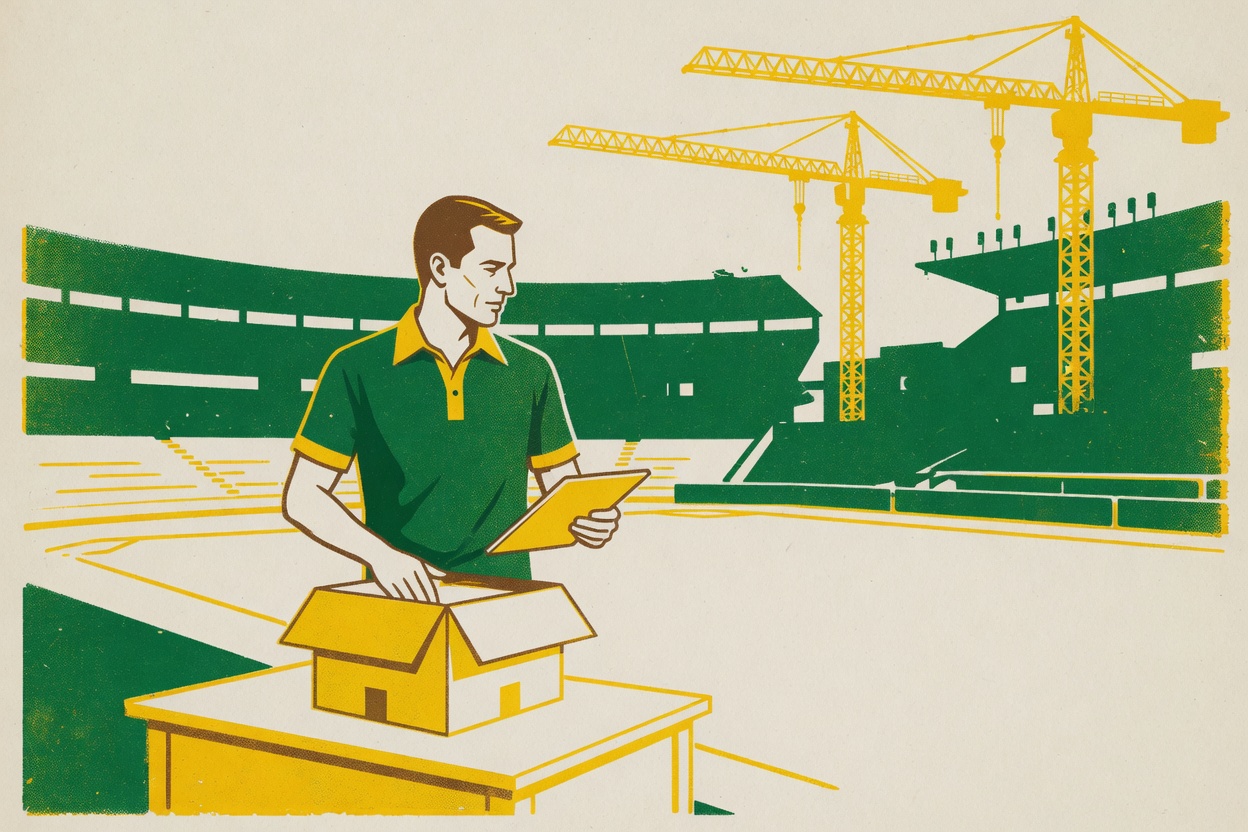
The A's are currently playing in Sacramento's Sutter Health Park, capacity around 14,000, after leaving Oakland in 2024, while they wait on a roughly 33,000-seat, $1.75 billion ballpark in Las Vegas targeted for 2028. That's not a stable place to build a baseball team. It's a franchise living out of suitcases.
The money tells the same story. This season the A's project to a year-end payroll near $96.9 million, which would rank 25th of 30 teams, and that's actually a bump up from a prior season when their Opening Day figure of around $61 million was the lowest in the sport. Fisher frames the constraint as revenue-driven and pins the fix on Vegas, saying the A's have had "a more challenging time signing free agents because we haven't had the revenues to support a payroll," and that "being in a new stadium, being in Las Vegas is going to change all of that."
Maybe. But the anger at Fisher long predates this week. Fans have chanted "Sell" for years, staged a reverse boycott, and begged him to hand the team to someone who would spend. Fisher has said flatly, "I have not considered selling the team." Even inside the sport there's friction: the San Francisco Chronicle's Bill Shea reported that other owners are annoyed MLB waived the relocation fee, and unhappy with how the A's have used revenue-sharing money over the years.
That's the backdrop one man just got shown the door against.
So who's really responsible?
My take: firing the general manager during a stretch that saw the A's lose 12 of 13 and sit tied with the Rockies for the second-worst record in the majors as of this weekend is treating a symptom. The 45-70 mark is a moving target with the season still going, injuries to players like Shea Langeliers and Nick Kurtz haven't helped, and none of it changes the underlying diagnosis.
For 30 years the baseball operation ran through Beane and Forst, and now, for the first time, it won't. Continuity is over. Feinstein may be a bridge or he may be the future; nobody knows yet, and the A's have said only that the search is beginning. But whoever gets the permanent chair inherits the same two problems Forst had: a payroll near the bottom of the league and a franchise that won't stop moving. Change the nameplate on the GM's office all you like. The person who controls both of those levers isn't leaving. He told you so himself.