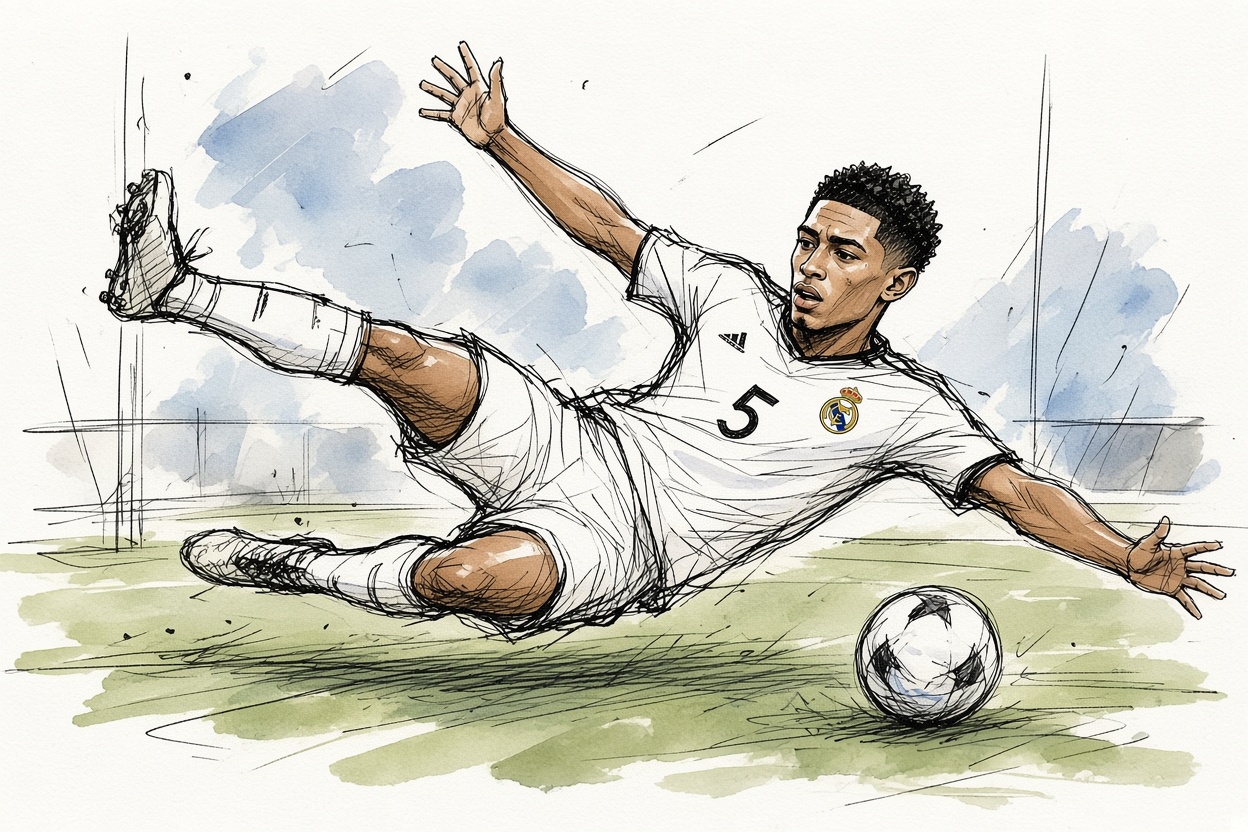
Cesar Soto Grado got it right. Jude Bellingham went down in the box under almost no contact, the referee went to the monitor, cancelled his own penalty and showed Bellingham a second yellow. Every step of that was the correct call.

⚡ Big upset:Alavés had a 6% chance before kickoff and beat Real Madrid 2–1.
 84%

It happened late in Saturday's 2-1 home defeat to Alavés at the Bernabéu. Toni Martínez gave the visitors a first-half lead, Ángel Pérez doubled it just after the hour, and Kylian Mbappé pulled one back to set up the kind of finish Madrid have made a habit of. Then Bellingham got to the ball ahead of Nicolás Valentini, went to ground, and won a penalty that would have been the equaliser. A few minutes later it was gone, and so was he.
The defeat ended Madrid's ten-game winning run and left them third, a point behind Atlético Madrid, as of Saturday night. That's the cost of one bad decision by one player, and the player was Bellingham.


The referee had the nerve
Think about what Soto Grado actually did. He gave a penalty to Real Madrid, at the Bernabéu, with the home side chasing the game. Then he walked to the monitor, looked at it honestly, and reversed himself. Referees get hammered for refusing to admit mistakes. This one admitted his on the spot, in the hardest stadium in Spain to do it, and punished the player who caused it.
The refereeing site Archivo VAR handed him a 3.5 out of 10 for the night. He can have a poor match and still get the biggest call of it right. A shaky evening doesn't poison the one decision that held up under a replay.
The first yellow is Madrid's best argument, and it fails
The strongest case for Bellingham is the earlier booking. Accounts of it differ: some match reports have him booked for protesting at the referee, while the live commentary had him cautioned for his part in a shoving match around the Alavés goalkeeper.
Say that first card was soft. It still doesn't make the red an accident built on a bad call. Soft or not, Bellingham knew he was carrying it. A player on a yellow who throws himself down in the box is gambling with ten men, and he lost the bet. The second card stands entirely on its own: simulation is a bookable offence no matter what came before it. Stacking a soft card on a soft card would be harsh. Stacking a correct card for diving on top of any earlier card is just the rulebook doing its job.
Mourinho saw it too
The most revealing thing said after the match came from Madrid's own manager. "On the iPad, I thought it could be an exaggerated penalty," José Mourinho said. Then he decided that didn't matter: "And when a player says it's a penalty, I have to think it's a penalty. I have to believe the player."
That's loyalty overruling his own eyes, and he said it out loud. Then came the needle. Mourinho claimed this referee sent off Mbappé two seasons ago and Vinícius last season, said "I think this referee likes to show off his power," and wondered whether Courtois would be next. In the same breath he admitted "we didn't lose because of the referee."
You can't have it both ways. If Madrid didn't lose because of Soto Grado, then dragging up his history is grievance-building for the next time he draws a Madrid game, a pressure play on an official who just did his job correctly. It's classic Mourinho, and it deserves zero sympathy.
The man who threw away Madrid's last real shot at a point on Saturday was Jude Bellingham, and Soto Grado was right to send him off for it.