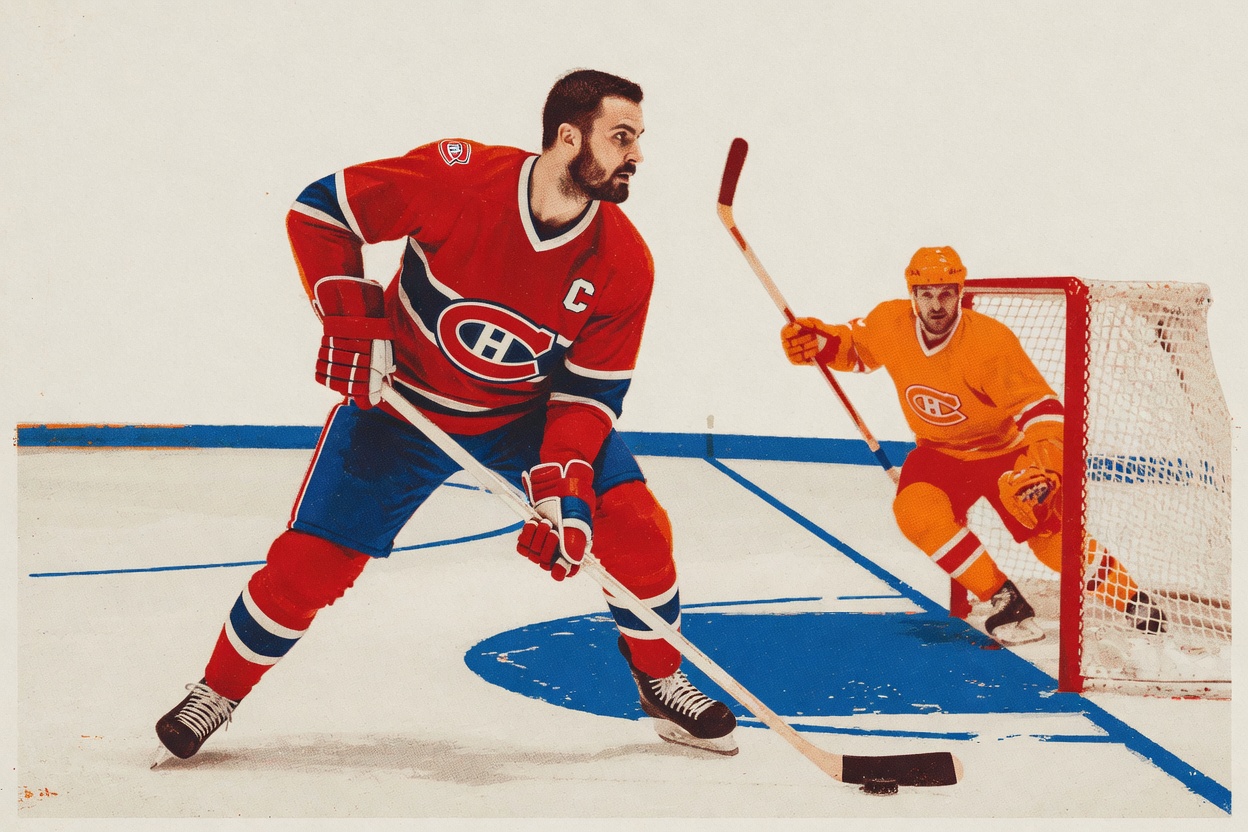
Chris Kreider could have collected the last year of his contract and gone quietly. Instead he walked away from real money to sign somewhere that felt like home. That says something about how veterans actually think, more than any cap spreadsheet will.
The numbers are worth laying out, because the gap is real. When the Ducks placed Kreider on waivers on Sept. 9 and terminated his deal a day later, he was owed roughly $4 million in the final year of the seven-year, $45.5 million contract he'd originally signed with the Rangers in Feb. 2020, a deal with a $6.5 million cap hit. Three days later, on Sept. 12, Montreal signed him for one year at $2.15 million guaranteed, with another $3.25 million available in bonuses. Even if he hits every bonus, his ceiling is $5.4 million. His floor is well under what Anaheim was still on the hook for. He chose less money.
Pierre LeBrun reported that Kreider's decision came down to three teams, and that his comfort with head coach Martin St. Louis and his history with president of hockey operations Jeff Gorton tipped it. Both ties go back to Broadway. Kreider and St. Louis were Rangers teammates in 2013-14 and 2014-15, St. Louis winding down while Kreider was a rookie just starting out. Gorton was the Rangers' assistant GM when Kreider arrived and later their GM for six seasons. The contract Anaheim just tore up? Gorton was the one who originally offered it in New York.
This is what veteran decision-making looks like once the biggest paydays are behind a player. Relationships and trust become the currency. Elliotte Friedman reported, before Montreal ever entered the picture, that Kreider wanted to head east, closer to family, and wouldn't report to a team he didn't want to play for. The framework was set early: location and people first, money second. Kreider just gave us a clean example of it.
There's a wrinkle worth mentioning. Kreider is one of the most booed visiting players in modern Montreal sports history, dating back to the 2014 playoffs, when he collided with goaltender Carey Price on a breakaway. Price missed the rest of that series with a knee injury, and the Rangers advanced to the Stanley Cup Final. Now the villain shows up wearing the CH. How the Bell Centre reacts once the season starts is a real storyline, and I won't pretend to know how it plays out.
Anaheim's side of this is where things get more critical. The Ducks needed cap room, fine. They matched a five-year, $90 million offer sheet on Leo Carlsson in July, an $18 million average annual value that's among the highest in the league this coming season. They re-signed Pavel Mintyukov for five years and $36 million. They still had to fit restricted free agent Cutter Gauthier, who led the team in goals and points last season, under a $104 million cap. Something had to give.
But the way they did it is the problem. Kreider isn't a broken-down passenger. Last season, his first in Anaheim, he put up 50 points in 75 games, hit 20 goals for an eighth straight year, and finished second on the Ducks in power-play goals. ESPN still rates him among the best net-front players in the league. Anaheim had acquired him barely a year earlier, giving up prospect Carey Terrance and a 2025 third-round pick to get him. Then they let him walk for nothing. No pick, no player, no return of any kind.
General manager Pat Verbeek's explanation was blunt: "Our rationale here is straightforward: We needed to create salary cap flexibility, and this accomplishes that." It did free up $6.5 million. But Pro Hockey Rumors noted the termination route came as a surprise, since a trade is usually the simpler path for both sides, and Friedman reported Verbeek "did not like the trade options presented to him." So the choice came down to taking an offer he considered underwhelming, or taking zero. He took zero.
That's the part I'd question if I ran that building. When a useful 20-goal scorer becomes a cap casualty, salvaging some return is the whole job. Anaheim turned a saleable asset into a giveaway, it seems, because the trade market didn't meet their price. No one has called it a mistake on the record, and I'll say plainly this is my read, not a reported verdict. Even Carlsson felt it, telling The Athletic's Mark Lazerus, "Chris, he's leaving, but he's also really happy for me, as well. It's a hard business." The money that kept Carlsson came straight out of Kreider's spot.
Montreal, meanwhile, got a proven scorer for a bargain. As of the signing, Kreider's cap hit ranked around tenth among Canadiens forwards. The team also signed Zachary Bolduc to a four-year, $16.8 million deal around the same time, so their cap math keeps moving. Montreal finished third in the Atlantic last season at 48-24-10 and reached the Eastern Conference Final before losing to Carolina in five. This is a team trying to take a step up, and it just added a net-front veteran on a discount because he wanted to be there.
Two teams, one player, opposite lessons. Kreider showed that fit and trust can beat a bigger paycheck. Anaheim showed how fast a high-cap veteran can go from asset to afterthought once a front office gets squeezed and settles for whatever clears the number. One of those looks smart to me. The other, less so.