The number matters most here. ESPN is reportedly ready to pay an additional $345 million a year for the rights to eleven more football games, and in exchange college football is prepared to double its postseason and quietly erase Championship Saturday. That's the trade on the table right now: more inventory, more ad breaks, marketed as "access."
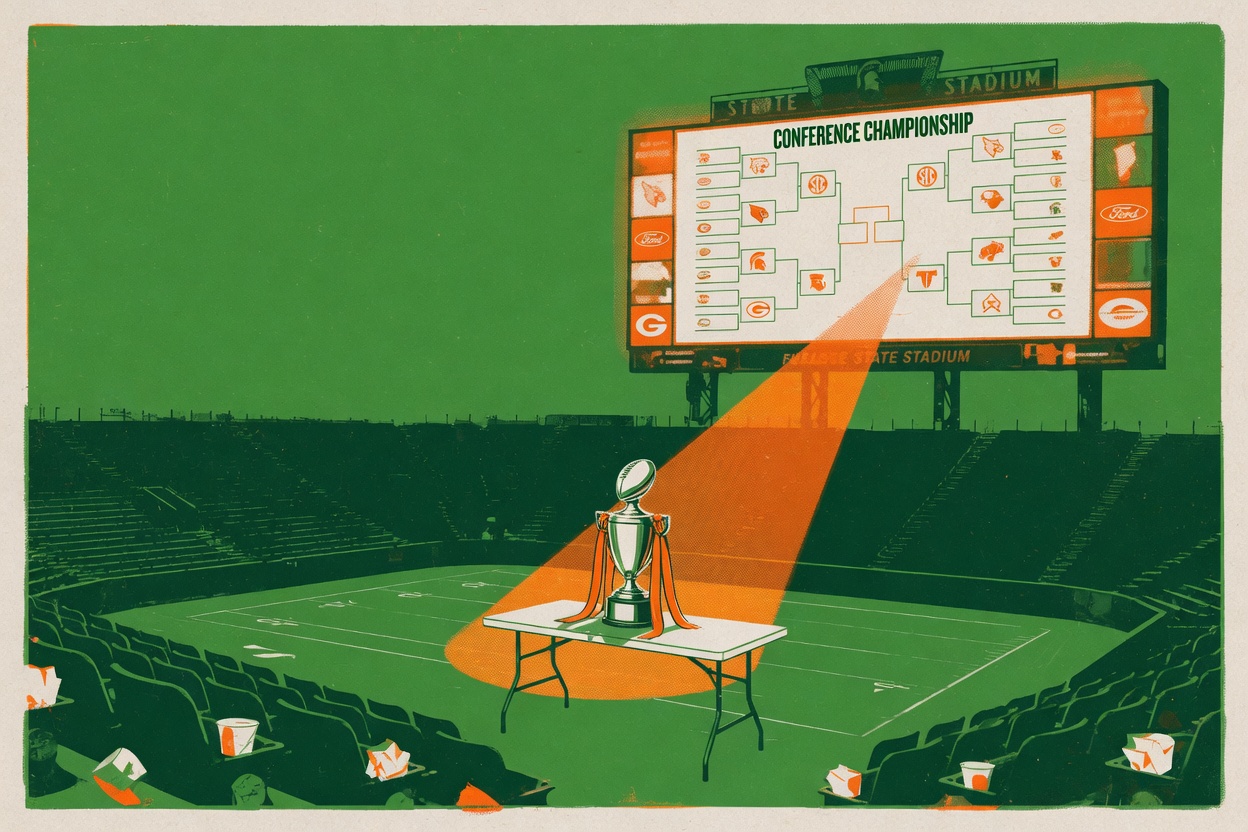
None of this is signed yet. The reporting describes a handshake agreement reached last week, with an official announcement expected soon and plenty of details still unfinished. Nobody has voted, nothing is locked, and the commissioners can still look you in the eye and say it's not done. But the shape is clear: a 24-team field starting in 2027, the top eight seeds getting a first-round bye, the first two rounds on campus, and the quarterfinals, semifinals and final at neutral sites. The piece they're willing to feed into the wood chipper to get there is the conference championship game.
The Power Four title games go away. The December stadiums full of people watching a league settle its own trophy on the field get replaced by a committee ranking in a conference room. The Big Ten floated this; its commissioner, Tony Petitti, pitched the expansion models that got the ball rolling. A league that spent decades selling Championship Saturday as appointment television is now ready to sell it for parts because there's a bigger check sitting next to it.
The money conferences lose by killing their title games is exactly the money ESPN's extra payment is designed to backfill. It's by design. The deal is built so the leagues come out even on paper and the network gets eleven more games to stuff with commercials. The fans who filled those December stadiums were never a line item.
The inclusivity pitch, the one thing that could make this defensible, falls apart the second you read the bid structure. Twenty-four teams, and the automatic bids go to the four power conference champions plus the single highest-ranked Group of Six champion. Five autobids. Nineteen at-large spots handed out by the committee. You don't need a calculator to guess where nineteen committee-selected teams come from in a sport where the committee already worships the SEC and Big Ten. The little guy gets one guaranteed door and gets told to be grateful. It's the same cartel, just with a bracket big enough to swallow any complaint about who got left out.
The product on the field has gotten better in the expanded-playoff era, and a bigger bracket does give a mid-major a shot it never used to have. Fine. But one autobid and nineteen at-larges amounts to a velvet rope for those teams. They expanded the room and kept the guest list.
The tell is that 24 won't hold. The same people who swore the four-team playoff was perfect expanded it to twelve, and the ink was barely dry on twelve before Petitti and the Big Ten were workshopping 24 and 28. Every time the number goes up, the check goes up, and every time the check goes up, the number goes up again. Nobody in that room gets paid to say enough is enough.
The College Football Playoff is expanding because a network will pay $345 million a year to air more games. The men who run the conferences would rather cash that check than protect a single tradition the sport has left. They'll call it growth right up until the day they come back for 28.