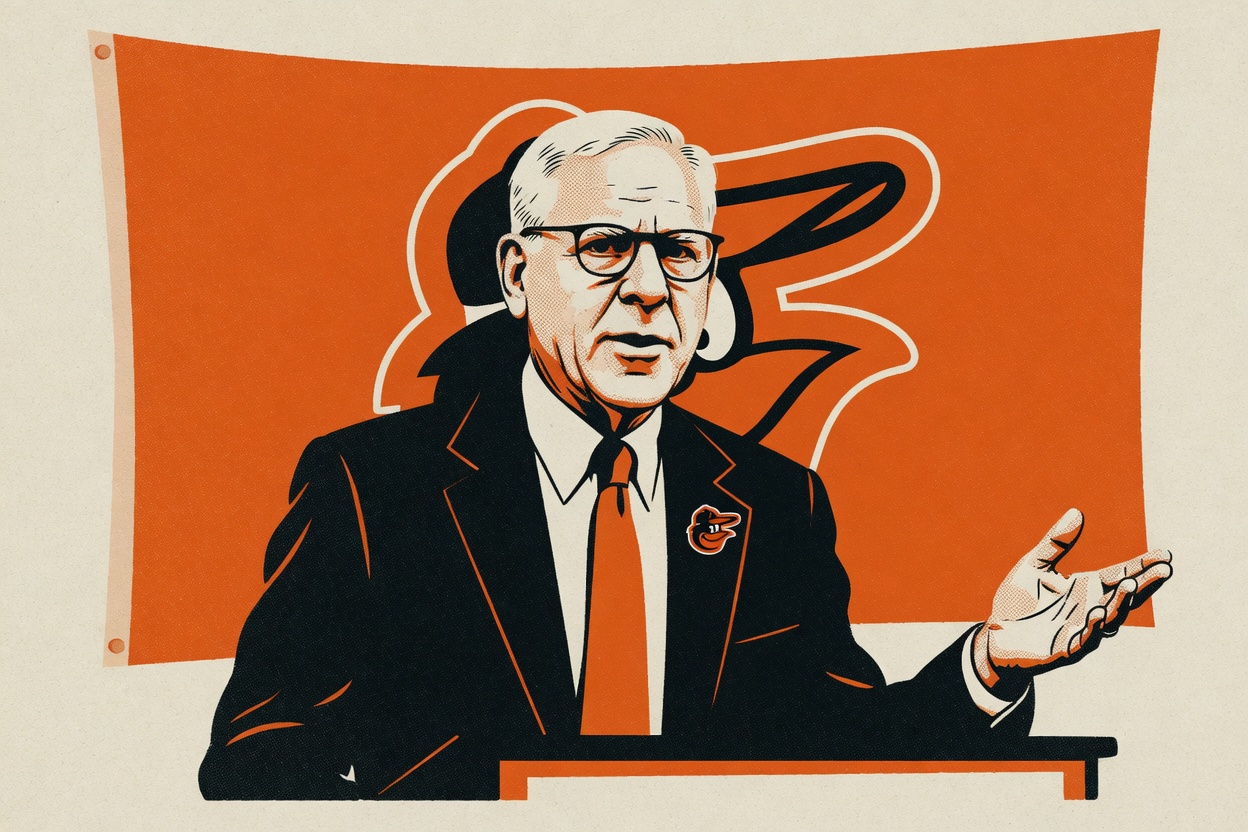
The owners are getting ready to tell you they can't afford to pay baseball players. David Rubenstein, who owns the Orioles and happens to be one of the richest men in the sport, just told you the opposite, in his own words, before his colleagues could stop him.
Here is what he said about buying the team: "A lot of my friends were buying teams, and I realized they're making money. They're making more money than I'm making in private equity. I thought I should look at it as a financial thing, but ultimately, I bought the Orioles for a philanthropic purpose."
This is a man who co-founded the Carlyle Group and has a net worth Forbes puts at $4.1 billion, saying owning a baseball team pays better than one of the most lucrative careers in modern finance. The timing makes it sting. The current collective bargaining agreement expires at 11:59 p.m. ET on Dec. 1, and a lockout is widely expected to follow. In roughly six weeks, the people who run this sport are going to walk to a microphone and plead hardship. One of their own just undercut the whole bit.
And it is a bit. The league pulled in a record $12.1 billion in revenue in 2024, and Forbes has team values up 8 percent, with the Yankees becoming the first team valued north of $8 billion at an estimated $8.2 billion going into 2025. The Dodgers, the team the cap crowd loves to point at, are up 25 percent to $6.8 billion. Across the sport, Forbes has teams up 36 percent in value over five years. Rubenstein's own case is the cleanest tell of all: he bought the Orioles for $1.725 billion in January 2024, and by a January 2026 Forbes report the team was pegged at $1.9 billion. He hasn't sold a thing and he's already up. It's an appreciating asset that prints cash the whole time he holds it.
Now hold that against his politics. Rubenstein has been one of the most public salary-cap advocates in the game. At Davos in early 2025 he said, "I wish it would be the case that we would have a salary cap in baseball the way other sports do, and maybe eventually we will, but we don't have that now." So the same man campaigning to cap what the players earn is also the man who admitted the owners are getting rich. You can't hold both of those in your head and still believe the cap is about competitive balance. A cap is a cost control that locks in profit margins and calls it fairness. The profit it protects belongs to the owners.
The balance argument doesn't even hold on its own terms. A YES Network researcher pointed out that baseball has had more teams win championships since 2000 than any of the three American leagues that already use a cap. The sport the owners want to imitate for the sake of parity has less parity than the one they already run. There's no competitive problem to fix here. The cap is about a payroll number owners don't like.
There's a real objection buried in here: a hard cap is a naked giveaway to owners, but a progressive luxury tax that bites harder as spending climbs could still rein in the biggest markets without simply handing the savings to ownership. Fine, that's worth having as its own conversation. Owners are heading toward a lockout to get the cap outright, because it guarantees them the money, and Rubenstein just confirmed how much money there is to guarantee.
He didn't stop at the accounting, either. He also said he "couldn't figure out why it is that people who are fans are so obsessed with the success of their local team," before landing on the idea that people take pride when something tied to their community wins. Charming. The man who can't quite grasp why you care is the same one asking you to accept that his industry needs your help keeping labor costs down.
Meanwhile the bill lands on you. With the Guardians leading the Rays 2-1 in the ALCS as of this writing and selling presale World Series tickets, the cheapest available seats at Progressive Field were listed around $770 for standing room, climbing well past a thousand dollars from there. That's the product the owners say they can barely afford to put on the field.
So when the lockout comes and the hardship speeches start, remember which owner slipped up and told the truth first. The people crying poverty in December are the same people getting richer every year they hold the asset. Rubenstein said so. Believe him over the press release.