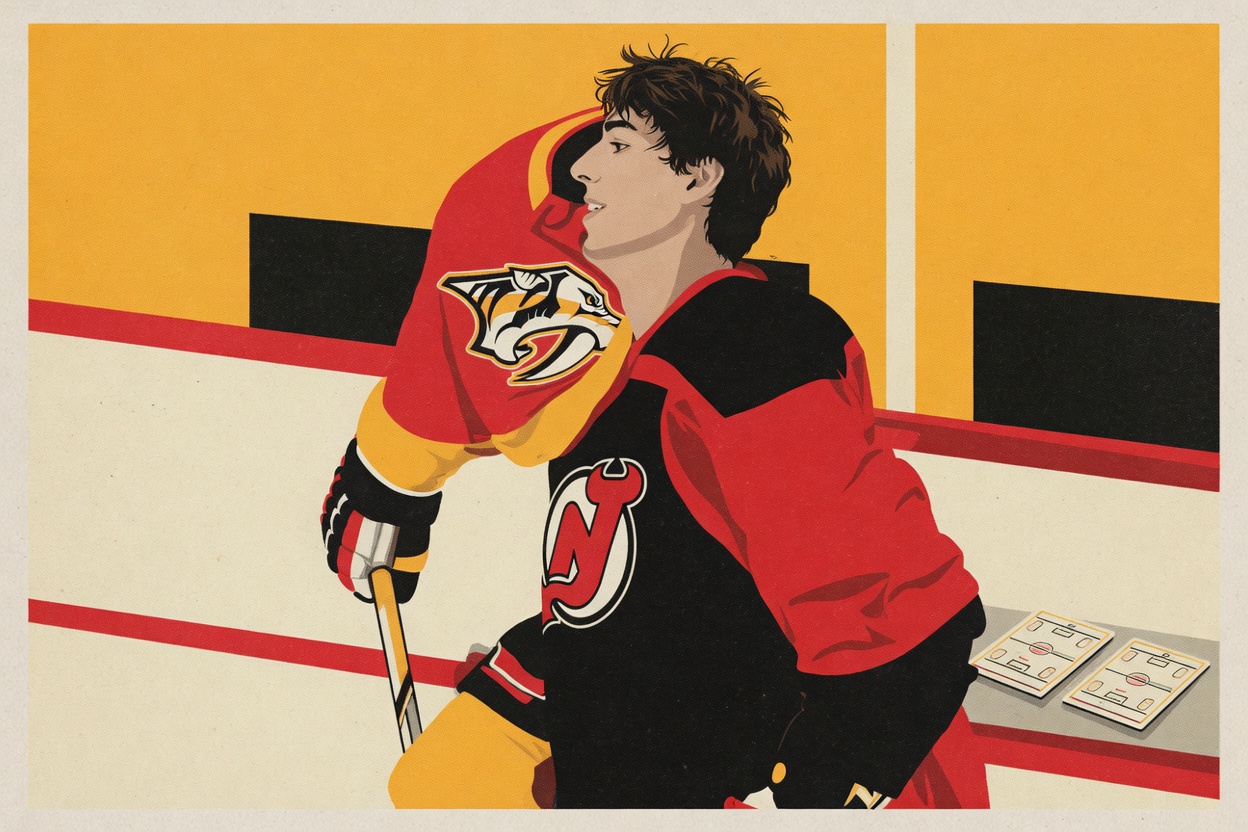
Rookie general managers are supposed to be cautious. Sunny Mehta, in his first offseason running the New Jersey Devils, has been anything but, and the late-night deal that brought Luke Evangelista over from Nashville is the boldest move yet in a busy summer.
The logic is easy to follow. The Devils couldn't score last season. They averaged 2.76 goals per game, near the bottom of the NHL, and finished 12 points out of the second and final Eastern Conference playoff spot. Evangelista is aimed at that problem: a 24-year-old winger who posted a career-high 56 points (12 goals, 44 assists) in 81 games last season, most of that damage coming as a setup man. He's entering the second season of a two-year, $6 million contract with a $3 million cap hit, then becomes a restricted free agent, with arbitration rights, after this season. New Jersey isn't renting a solution for one year. If the fit works, Mehta keeps team-friendly control on the back end. That's the case for the deal, and it's a good one.
The case against isn't as clean. New Jersey sent Nashville a conditional 2028 first-round pick and the Devils' own 2028 second-round pick. The first-rounder is the interesting one. It isn't New Jersey's own pick. It's the one Mehta pulled out of Calgary on June 23 when he traded Simon Nemec, a former No. 2 overall selection, along with Maxim Tsyplakov, and got back Etienne Morin, a 2026 second-rounder, a conditional Vegas first, and this Colorado first. Trace the pick back and the chain runs like this: a top-of-the-draft defenseman got converted into a basket of futures, and one of those futures immediately became the price of a middle-six winger. Call it a first and a second on paper. In practice, Mehta is spending premium capital he'd only just acquired.
And that first-rounder is slipperier than it looks. It's heavily protected. If Colorado's 2027 first doesn't transfer to Toronto, or if Colorado's 2028 first lands in the top 10, Nashville instead receives Colorado's 2029 first. Given how good Colorado has been, the top-10 protection isn't a formality. So the asset New Jersey gave up could convey as a late first, or slide a year. It's real futures value dressed in enough conditions that both sides could talk themselves into loving it. That's a defensible price for a proven producer. It's not an obvious bargain.
The part that should nag at Devils fans is who was selling. Nashville didn't have to move Evangelista. GM Chris MacFarland, who's no rookie, having run Colorado for four seasons before taking over the Predators on June 2, framed it as a value play, not a hockey trade. "This trade brings us two more high draft picks, giving us seven in the first two rounds over the next two seasons; provides us with flexibility from a roster and salary cap standpoint to make additional improvements to our team; and creates a space for the promising young wingers within our organization to compete for, and earn, an NHL job," he said. When a GM who spent years stockpiling picks in Denver decides a 56-point winger is worth more as picks and cap room than as a player, it's fair to ask what he sees that the market doesn't.
There's also a redundancy question. Before this deal, New Jersey's forward group already included Jesper Bratt, Timo Meier, Dawson Mercer, Connor Brown, Evan Rodrigues, and Anthony Mantha. That's not a group starved for bodies on the wing. The defense of the move is that none of them plays exactly Evangelista's distributor role, and a team that couldn't finish could use another player who creates chances. Fair enough. But paying futures for a piece that overlaps with what you already have is exactly how a good process turns into an overpay.
None of this makes it a bad trade. Mehta has been decisive all summer: flipping Nemec, moving Jacob Markstrom to Florida, re-signing Nico Hischier and Arseny Gritsyuk, and refusing to stand still. Aggression from an analytics-minded GM who grew up watching this team is easy to root for. Just keep the receipt. He turned a former No. 2 overall pick into a conditional first that may not stay a first, then spent it, plus a second, on a player Nashville was glad to sell. If Evangelista pops in New Jersey, no one will remember the ledger. If he's what he already was, the questions won't go away.