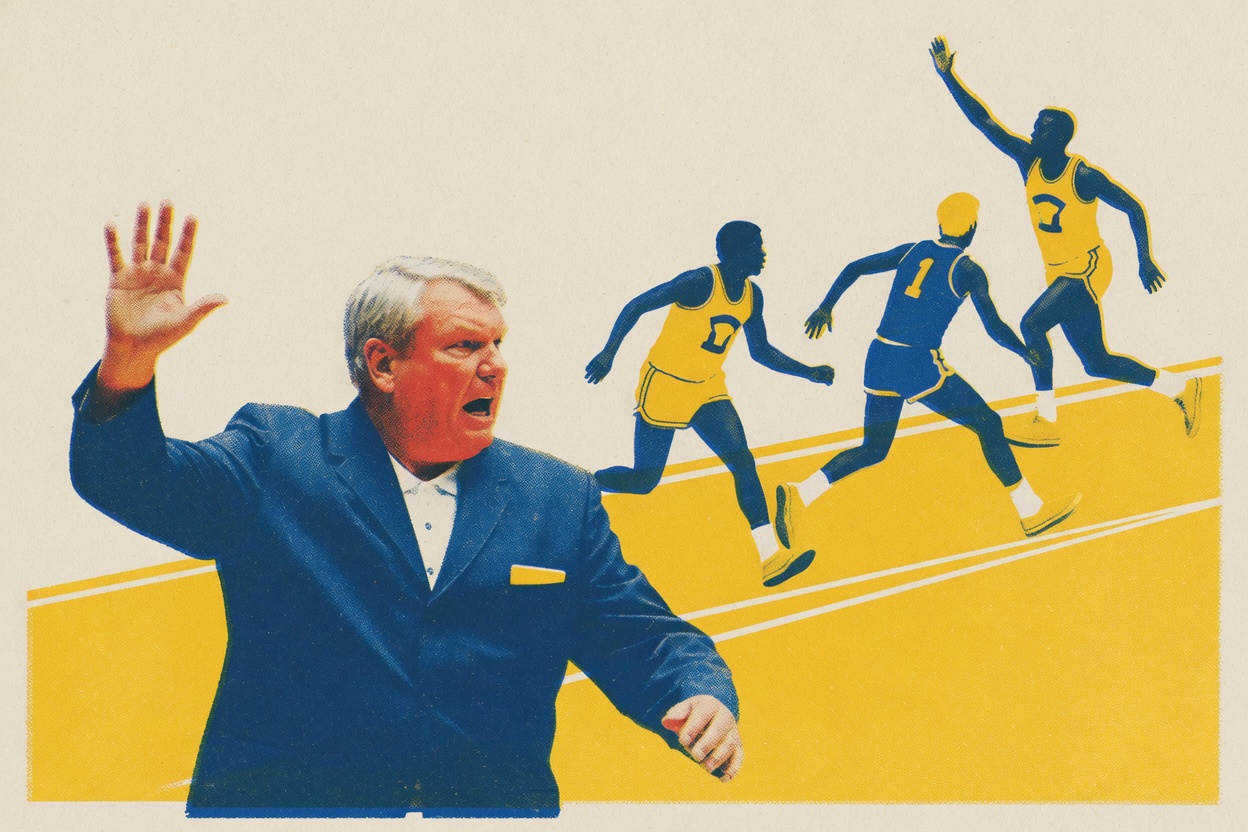
Don Nelson died Sunday, August 9, at age 86, and within an hour the shorthand was set: Hall of Famer, five-time champion as a player, second-winningest coach in NBA history, never reached the Finals from the sideline. All true. All incomplete.
We're measuring one of the sport's great inventors with the wrong ruler.
Nelson coached 31 seasons across the Milwaukee Bucks, Golden State Warriors (twice), the New York Knicks and the Dallas Mavericks, and finished 1,335-1,063 in the regular season. He held the all-time coaching wins record for nearly 12 years before Gregg Popovich, one of his closest friends, passed him in March 2022. That record was the headline for a long time; it shouldn't be now.
Watch a game tonight: a forward brings the ball up, a team goes small and dares you to punish it, nobody has a fixed position anymore. That's Nelson. He got there first, decades early.
The ideas came before the copycats
Start with the point forward. In Milwaukee, Nelson handed the ball to Paul Pressey, a 6-foot-5 forward with a long wingspan who could see over defenders and pass. In Pressey's third NBA season his assists jumped from 3.1 to 6.8 per game, and he pushed to a career-high 7.8 the following year in 1985-86. The Hall of Fame's own bio credits Nelson with introducing the concept to basketball. Every time a big, non-traditional wing runs an offense today, that's the tree Nelson planted.
Then there's the small-ball framework everyone now takes for granted. Nelson played Dirk Nowitzki at center in Dallas alongside Steve Nash and Michael Finley. He did it again in Golden State, putting Stephen Jackson and Al Harrington at center next to Baron Davis and Jason Richardson. People called it "Nellie Ball" before most of the league would admit it was a strategy and not a stunt.
You don't have to take my word on the through-line. Steve Kerr, who built a positionless, three-point-soaked dynasty in the Bay Area, said it plainly this week: "Don Nelson was a true innovator whose influence on the game of basketball is still felt today." Kerr added that Nelson "saw possibilities in the game that others often did not," and that "so much of what is now commonplace in the modern NBA can be traced back to the way Nellie approached the game." When the coach of the team that perfected the modern style tells you it's borrowed, listen.
The résumé irony writes itself
Nelson developed Nash into one of the league's best point guards. Nash then went to Phoenix and won back-to-back MVPs in 2005 and 2006. Nelson, with his son Donnie, talked a 20-year-old Nowitzki out of European basketball and into Dallas. Nowitzki won MVP in 2007.
That same 2007 season, Nelson's No. 8-seed Warriors, the "We Believe" team led by Baron Davis, knocked out the 67-15 top-seeded Mavericks in the first round in six games, closing it out with a 111-86 win in Game 6 on May 3. First No. 8 seed ever to beat a No. 1 in a best-of-seven. He did it to the very roster architecture he'd built. The innovator beat his own blueprint.
About that missing ring
No, Nelson never coached in an NBA Finals. He took the Bucks to the conference finals three times and the Mavericks once, and his 2003 Dallas team came within two wins of the Finals after a 60-22 season before the Spurs ended it. Three times Coach of the Year, playoffs in 18 of 31 seasons, and no title. That gap is real. I'm not going to pretend otherwise.
But judging Nelson only by the trophy he didn't win is like judging an architect by whether he personally moved into the building. His job was to see the game before anyone else did, and he kept doing it right up to the edge of his life. In his final season, 2009-10, he coached a rookie named Stephen Curry. Curry said this week that Nelson "had an immeasurable impact on the sport and will go down as one of the greatest minds in the history of the game."
Nelson stayed visible almost to the end. In 2025, he traveled from his home on Maui to Oklahoma City, before Game 2 of the Finals, to accept the Chuck Daly Lifetime Achievement Award. He was inducted into the Hall of Fame in 2012. As a player he won five titles with the Celtics, who retired his No. 19 in 1978, and hit the Game 7 jumper in 1969 that helped seal a Boston championship.
So let the record book list him second in wins behind Popovich. That's accurate, and it's fine. Just don't let it be the last word. The game itself is, the one you'll watch this season, played the way Nelson imagined it long before the rest of the league caught up.