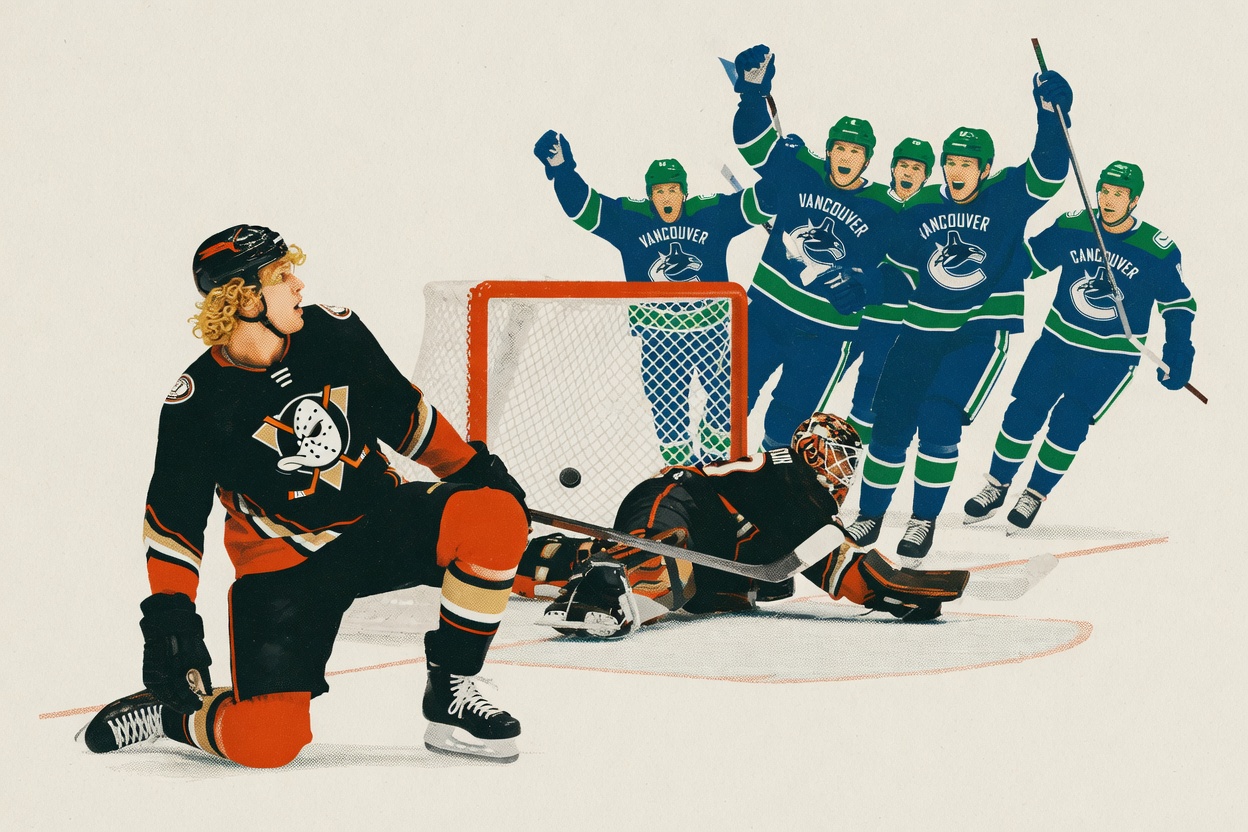
Anaheim quit protecting a lead against a team mired in a 10-game losing streak on Tuesday night, and that team thanked them for it. The Ducks were up 5-2 on the Canucks at Honda Center with under eight minutes to play, and they lost 6-5 in overtime. Vancouver, winless in its previous ten, walked out with two points.

⚡ Upset:Canucks had a 29% chance before puck drop and beat Ducks 6–5.
 23%

If you want to believe this was a fluke, you have to ignore the men who were on the ice. "We just sat back and let them come," defenseman Jackson LaCombe said afterward. "That's not our identity and the way we want to play. We can't do that." Joel Quenneville called it "a terrible loss." Mikael Granlund said the quiet part plainly: "That can't happen. Sometimes these things happen, but it's unacceptable. We have to do a better job to close out these games." When your own room says that unprompted, the bad-bounce theory is already dead.
Look at how it actually happened. Vancouver began its comeback with 7:37 left in regulation. Over the final twelve minutes, the Canucks outshot Anaheim 8-2. Jonathan Lekkerimaki scored twice down the stretch, Jamie Oleksiak added one, and it ended on a Filip Hronek power-play goal with about eleven seconds left in overtime, on a 5-on-3. That last detail should keep the Ducks up at night: they took seven minor penalties in a game they were trying to close out, against Vancouver's two. You don't accidentally hand a desperate team seven man advantages. That's a discipline problem.
RatingAnaheim did this to itself. Vancouver had been held under 20 shots in five straight games, averaging under 20 a night. Against the Ducks it put up 33. The Ducks stepped off the gas, and Vancouver's offense suddenly looked dangerous.
One collapse doesn't build a trend, and third-period meltdowns happen to good teams too. Granlund himself said as much: "sometimes these things happen." Except this one doesn't stand alone. Through late October, Anaheim is 5-6-1 and has lost six of its last seven. They've started 1-3-1 at home. Vancouver has won nine of its last ten at Honda Center and four of its last five against the Ducks overall. This is a team with a specific, recurring habit of letting the moment get away, against a specific opponent who keeps exploiting it.
Anaheim wasn't the only team that blew a lead that night; three teams let three-goal advantages slip. Columbus coughed its lead up too and won in overtime; the Islanders did the same and won in a shootout. The Ducks were the only ones who turned a blown lead into an actual loss.
None of these numbers are settled yet. It's late October, the season is twelve games old, and Vancouver sitting at 3-10-1 with a wretched goal differential means this win probably stops the bleeding for one night and nothing more. But leads have to be protected the same way in Game 12 as in Game 72, and Anaheim keeps failing that test. Quenneville's staff has watched this movie six times in seven games now. Until someone in that room makes holding a lead non-negotiable, this becomes the thing the Ducks are known for by April.