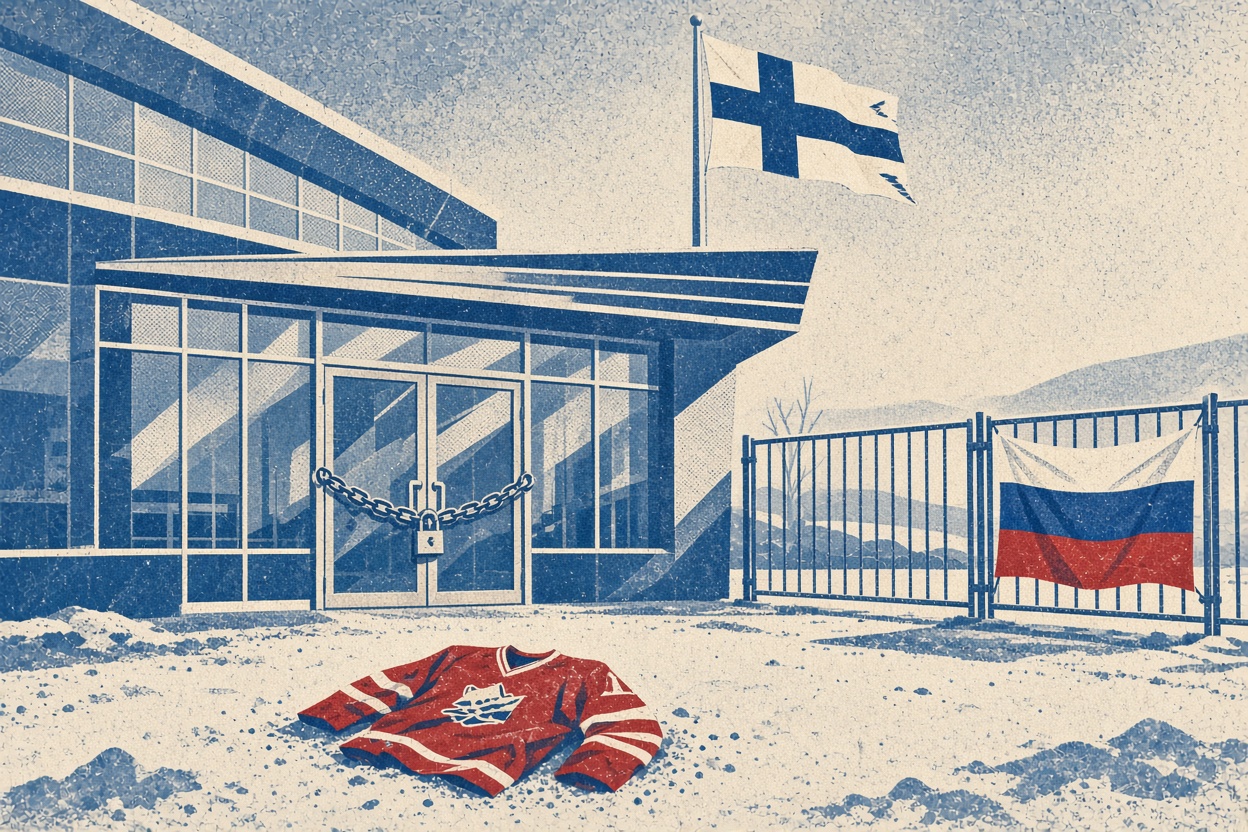
Finland is right, and Canada should copy it word for word. A country that invaded its neighbor and is still occupying parts of it, three and a half years on, does not get a seat at the table of international sport, under any flag or anthem. Everything else here is downstream of one decision made in Moscow.
On Friday, the Court of Arbitration for Sport overturned the International Ice Hockey Federation's exclusion of Russian national teams from upcoming world championships. The three-person panel found that the IIHF's arguments citing safety, security and other concerns "were not supported by sufficient evidence." Two days later, Finnish Foreign Minister Elina Valtonen posted that "Russian athletes have no business coming to Finland next year if Russia continues its war of aggression against Ukraine." She says she had already contacted EU foreign ministers in October about restricting Russian athletes' access to the Schengen Area, with the European Commission looking into it. The mechanics are still being worked out, so this is only a statement of intent for now.
What CAS actually ruled is narrower than Moscow is claiming. The court was asked whether a 2022 safety rationale still held up as a legal justification in 2026. Whether Russia has morally earned a return is a different question, and anyone treating a procedural win for Russia's hockey federation as vindication of Russia's government is either confused or doing public relations. Russia's own sports minister, Mikhail Degtyaryov, welcomed the ruling and said it "puts an end to the issue, as it's final and not subject to appeal." A government that greets a legal technicality like a trophy treats international hockey as a stage for itself.
Put this ruling next to the Olympics and the gap shows. At Milano-Cortina this year, the IOC let Russians compete only as individual neutral athletes, under the same rules as Paris 2024: no flags, no anthems, no emblems, medals that don't count toward Russia's tally, and no team events at all. Hockey is a team sport. The compromise the Olympic movement built specifically to punish the Russian state while sparing individuals would not even allow a Russian hockey team onto the ice. CAS just went further for Moscow than the IOC has ever been willing to go, and whether a restored Russian team would skate under its own flag is still unresolved.
This lands squarely on Finland and Canada because they're the sport's primary hosts for the next several years. Edmonton and Red Deer host the 2027 World Juniors, Finland hosts the 2028 edition at Nokia Arena in Tampere and Gatorade Center in Turku, and Quebec City and Trois-Rivieres host 2029. The women's calendar leans the same way, with Quebec City in 2027 and Finland in 2031 among the upcoming hosts. Their visa and entry rules are the real lever here: a host nation controls its own border, and no sports court can override that.
Finland has proven it will pull that lever. It shut its eastern border with Russia in December 2023, accusing Moscow of deliberately funneling migrants toward its checkpoints as a hybrid tactic after Finland joined NATO, and it has kept that border closed. Helsinki doesn't bluff about this kind of thing. A targeted entry ban on Russian national-team athletes is a smaller version of a tool it has already used and held for years.
The honest objection is about the athletes themselves: is it fair to bar a 19-year-old because of what Putin does? That question risks getting muddled, because Russian NHL players are about to be in Helsinki regardless. The Carolina Hurricanes and Seattle Kraken play two games at Veikkaus Arena on Nov. 12 and 14, and Carolina's roster includes Pyotr Kochetkov, Andrei Svechnikov and Alexander Nikishin. They're paid by an American franchise, and nothing ties them to the Russian Hockey Federation or suggests they're caught up in any of this. Keep those two things apart. Valtonen's threat is aimed at athletes competing under Russia's flag in IIHF events, a statement against a state apparatus that uses its teams as propaganda. Suiting up for Carolina is a hockey job. Representing Russia at a tournament is a political act for the Kremlin.
Finland isn't alone in this, either. Canada, Germany, Czechia, Sweden and Austria oppose the ruling, and Ukraine has denounced it outright. Canada's Secretary of State for sport, Adam van Koeverden, framed it around Russia's "illegal and unjustifiable full-scale invasion." Germany, which hosts next year's men's Worlds, says letting Russia in carries "significant security, political and financial consequences for us as hosts." The pressure is there. What's missing is someone besides Finland willing to say the quiet part at full volume.
The Russian government, and the war it started and keeps choosing to wage, is responsible for all of this. Finnish officials drafting visa rules and IIHF administrators rewriting logistics are only reacting to that. Handing Russia back its flag and anthem while the shelling continues is surrender with legal paperwork attached. Finland said no. Canada should say it tomorrow, loudly, and mean it until the day Russian forces stop firing into Ukraine.