Everyone wants to relitigate the last play. The last play is the one call the officials actually got right.
No. 3 Miami beat Florida State 43-35 in double overtime at Hard Rock Stadium, and the argument that's followed is aimed at the wrong target. Trailing by eight in the second overtime, Ashton Daniels rolled right and threw toward Duce Robinson in the end zone. Robinson came down in a pile with it, and so did Miami defensive back Bryce Fitzgerald. Officials ruled interception, replay upheld it, and the Hurricanes stormed the field.
Here's the standard that matters: a ball caught at the same instant by an offensive and a defensive player goes to the offense. So the whole review came down to who controlled it first. The ACC's replay center looked at it, saw both players with hands on the ball, and concluded Fitzgerald had gotten enough of it, with nothing clear enough to overturn the call on the field. ESPN rules analyst Steve Shaw put it flatly: "It was an interception. Clearly, nothing to overturn it. This was the correct call."
This is what replay review is supposed to look like. The on-field crew made a judgment, the booth looked for the clear-and-convincing evidence required to flip it, and the evidence wasn't there. A blurry freeze-frame where you can talk yourself into Robinson's fingers isn't proof. If that overturns a call, no catch in a scrum is ever safe again, and every pile in the end zone turns into a coin flip decided by whichever slow-motion angle you squint at hardest. Florida State fans who wanted that call reversed are asking officials to settle games by freeze-frame guesswork.
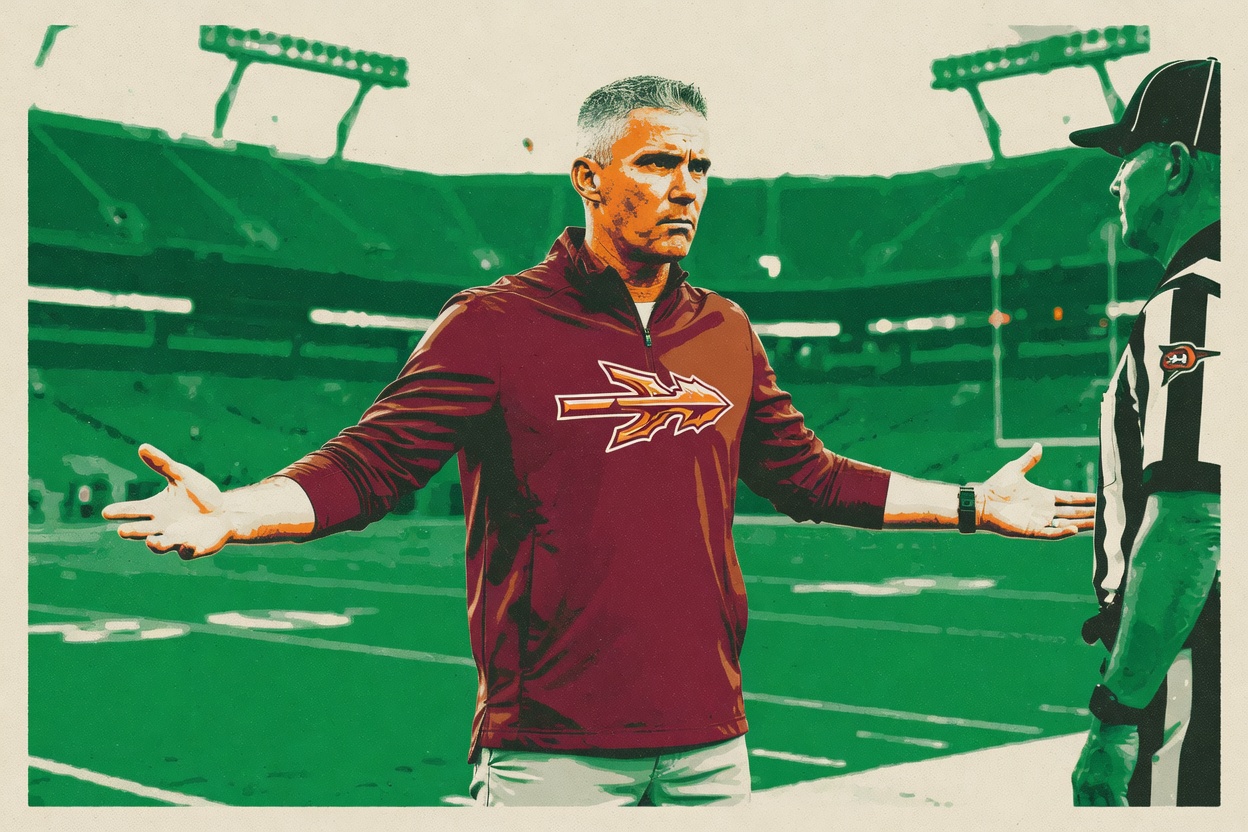
Mike Norvell leaned on the old line: "Since the start of football, if it's a tie it goes to the receiver." True. But the ruling was that it wasn't a tie. Fitzgerald got there first. Repeating the simultaneous-catch rule doesn't help when the officials already decided the catch wasn't simultaneous.
The real complaint belongs to the play before it. One snap earlier, Daniels found Micahi Danzy in the end zone for what looked like the touchdown that wins the game. Then a flag landed on Seminoles left tackle Xavier Chaplin for holding. The touchdown came off the board. Fourth-and-21 from the Miami 36 became fourth-and-31 from the Miami 46, turning a score into a near-impossible heave.
That's the call that decided the game, and it's the one call with no replay to check it. That was holding on a game-winning touchdown, in double overtime, against the home favorite. Chaplin's block looked no worse than the blocking happening everywhere else on the field. Norvell said as much, and he wasn't wrong. When he asked what the officials saw, he got nothing back. "I didn't get an explanation." That's what should make a Florida State fan furious: a flag nobody will stand behind, one no camera can second-guess, thrown by a referee who never offered an explanation. The interception at least had a rules analyst, the replay booth and multiple outlets all backing it up.
That's the difference between the two calls. One went through a transparent process and survived it. The other was a split-second judgment that took points off the board and left a coach standing on the field with no answer. If you're going to decide a rivalry game in double overtime by throwing a holding flag on an apparent game-winner, you'd better be dead certain. Nothing about that flag looked dead certain, and no one has said a word to suggest it was.
Florida State fell to 3-4, 1-3 in the ACC. Miami stayed unbeaten at 6-0, 4-0, with Darian Mensah throwing for 326 yards and three touchdowns to get them there. The Hurricanes earned plenty of this game. They did not earn that flag, and the officials owe the Seminoles the explanation they never gave.