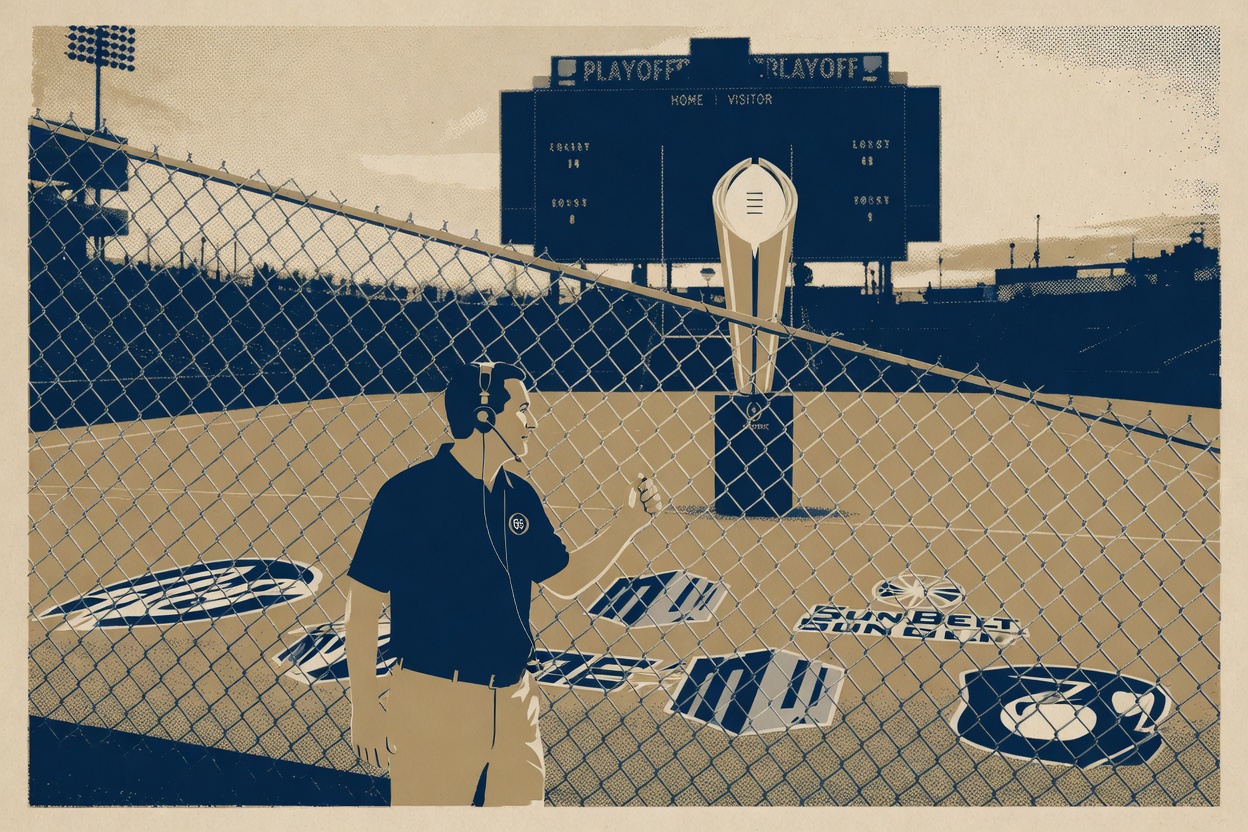
Most of the men running Group of Six programs just told a survey they'd rather play in their own tournament than keep fighting for a real seat at the big one. That's a white flag. And they're the ones holding the pole.
On3's Brett McMurphy and Pete Nakos surveyed Group of Six head coaches this week, and nearly two-thirds of those who gave an opinion favored a separate G6 playoff, on one condition: that the Group of Six keeps at least one guaranteed spot in the College Football Playoff. One coach, speaking anonymously, put the logic flat out: "There's no ability for any of us to realistically win the (CFP) national title. That's the truth."
He's probably right about the odds. He's dead wrong about what to do with them.
Start with that condition, because it torpedoes the whole idea. These coaches want a bracket of their own and a key to the real one. If you genuinely believe your own tournament carries weight, you don't demand a backstage pass to the event you're supposedly replacing. It's a hedge from people who know a G6-only trophy wouldn't mean much, and want to keep the CFP door cracked in case anyone notices.
Build that separate playoff and you've built FCS with a bigger TV deal. A national championship means something because it's open, at least on paper, to everyone who shows up and wins. Cincinnati proved the door was real in 2021, going 13-0, winning the American, and crashing the four-team field before Alabama ended it. That program now plays in the Big 12, proof of how the ladder works for anyone good enough to climb it. Last season, two Group of Six teams, Tulane and James Madison, reached the 12-team playoff for the first time. The access is thin, but it exists, and it's worth more than a closed-off consolation bracket where the ceiling is a title nobody outside the conference logo will respect.
The format itself should make people angry. Going into 2026, it tightened so that only the highest-ranked G6 conference champion gets an automatic bid. The 24-team model being kicked around hands automatic spots to the SEC, Big Ten, ACC and Big 12 champions, then one berth, exactly one, to the top Group of Six team, with a pile of at-large seats on top. Most of those at-large seats will go to power-conference teams too. The power conferences wrote a bracket that treats a conference champion from one half of the sport as a guest. A decision on the 2027 format is due December 1. The frustration is earned, but the response is a gift to the people who caused it.
Because a voluntary breakaway is precisely the exit the big-money leagues have been waiting on. Nick Saban floated a separate G6 postseason months ago. There's also unproven, anonymously sourced chatter floating around the industry — reported by a single regional outlet — suggesting this could be a step toward splitting the sport into tiers, with the richest brands forming something closer to a closed league. It's suspicion, not established fact, but if the Group of Six walks off into its own tournament, nobody has to force the split anyway. The little guys will have packed their own bags and called it empowerment.
Being used as a one-and-done sacrifice in a bracket built for somebody else is humiliating, and a tighter, more competitive G6 tournament might produce better football than watching James Madison get fed to a two-seed. If the games are good, people will watch. But "good games" and "a real shot at the actual championship" are not the same prize, and only one of them is worth keeping a seat at the table to fight for.
The coaches who want out are tired of losing a rigged argument. I get it. But marching to the margins won't beat a system built to shove you there. Stay in the room, and make the exclusion ugly and public enough that the people writing these brackets have to keep slamming the door on champions in front of a national audience. The moment the Group of Six leaves, the problem belongs to them alone.