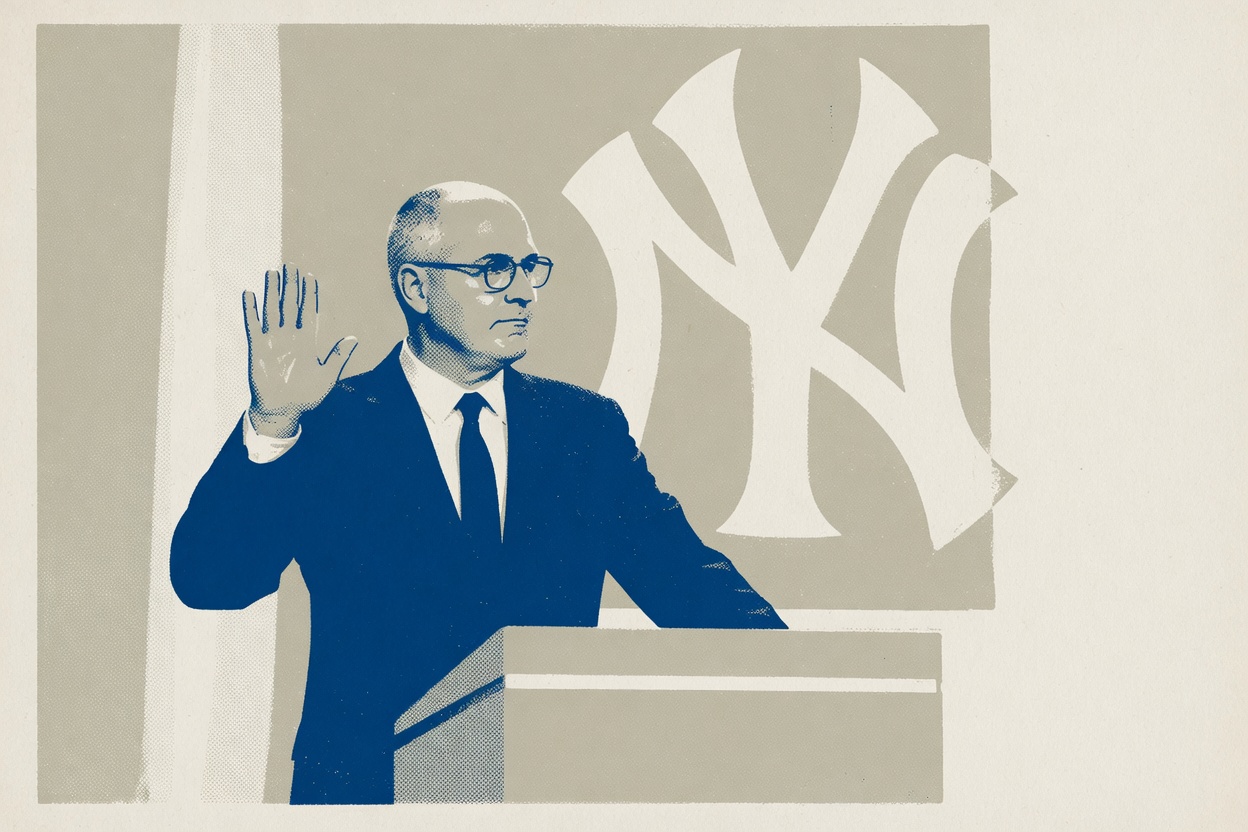
Hal Steinbrenner backs a salary cap. When a reporter asked him the obvious follow-up, how a cap would possibly help the Yankees, he changed the subject. That dodge is the answer: a cap helps him, he just can't say so out loud.
At the Yankees' end-of-season press conference Wednesday, the owner put it like this: "I've said before, let me put it this way as a member of the labor policy committee -- I helped craft, one of many, the proposals that we have given at the bargaining table. And I support those proposals in their entirety. That's absolutely the case, so that should answer your question."
Those proposals, the ones MLB has been feeding the players' union, each include a salary cap and a floor. The union is dead against a hard cap. With the CBA set to expire and a lockout expected to begin Dec. 1, this is the fight that decides the next several years of baseball. Steinbrenner just told you which side he helped write the playbook for.
Then he was asked how a cap would benefit a team that spends like the Yankees. He wouldn't go there. He pivoted to not wanting to steal attention from the World Series between the Brewers and Rays, and to his optimism about getting a deal done. The man who helped draft the proposal couldn't manage one sentence defending what it does for his own team.
The money explains the silence. The Yankees ran the third-highest payroll in baseball this season, $336 million for luxury-tax purposes. The only teams ahead of them were the Dodgers at $422 million and the Mets at $358 million. For most of Steinbrenner's ownership the Yankees were the team everyone else wanted capped. Now two teams are outspending him, and suddenly he's the committee's enthusiastic cap guy.
A cap drags the Dodgers and Mets back down toward the Yankees. That's what it does for him. The floor is the part he's happy to talk about, the teams that "aren't spending enough money on payroll to improve their team would have to spend more," as he put it last year. It also gives him cover: he gets to claim he's lifting the Pirates while the real work of the proposal is nailing a ceiling over the two rosters that just outbid him.
A cap could genuinely improve competitive balance. A real ceiling with a real floor would squeeze the gap between the top and bottom of the sport, and small-market fans have every reason to want that. That argument stands no matter who makes it. Is this owner, on this committee, with this payroll, pushing it for parity? He'd rather talk about the Brewers and Rays than answer the simplest question about his own position.
He offered the "it's a diverse committee" defense himself: seven owners, Boston, him, mid-markets, small markets, a unanimous vote. Seven owners landing on a mechanism that suppresses what every one of them pays for labor is the one thing owners of every market size can always agree on: paying players less.
Remember whose chair he's sitting in. The Steinbrenner name was built on George spending whatever it took and daring the rest of the league to keep up. His son's version of the family business is lobbying to make that kind of spending illegal, now that the biggest checkbook belongs to somebody else.
Strip away the committee talk and the parity language and you have an owner who profits off player salaries arguing to cap player salaries, then refusing to explain the one part that implicates him. He had the easiest layup in the room. How does this help the Yankees? He wouldn't shoot it, because the honest answer is that it helps Hal Steinbrenner.