The IIHF didn't get handed these jerseys by bad luck. It went to a Swiss court and fought to force them onto the backs of the two best women's programs on earth, which is why the 2026 Women's World Championship opens in Denmark with Canada and the United States wearing sweaters that look like a rush job from a print shop.
The facts alone make the case. A little over a year ago the IIHF announced a deal with True Hockey to supply jerseys for all its member associations. Hockey Canada already had an agreement with Bauer running through 2033-34, and USA Hockey has its own deal with CCM, long-term commercial relationships the federations signed in good faith, years before the IIHF decided it wanted into the uniform business.
The IIHF's own rulebook should have ended the argument on the spot. Its bylaws give it final approval on jersey designs, but say member national associations "retain all rights related to their national team logo, emblem and uniform design," and that "the IIHF shall not use MNA team jerseys for commercial purposes unless approval is provided by the respective MNA." You could not write a clearer protection if you tried.
When that clause got in the way of handing True Hockey exclusive commercial control, the IIHF called an Extraordinary Congress in May to change its own statutes and seize the uniform rights it had spent years promising belonged to the federations. It legislated its way out of contracts it no longer liked. Hockey Canada and USA Hockey appealed, then filed for a temporary injunction after a September congress ruled the IIHF had the authority to override the statute. They won that injunction, but the process overturned it and the injunction was lifted. A court at that time found the IIHF holds "broad commercial rights connected to its competitions, including the supply of on-ice uniforms."
The reading may hold up legally. The appeal is still pending before a Swiss court. But winning in court doesn't make this smart hockey business. The IIHF wrote statute 24.3 to protect national logos, voted to override its own protection, and fought in court to keep that override alive right up against puck drop. For a sport trying to grow its women's game, that's a rare own-goal.
Then came the part no organization that respected its athletes would allow. Hockey Canada said its team officials hadn't even been shown the jersey as of Wednesday, two days before Canada was scheduled to open against Sweden. Players were learning what they'd wear to represent their country 48 hours out, because the people running the tournament were still busy winning a rights fight nobody asked them to pick.
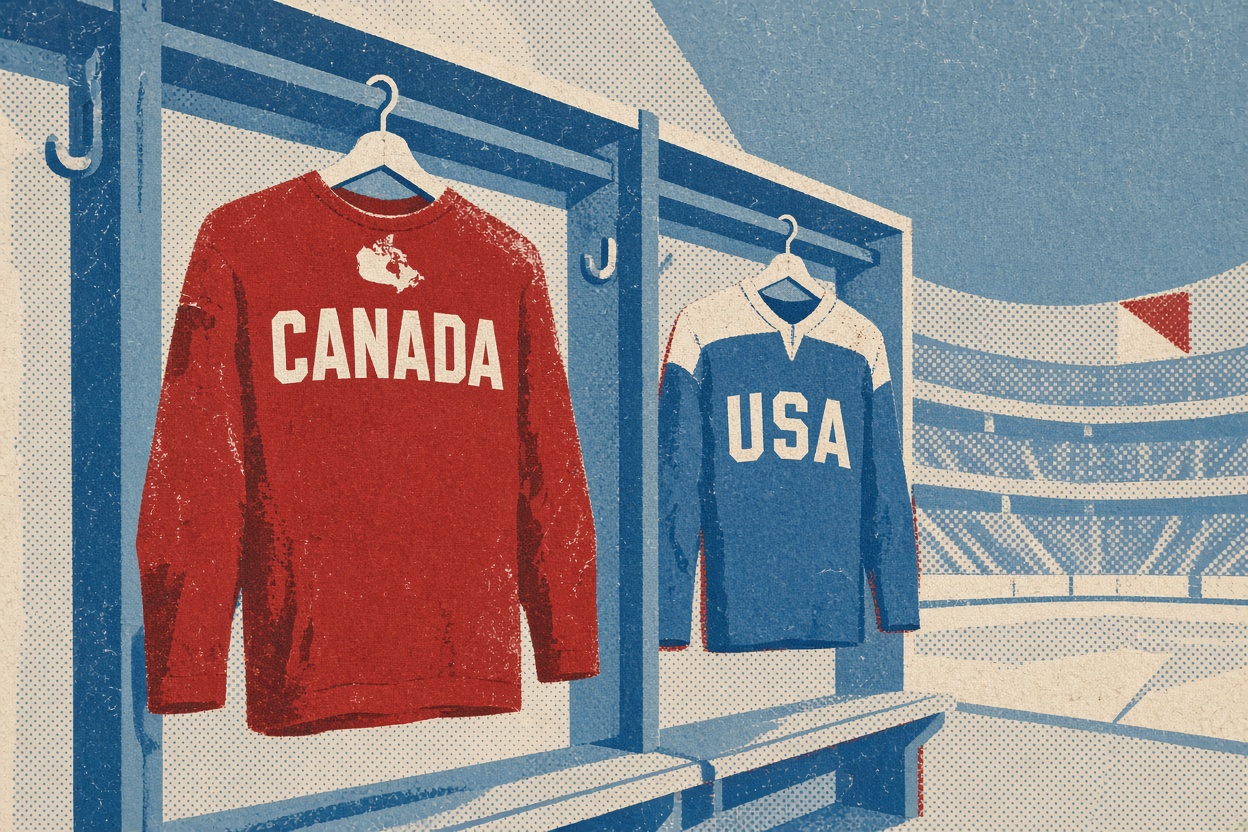
When the sweaters finally surfaced Thursday, the reaction was instant. Canada's is all red, with "CANADA" slapped across the top third of an otherwise bare front and a small outline of the country tucked near the collar. The United States gets "USA" on the top third of a blue shirt with white shoulders. No crest. No Maple Leaf, a symbol Canadian players have long worn with real pride. One response making the rounds, "I'm sorry what," covers the mood.
There's a version of this where you shrug. Supplier switches create ugly transition years, and fans forgive them. One Reddit user even said they liked the little country outline near the collar. But a stray laugh at the collar doesn't excuse the process that produced it. A design team running short on time doesn't pick a legal war over its most important women's programs, lose the moral argument buried in its own bylaws, force a vote to win anyway, and drag the fight out until the athletes themselves were in the dark. The IIHF did exactly that.
True Hockey, the Brantford, Ontario company stuck manufacturing these things, isn't responsible. Neither are Bauer and CCM, or Hockey Canada and USA Hockey, who went to court trying to stop it, or the players eating the embarrassment on opening night in Denmark. The IIHF leadership and the congress majority that voted to break statute 24.3 made this happen, deliberately, and they can wear that.