No one broke a rule on the play that ended Jared Young's season. No one threw an elbow, nothing you could suspend, fine, or even scold.
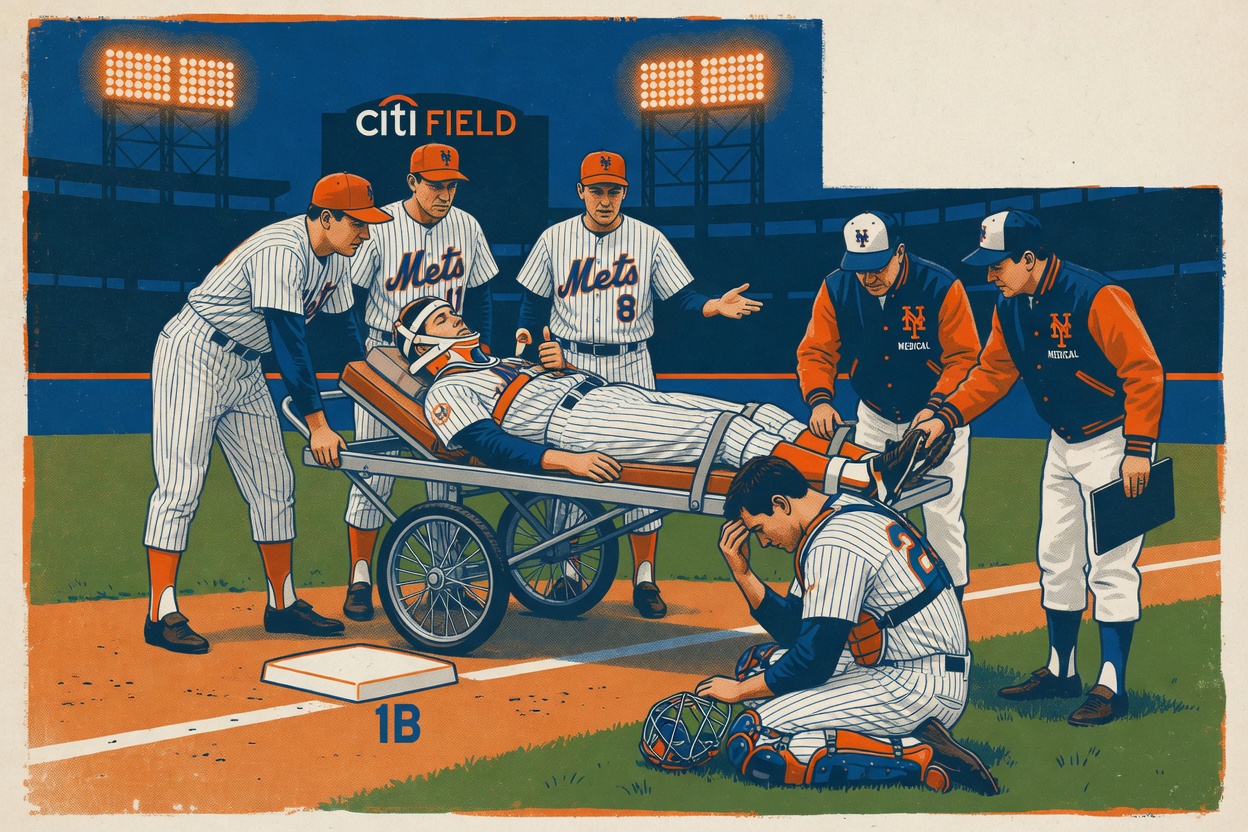
And Young still got carried off Citi Field on a stretcher, head and neck stabilized, after being knocked cold by a teammate's knee.
That should scare MLB more than any dirty slide ever could. Dirty plays have a fix. You legislate them out, you eject people, you deter the next guy. What do you do about two players making a completely honest effort on the same slow grounder, converging at full speed, one knee finding the other man's skull? Right now the answer is you hope. You pray, like catcher Francisco Alvarez appeared to on the infield grass, or take a knee near third like the Phillies' Alec Bohm. Then you wait to see if he wakes up.
What actually happened
In the sixth inning Thursday, with the Mets trailing 1-0 in what became a 3-0 loss to Philadelphia, Justin Crawford tapped a slow roller. Pitcher Nolan McLean broke to cover first. Young, the Mets' first baseman, moved back toward the bag, then reached for the ball with his right hand while keeping a foot on the base. McLean, briefly paused, resumed running and collided with Young's head, tripping over him as Crawford crossed.
Young was out cold for a moment, then down for an extended stretch while medical staff worked on him. When he came to, per manager Andy Green, he asked "What happened?" He flashed a thumbs-up from the immobilized cart before it disappeared behind the left-center wall.
"It was a terrifying moment on a baseball field," Green said. "Took him a while to come to. It was a really scary collision."
The good news: a CT scan came back negative. Young had feeling in his extremities the whole time. By Friday, Green called the outcome "as good as could be expected and hoped for, given what we saw last night." A team physician noted most concussion patients recover within about two weeks regardless of how violent the collision looked, provided there's no brain bleeding. Young was still dealing with headaches and short-term memory loss on Friday, and the Mets placed him on the 7-day concussion injured list. With the season winding down toward a Sept. 27 finale, that ends his year.
He's expected to be fine long-term, but that doesn't make the play any less alarming.
The pattern MLB keeps ignoring
MLB keeps filing these under "freak accident" when they're really a recurring hazard the sport hasn't seriously addressed.
Go back about a month. In mid-August, Vladimir Guerrero Jr. was pulled from a game against the Yankees after Yankees shortstop George Lombard Jr., turning to chase a ball and trying to avoid him, drove a knee into the side of Guerrero's face. Guerrero went into concussion testing, landed on the seven-day injured list, and returned about a week later. Different play, same physics: an infield convergence, a knee, a head.
This exact pitcher-covers-first collision has a history, too. Years ago, Blue Jays infielder Lourdes Gurriel Jr. was placed on the seven-day concussion list after a violent collision at first base with a pitcher, accidentally kicked in the head. What makes his case a warning is that the training staff found no early symptoms and let him keep playing, monitoring him between innings, until the severe headache and nausea showed up after the game ended.
That's the whole argument for tighter protocols. Concussion symptoms don't always announce themselves in real time. A player can pass a between-innings check and still have a brain injury cooking. When the collision is this violent, "he seems okay, run him back out there" is a gamble with the one organ you can't put on the seven-day IL and forget about.
The honest complication
I'm not going to pretend there's a clean rule change waiting here. You can't ban the pitcher from covering first. You can't tell a first baseman to stop fielding grounders. Some contact is baked into the geometry of the position. That's what makes this hard, and it's why the league has mostly shrugged.
But hard isn't impossible. Baseball has shown before that it can adapt when player safety demands it, even amid the inevitable grumbling about softening the game. The convergence play at first, pitcher and infielder charging the same soft grounder, deserves that same hard look: clearer right-of-way conventions, mandatory removal after any head contact this severe, independent spotters with the authority to pull a player rather than trusting an inning-by-inning check.
Green himself gave the sport a data point worth sitting with: he admitted McLean was "shaken" and that he "probably" shouldn't have left his pitcher in to finish the inning. Even a manager, in the raw aftermath, second-guessed whether a visibly rattled player should have stayed on the field. If the people closest to it are asking that question in the moment, the league should be asking it at the policy level.
The part that stings
Young was one of the few things going right for a Mets team that has been a mess. He'd been productive, hitting .266/.330/.429 with nine home runs across his plate appearances this season, a genuine bright spot on a club that suffered a 12-game April losing streak and is long since out of the playoff race. He'd already fought back from meniscus surgery on his left knee earlier in the year. This was supposed to be the good story on a bad season.
McLean, the 25-year-old having a breakout year, will carry the image of a teammate motionless on the grass with him. There's no villain here, and that's the part that should worry the league most. When the play is clean and the outcome is a stretcher, the only thing left to fix is the game itself.
Young is expected to recover. Guerrero recovered. Gurriel recovered. The league has been lucky. Luck is not a safety protocol. Sooner or later, one of these convergence plays produces something a CT scan doesn't come back clean from. The question then will be why it took that long to act.