Jayden Bogle planted his studs on Mathys Tel's Achilles, left him in a heap, and didn't even pick up a yellow card. That's the part worth being angry about: a challenge the Premier League's own officials called "reckless" drew no sanction at all, whatever you think about whether the red card itself was debatable.
Walk through the sequence and it gets worse the closer you look. In the 34th minute at Elland Road, with John Brooks refereeing matchweek 10, Bogle caught Tel on the Achilles and he went down needing treatment. Brooks waved play on. VAR official Tony Harrington then took a long look, well over four minutes of it. The Premier League's statement afterwards read: "The referee's call of no red card to Bogle for the challenge on Tel was checked and confirmed by VAR. VAR: 'I'm confirming the on-field decision of no red card. Confirming a reckless challenge'." Brooks never went to the pitchside monitor to watch it back.
Four-plus minutes of review isn't a quick glance. It's officials telling you, with their time, that this was serious enough to agonize over. And at the end of the agonizing, a challenge their own words call reckless draws nothing. Either it was worth that much scrutiny or it wasn't worth anything. It can't be both. A review that long ending in zero action means the system has no idea where its own line is.
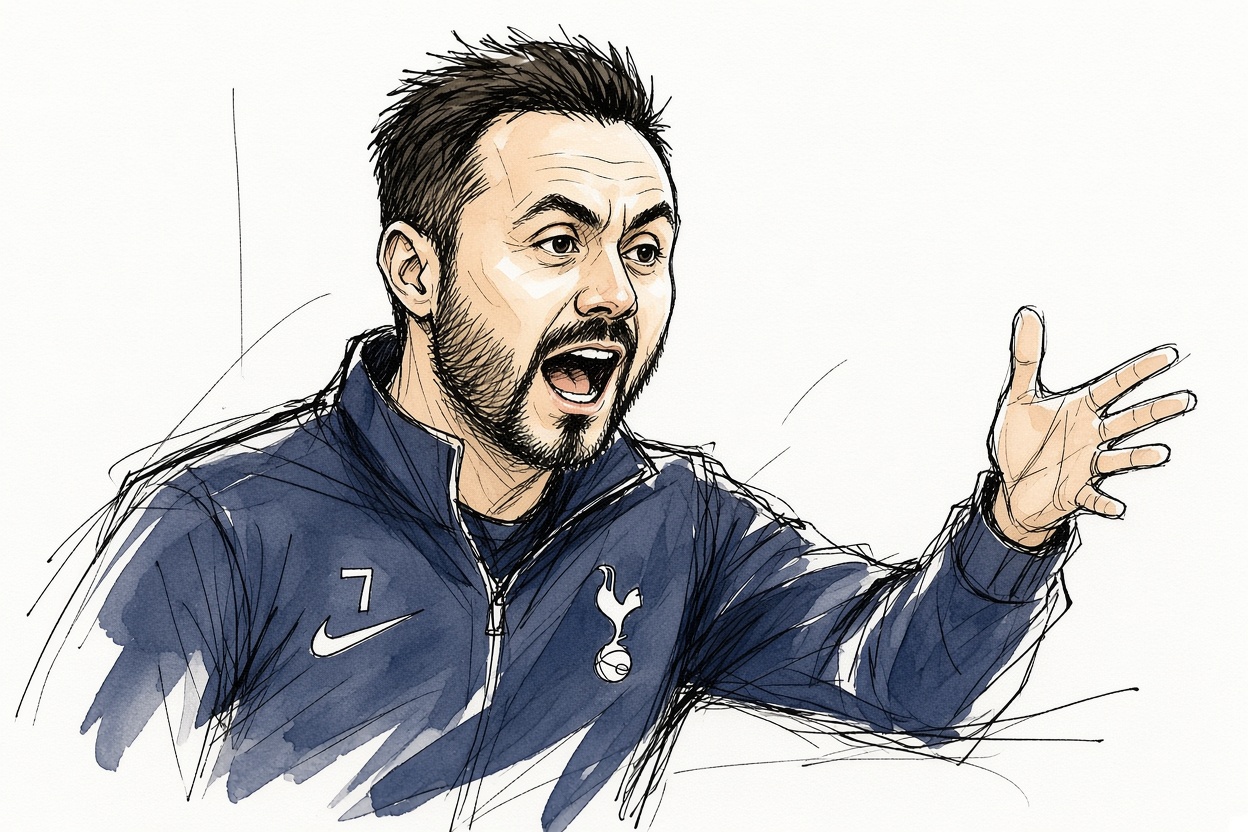
Tel paid for it. He tried to carry on, then signalled to the bench that he couldn't, and was replaced by Dominic Solanke before half-time. Roberto De Zerbi spent the opening 45 remonstrating with fourth official Josh Smith, and you can see why. His player was removed by the tackle; the man who made it kept playing without a mark against his name.
Six days earlier, at Tottenham Hotspur Stadium, Crystal Palace's Jean-Philippe Mateta caught Micky van de Ven studs-up contesting a loose ball. Michael Oliver initially gave yellow, then changed it: "After review, Crystal Palace No.14 makes full, forceful contact with the studs on his opponent's achilles. The final decision is red card." Palace appealed, and an independent commission rejected it, with that ruling confirmed just three days before Bogle's challenge. Same body part, same studs, same club on the receiving end. One tackle is a red card upheld by a panel; the other is not even a booking. Both can't be right, and the officials have now put their names to both.
Brooks has drawn this line before. He sent off Tottenham's Xavi Simons last season for a reckless challenge on Virgil van Dijk, upgrading his own yellow to a red after review. He knows where a studs-first tackle sits when he wants to see it. On Saturday he decided it sat nowhere at all.
The pundits watching live mostly agreed on what they'd seen. Darren Fletcher called it "No sense at all" on commentary. Glenn Hoddle said Bogle "was, in my opinion, very fortunate to escape a red card," comparing it directly to a recent dismissal. Michael Brown and Danny Murphy landed in the same place. The one serious voice on the other side is former assistant referee Darren Cann, who said, "In real time, I'm not thinking that's a red card by any means." He's right that in real time, at full speed, a defender can win this argument. That is exactly what VAR exists to fix. The whole point of a four-minute review is to remove "in real time" as a defence. Harrington had the replays, the angles and all the time he wanted, and still produced nothing. The real-time excuse protects Brooks for a second. It does nothing for the man who sat in the booth and confirmed it.
There was even a small cruelty to the aftermath. Cleared of serious foul play and cheered on by the home crowd, Bogle swung in a cross for Lukas Nmecha, whose header went straight at Antonin Kinsky. The man who'd just injured an opponent was back attacking down the right while that opponent limped through his last minutes on the pitch.
Leeds got their win, Noah Okafor settling it in the 79th minute to end a five-match winless run in the league. Good for them. The Premier League checked a tackle, called it reckless out loud, and handed out nothing, three days after insisting the identical offence was worth a three-match ban. Brooks missed it, and Harrington had every chance to correct him and chose not to. Both of them own this one.