There's a version of this summer where Jaylen Brown quietly cleans out his locker, posts a nice graphic, and gets on with the business of being a Philadelphia 76er. That would have been completely normal. It's how most star departures go now: a trade lands, the fan base rages for a week, and everyone moves on to the next transaction.
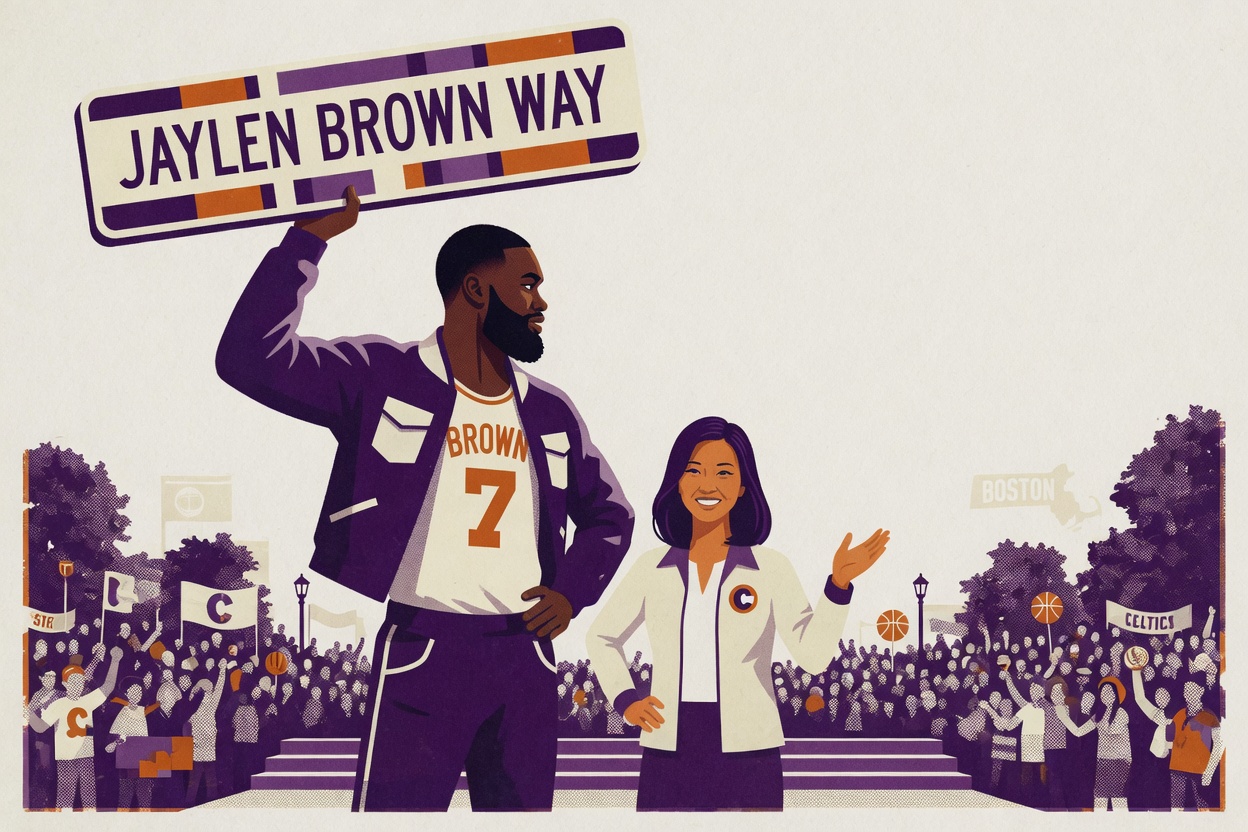
Boston didn't do that. On Sunday, Aug. 30, the city held a free block party at Boston Common called the 741 Frequency Fest, and it turned into something you almost never see anymore. Mayor Michelle Wu handed Brown a street sign reading 'Jaylen Brown Way.' He got the key to the city of Boston and the key to the state of Massachusetts, the latter presented by Massachusetts Rep. Christopher Worrell, who cited Brown's "incredible work in the Black and brown community." Fans of all ages packed the Common, some in Celtics jerseys, a few already in Sixers gear, all there to say goodbye.
That scene is worth more than a highlight reel, because of what it's set against.
A goodbye that shouldn't have happened
Remember how this ended. The Celtics traded Brown to the 76ers for Paul George, two first-round picks, and two second-round picks, a deal that became official on July 6. The reaction was not gentle. One general manager told ESPN, "the guy got traded for less than Walker Kessler... That's baffling to me." The Philadelphia Inquirer wrote that "rarely does an NBA team encounter such a universal and vociferous disagreement with a trade as the Celtics did." Even Brad Stevens conceded the move was not "for the faint of heart," framed it around financial flexibility, and allowed that it could prove to be the wrong decision.
So the front office made a cold, business-first call, one a lot of people in Boston hated. Then the city turned around and threw the guy a party. That split matters. The send-off wasn't the Celtics' brass papering over an unpopular trade. It was Boston, the place and the people, thanking a player the team itself had just moved for parts.
Brown didn't pretend the departure was painless, either. He's said he "wasn't that surprised" given years of trade chatter, but that when it actually happened, "I just threw my phone across the room." That honesty is what makes Sunday land. This wasn't a manufactured loyalty photo op. He was hurt by how it went down and still stood on that stage and said, "I just want to say thank you to Boston. Thank you to the city, and I love you." He added, "I ain't got too much to say because I'm at a loss for words."
What Brown actually gave Boston
The basketball case isn't complicated. Brown spent roughly a decade in Boston, made five All-Star teams, and in his final season there averaged 28.7 points per game. He helped the Celtics win the 2024 NBA Finals and was named Finals MVP. Over his ten years, the Celtics led the league in both regular-season wins (530) and playoff wins (86). You don't have to squint to see why the city wanted to mark his exit.
But Wu made a point of arguing the ledger runs past basketball. She told the crowd she'd come with government colleagues because "Jaylen has been about so much more than basketball here in Boston," citing seeing him in Boston schools, classrooms, and parks. "He has changed lives throughout Boston," she said. "We're never going to let you forget us, and we are never going to forget you." Then, handing over the street sign, she got the line of the day: "it doesn't allow for free parking on the street, just FYI, but this is so that you never forget our city."
Brown, for his part, left the stage at one point, walked a blindfolded mother of four and her kids out to the street, and revealed a new car he was giving the family. A$AP Ferg performed. Brown signed both Celtics and Sixers jerseys, and when a fan asked him to sign the Notes app on their phone, he quipped, "I don't know how to do this." It was a genuinely warm afternoon, by every account.
The era that makes this rare
I keep coming back to it because of the summer around it. Giannis Antetokounmpo went from Milwaukee to Miami. Kawhi Leonard and Brandon Ingram headlined a Toronto-Clippers swap. Ja Morant was traded from Memphis to Portland. And LeBron James, the patron saint of modern player movement, left the Lakers to sign a two-year, roughly $8 million deal in Philadelphia that he called his "final run at another NBA championship." Which means the roster Brown now joins is anchored, in part, by the player most associated with treating franchises as stops on a business itinerary.
I'm not scolding any of them. Players optimizing their careers is the correct response to a league where teams treat contracts as line items to be shed the moment the math changes. But that's exactly what makes a player-city bond feel like a relic. When everyone's a rental, on both sides of the deal, the idea that a place would grieve a departure publicly, with a key to the state, starts to look almost quaint.
So credit Boston for being quaint, for separating what the team decided from what the player meant. The Celtics chose flexibility. The people chose to say thank you anyway. And Brown, who had every reason to leave bitter, said it back: "When I first got to Boston, I didn't imagine this... Just know the feeling is mutual."
What's still coming
The reunion isn't finished. Brown is scheduled to return to TD Garden for a preseason game against the Celtics on Oct. 10, and Boston hosts the 76ers in the regular season on Jan. 21. What kind of reception he gets is anyone's guess, and I won't pretend to know. But Sunday gave us a decent preview, and a reminder that the transaction isn't the whole relationship.
The league runs on movement now, and it isn't going back. That's fine. It just makes afternoons like this one, a city naming a street after a player it no longer employs, feel like something worth protecting.