You know the feeling in a stadium when the cart comes out. The noise drains. Players drop to their knees. Within seconds, half the phones in the building are typing something they don't actually know yet.
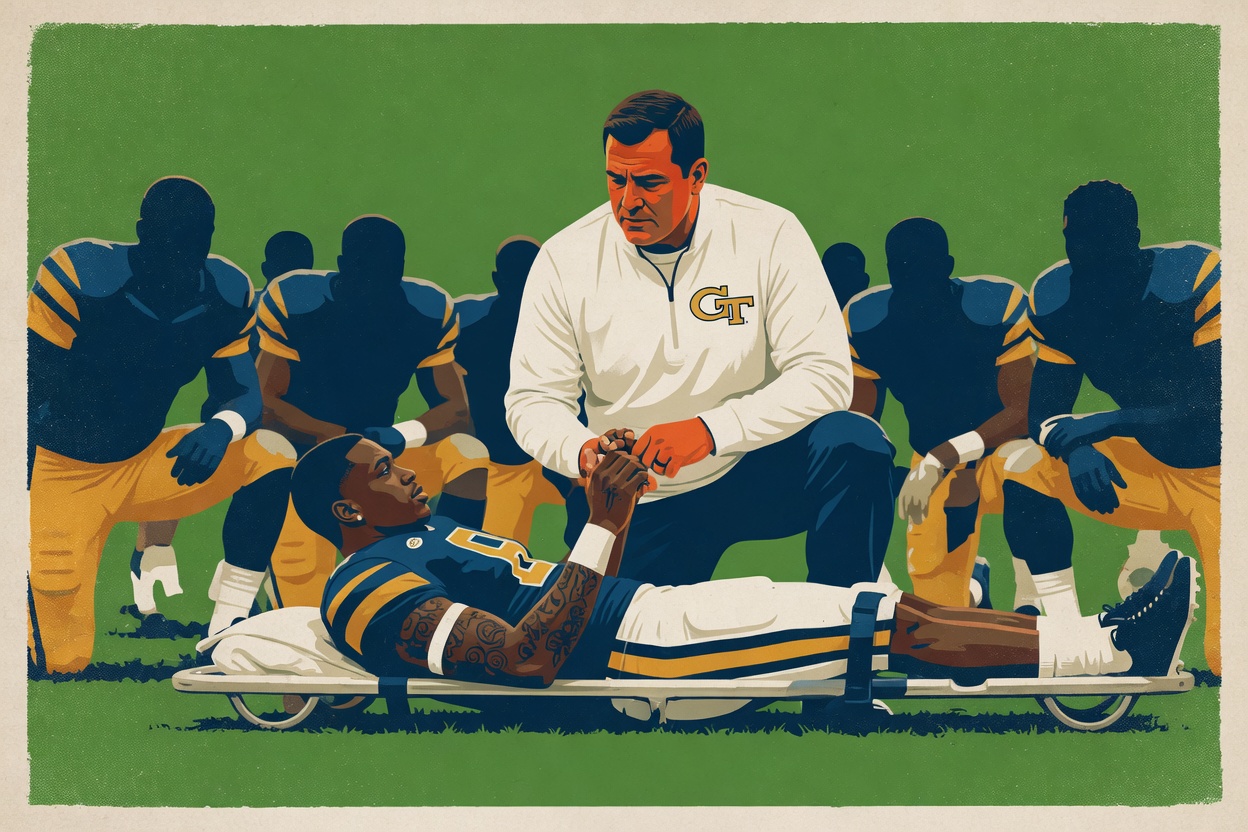
That's what happened Saturday night in Atlanta. In the third quarter of Georgia Tech's home game against No. 18 Tennessee, Jaylen Mbakwe went to make a tackle and his head collided with teammate Jordan Walker's knee. Both players were hurt on the play. Walker left the field. Mbakwe stayed down on the turf for several minutes, then got strapped to a stretcher while his teammates knelt around him and coach Brent Key held his hand. As he was carted off, he lifted an arm.
By Sunday, Georgia Tech announced he'd been evaluated overnight at Grady Memorial Hospital and released. Mbakwe himself posted that he was "fine and feeling well." That's where things stand: released, reassuring, no confirmed diagnosis of what was actually checked at the hospital.
Here's the part worth sitting with. From the outside, the sequence looked terrifying. From the inside, it looked like a system working the way it's supposed to.
The scary part is often the good part
This is my read on it, not something anyone official said outright: the immobilization, the stretcher, the ambulance ride to a trauma center, the overnight observation, the team refusing to guess at details before he was cleared. None of that means things went wrong. That's the protocol doing its job.
A generation ago, a player who could move his arms and talk might have been helped to the sideline and waved back in. Now the default is caution. You backboard first and ask questions later, because the downside of being wrong the other way is unthinkable. When training staff take the slow, careful route, it can look worse to a crowd than a quick jog to the bench. Usually it's the opposite.
Key said afterward that Mbakwe was alert, talking, and had movement in all his extremities before being taken to the hospital. Every step after that, caution included, is what you want to see. The cart isn't a verdict; it's an insurance policy.
Bob Wischusen showed how it's supposed to sound
The cleanest lesson of the night came from the broadcast booth. On the call, Bob Wischusen didn't reach for drama. He told viewers, "This is one of those situations you just really can't prevent... It's how football goes sometimes. You just hope the very, very best, obviously, for Jaylen Mbakwe." Later, as the signs turned positive, he narrated them in real time: "Just moving your extremities around is exactly what you want to see. And now a signal to the crowd and his teammates as well. That is very encouraging."
He described what was actually happening, hoped for the best out loud, and let the moment breathe. He didn't diagnose anything or speculate about severity he couldn't possibly know from a booth.
Compare that to the way these scenes travel online, where the instinct is to label a stretcher situation "serious" before anyone has a shred of medical information. That's not a knock on any single account, and real-time uncertainty is a normal part of live coverage. But the gap between the calm, factual call and the alarmed guesswork that floods timelines is real, and Saturday night was a tidy illustration of which approach held up better.
What we actually know, and what we don't
Be honest about the limits here. No one has disclosed what was evaluated or ruled out at Grady. The language from the team is "precautionary observation." So the honest frame is simple: hospitalized for observation, released the next day, feeling well. That's it. Anyone filling in the medical blanks is guessing.
His football timeline is still open too. Georgia Tech's next game is at home against Mercer, and his status for it hasn't been announced. Don't let anyone tell you he's out, and don't let anyone tell you he's a lock to play. Neither is known.
The on-field result, for the record, went to Tennessee 45-24, which dropped Georgia Tech to 0-2 for the first time since 1989. That's a story for another day. Mbakwe put it better than any of us could in his own post: "Minor Setback for a Major Comeback."
So the next time the cart rolls out and your thumbs start moving, borrow Wischusen's approach. Hope out loud, describe only what you see, and wait for the people who actually know to tell you the rest. Saturday night, the ones who waited got it right.