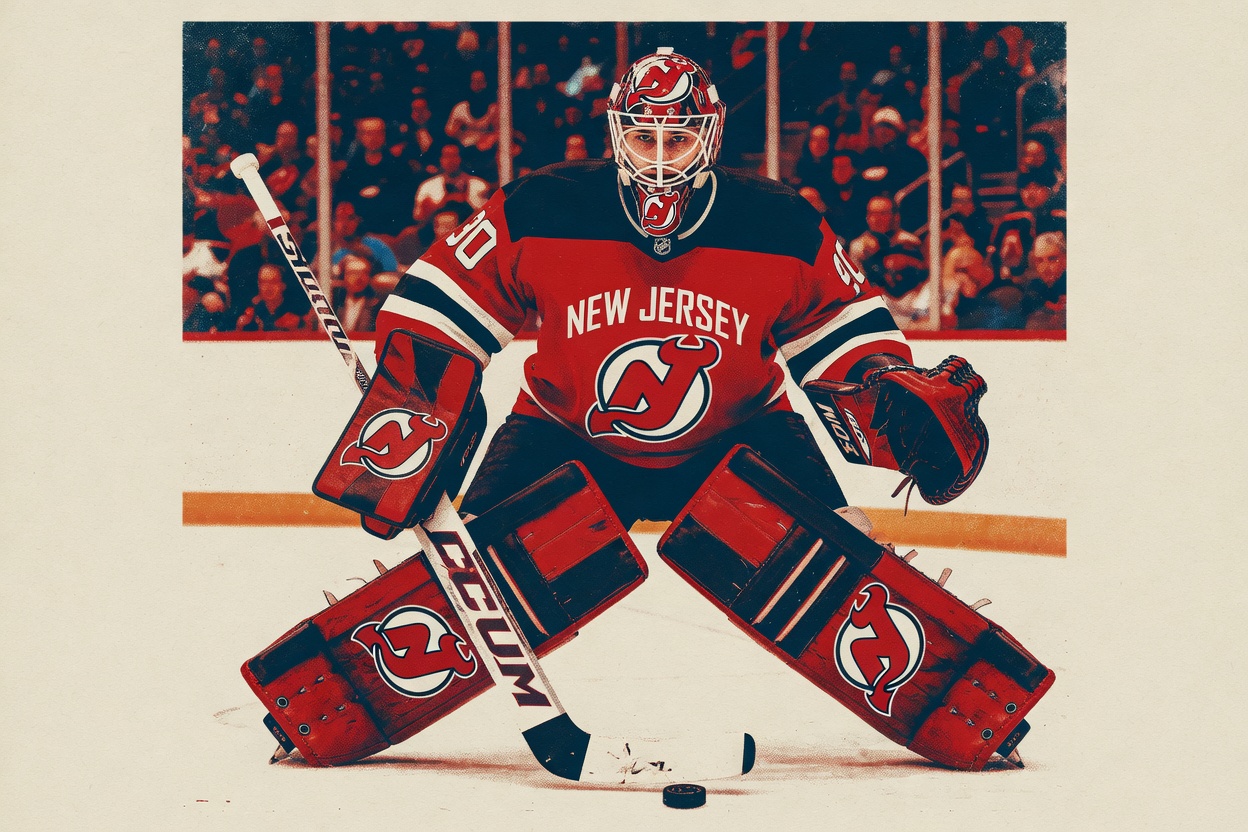

There's a version of this signing that reads like pure conviction, and Utah's front office has been happy to sell it that way. General manager Bill Armstrong called John Marino "a foundational piece of our future." President of hockey operations Chris Armstrong went with "an invaluable cornerstone for our franchise." The Mammoth handed the 29-year-old an eight-year, $54 million extension, an average annual value of $6.75 million, announcing it Tuesday, July 21. On paper, it's a franchise planting a flag.
And here's the part I actually like. Utah, in its post-relocation life, has decided it isn't going to be a churn team. Marino now joins a core the Mammoth have nailed to the floor: Logan Cooley, Nick Schmaltz, Dylan Guenther, Mikhail Sergachev and Mackenzie Weegar are all signed through at least 2030-31. Schmaltz got eight years and $64 million running through 2033-34. Cooley's extension was eight years and $80 million. On the blue line alone, signing Marino means the club now has eight players carrying more than three years left on their deals, a group that also includes Sergachev and Weegar. That's not a team feeling out its identity. That's a team that's picked one.
So the stability argument is real. Continuity has value that never shows up cleanly in a box score, and a franchise still finding its footing after the move from Arizona has decided it would rather overpay for cohesion than shop for it every summer. Fine by me. I'd rather cheer that plan than the alternative.
But eight years is the kind of number that ought to make you check your work.
Start with what Marino actually is on this roster. He's a good defenseman. He is not, on the current evidence, Utah's No. 1. He ranked third on the Mammoth in average ice time last season at 20:12, and in the first-round loss to Vegas he again logged the third-most minutes on the team at 22:27, behind Sergachev and Nick Schmaltz. He started the year on the top pairing with Sergachev and was moved off it two games in, landing next to Nate Schmidt for game three. That Marino-Schmidt pairing thrived, running plus-29 at five-on-five, apparently the best mark among all NHL defense pairs last season. Treat that as a strong indicator rather than gospel, because that's what it is. Either way, the honest description of Marino is an excellent complementary piece next to a true top guy, and Sergachev is that guy.
That matters because of what you're actually paying for. Marino's career line, across stops in Pittsburgh, New Jersey and Utah, is 23 goals and 157 points in 443 games. He posted a career-high 36 points last season, four goals and 32 assists in 80 games. Those are the numbers of a reliable second-pair transition defenseman, and there's nothing wrong with that. It's just not the profile that usually earns the longest term the rules allow.
Which brings me to a detail worth sitting with. NHL contract terms shrink in September under the incoming collective bargaining agreement, with the maximum falling to seven years to re-sign with your own team. Marino got his eighth year now because now was the last chance to get it. Both sides wanted certainty ahead of a rising cap, and I get the logic. But it means the length of this deal was shaped, at least in part, by a closing regulatory window rather than by anyone's belief that Marino belongs in the eight-year club on merit alone. When the term owes as much to the calendar as to the player, that's worth saying plainly.
There's history here too, and it should keep the optimism honest. This is Marino's second long-term commitment. The first, a six-year deal in Pittsburgh, came with a GM's endorsement of him as a "top-four defenseman with great hockey sense," which is precise and telling: top-four, not top pair. That earlier stretch had its bumpy patches, with Pittsburgh bouncing him around the lineup. It's old context, from a different team and a younger player, and Marino has clearly grown into a steadier version of himself. But it's a reminder that his ceiling was always very good, not elite.
Armstrong's own defense of the term is actually the most persuasive part of this. "His body for me is still fresh," he said, noting Marino hasn't logged a heavy games total for a player his age. If Marino ages like a defenseman who never got run into the ground, the back end of this contract survives. The pizza metaphor he offered, everybody getting a slice so nobody eats too much, is a real philosophy, and $6.75 million against a climbing cap isn't the kind of number that breaks a team.
Here's where I land. The signing is defensible, probably even smart, in the near term. The extension doesn't even begin until 2027-28, with Marino playing this coming season on his existing $4.4 million cap hit, so nobody has to sweat the ledger tomorrow. My worry isn't 2028. It's 2033. Eight-year deals almost never get regretted for the front three seasons. They get regretted for the tail, when a 34-year-old is being paid like the player he was at 29. Utah bet that its second-best defenseman will still be worth cornerstone money in a decade. That's a longer runway than his track record has earned, and the closing CBA window, not pure conviction, is part of why the runway is that long.
Call it a good deal with a nervous ending. That's my read, and it's a read, not a verdict Utah's front office would share. They think they've locked in a foundation. I think they've locked in a very good player and hoped the last two years take care of themselves.