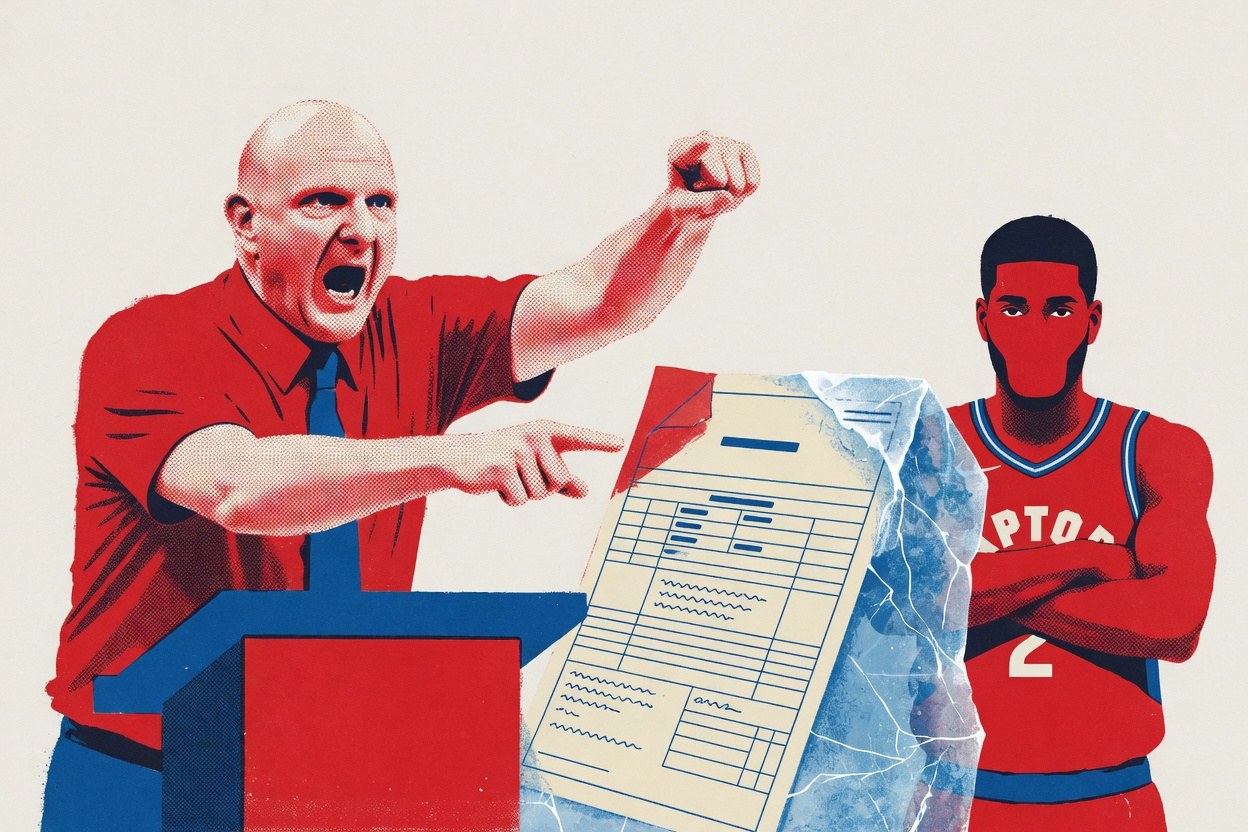
There's an uncomfortable coincidence sitting at the center of the Kawhi Leonard investigation as it stands in late August 2026. The moment it started producing headlines that read like exoneration was also the moment a stalled blockbuster needed to move.
Back up to how we got here. A little over a month before the 2025-26 season, journalist Pablo Torre reported that the Clippers had used their sponsor Aspiration, a company Steve Ballmer had personally invested in, to pay Leonard roughly $28 million through an endorsement deal. A former Aspiration employee said on Torre's podcast that the arrangement "was to circumvent the salary cap." The Clippers denied it flatly. The NBA opened a formal investigation and handed it to the outside law firm Wachtell, Lipton, Rosen & Katz. Later reporting widened the net to other companies tied to the team, including Daktronics and Boingo Wireless.
Then came the basketball part. Around July 8-9, 2026, the Clippers agreed in principle to send Leonard back to Toronto. The reported package has Brandon Ingram, Gradey Dick, two first-round picks, a pick swap and two second-round picks going one way, with the Raptors reportedly sending unprotected first-round picks in 2031 and 2033 plus a 2027 swap. Those are the reported terms, not signed-and-stamped ones, because the trade was immediately frozen. Toronto said the league office informed the Raptors that they would assume the risk of any outcome affecting Leonard, and that there was no timetable for the probe's conclusion.
For weeks, everyone waited, and then the ice started to crack.
On August 17, ESPN reported, citing sources, that the NBA's roughly 11-month investigation had found no evidence Ballmer or the Clippers used sponsors to secretly pay Leonard beyond his contract. ESPN called it the removal of the biggest obstacle to the trade. If you'd circled the calendar based on insider chatter, this wasn't a surprise. Days earlier, insider Jake Fischer had floated a belief in some corners of the league that the matter could wrap within six weeks, with an outcome that included sanctions against the Clippers but ultimately cleared the teams to complete the deal. The reporting landed almost exactly where the whisper network said it would.
That's the part worth chewing on. When the anticipated result and the leaked result line up this neatly, and both arrive just as training camp looms and a frozen trade needs a thaw, it's fair to ask whether the league's enforcement of cap-circumvention rules is a real deterrent or a speed bump that gets smoothed over when a star wants to move.
The counterweight is real, though, and it's substantial. This isn't a clean story of the league quietly rubber-stamping star movement. The NBA did something unusual: within hours, it publicly disputed a report from its own broadcast partner. Chief communications officer Mike Bass said ESPN's article "contains numerous and significant inaccuracies" and added that "the results in this matter will be made clear once the investigation is concluded." He didn't specify what was wrong. ESPN stood by its reporting. That's not the behavior of a league desperate to declare the Clippers innocent and get out of the way.
More complicates the tidy "the fix is in" version. Even ESPN's own account noted the probe has narrowed rather than vanished, with the league now weighing whether the team's introduction of Leonard to sponsors amounts to a "failure to supervise." The NBA has reportedly raised the Joe Smith case with the Timberwolves, who were stripped of five first-round picks with two eventually returned, as a possible template. That's not a league looking to hand out nothing. And Ballmer, per ESPN, has told confidants he won't accept a result implying wrongdoing. A commissioner rushing to grease a trade doesn't usually leave the accused owner threatening to fight the verdict.
So where does that leave the cynic's angle? Not at collusion, which nobody here can prove, but at something more defensible and honestly more damning: the process itself is opaque enough that reasonable people can't tell what happened. We have dueling leaks, a public spat between the league and ESPN, no named inaccuracy, no public report, no specified punishment, and no confirmed rule anyone agrees was broken. OutKick put the epistemics well: "Until official findings are released, declaring the Clippers cleared is just as premature as declaring Steve Ballmer guilty in the first place."
That vacuum is the problem. When enforcement of the sport's most important financial guardrails plays out through anonymous sourcing and competing spin rather than a transparent ruling, fans have no way to know whether the cap means anything. If the eventual outcome is a fine or a couple of forfeited picks paired with a completed trade, the message to every deep-pocketed owner is that the price of creative cap math is negotiable and survivable. If the outcome is genuinely tough, the league owes everyone the receipts to prove it.
As of this writing, the trade is agreed, frozen, and not final. Insiders point to a mid-September Board of Governors meeting as a possible turning point, with training camp as the outer edge. Toronto is betting on one expensive year of a player who's owed roughly $50.3 million in 2026-27, the final season of his deal, and who averaged 27.9 points, 6.4 rebounds and 3.6 assists over 65 games with the Clippers last season. That's the on-court stake.
The off-court stake is bigger, and it belongs to the league. The Clippers may well have done nothing that breaks a specific rule. But a system that only reveals its findings through leaks its own office then disowns isn't one anyone should trust to police the next Ballmer. Clear the Clippers if the evidence clears them. Just show your work.