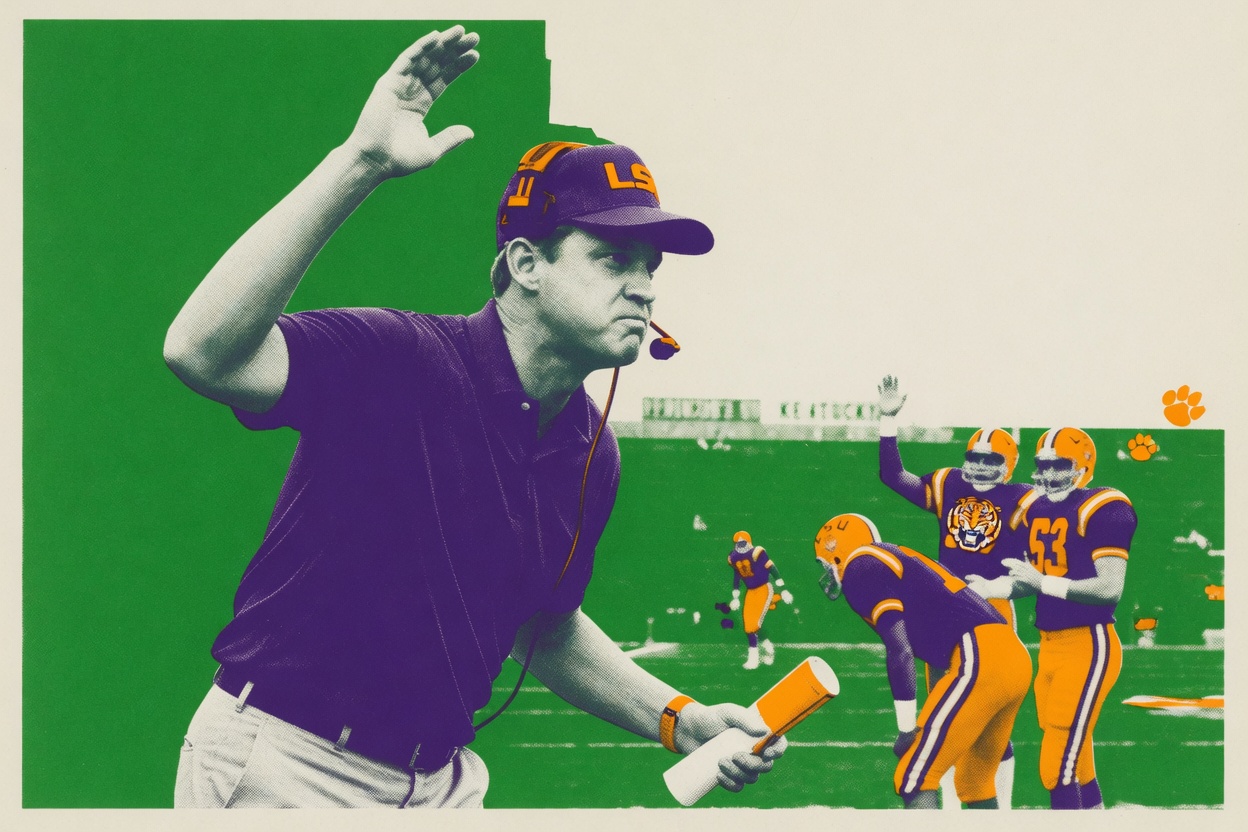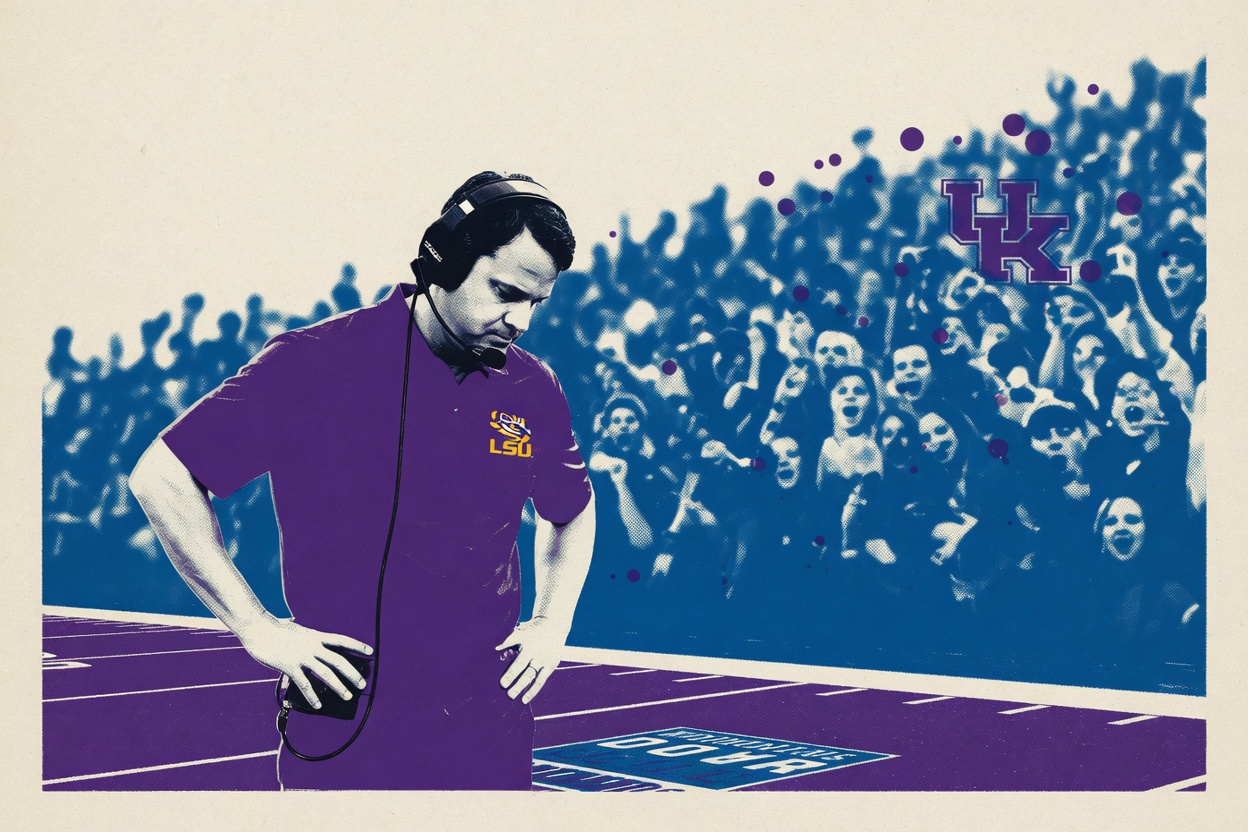
Kentucky did the same insane thing two Saturdays in a row: trailed in overtime, scored, waved off the extra point, went for two, and won it outright. Last week it was South Carolina on the road, 35-34. This week it was No. 10 LSU at home, 35-34 again, Kenneth Minchey running untouched up the gut for the conversion that finished it. The clip is everywhere today. Lane Kiffin was standing on the other sideline watching a $91 million contract get beaten by a quarterback draw.
This one landed hard for a reason. LSU lost more than a road-adjacent SEC game. This is the program that fired Brian Kelly mid-season last year, ate a buyout north of $50 million for it, then handed Kiffin a seven-year, $91 million deal with a buyout so friendly the school would owe him roughly $72 million with no offset if it ever wanted out. For a stretch this fall LSU was writing checks to three head coaches at once. The governor of Louisiana called the Kelly payout rewarding failure. Then the school doubled down, bankrolled more than $25 million in NIL and revenue-share support, and brought in the No. 1 transfer class in the country to make sure the Kiffin era started loud.
So when that era gets run over up the middle in overtime, by an unranked-a-week-ago Kentucky team that was missing most of its linebackers, the schadenfreude isn't complicated. People are enjoying LSU's invoice. When you spend like that and publicly dare the sport to doubt you, every tight loss becomes a referendum, and this was the loudest possible way to fail the test.
Winning the exact same way in back-to-back weeks is at least partly luck, partly the other side botching it. Minchey walking in untouched says as much about LSU's defense in that moment as it does about Kentucky's playcall. A team doesn't engineer two walk-off conversions on nerve alone.
But nerve is exactly what Will Stein kept showing. Kicking the extra point to force a second overtime is the safe, anonymous choice. Stein took the game into his own hands twice in seven days and dared his quarterback to end it. That's a first-year head coach, hired off Oregon's staff to replace Mark Stoops, deciding he'd rather win or lose on his own aggression than survive another period. There's a nice symmetry to it too: Stein was in the stands rushing the field when Kentucky knocked off No. 1 LSU in overtime back in 2007, and this time he was the one everyone was mobbing.
The game before the game had its own chaos. Adam Zouagui missed from 42, missed from 26, then drilled a 33-yarder with 12 seconds left to force overtime at all. Sam Leavitt put LSU ahead in the extra period from 15 yards out before C.J. Baxter punched in the one-yard answer and Stein sent Minchey. "There was nobody in the middle, so I figured I would run there," Minchey said afterward. That's LSU's $91 million problem.
Kiffin's own review sounded like a eulogy. "It came down to a one-play game, but there were a lot of plays before that to close the game out," he said. "Disappointing all three phases. If you don't execute, you don't execute." He's right. His team didn't execute. The difference is that Stein's team keeps executing the one play nobody else has the stomach to call.
LSU sat at 4-2, 1-2 in the SEC after this one, with plenty of season still to play, so nobody should be writing an obituary for the whole experiment yet. But the hiring was sold as a shortcut to the top of the sport, a problem you solve by outspending everyone. You can't buy a defender into the right gap. LSU just found that out for about $91 million.