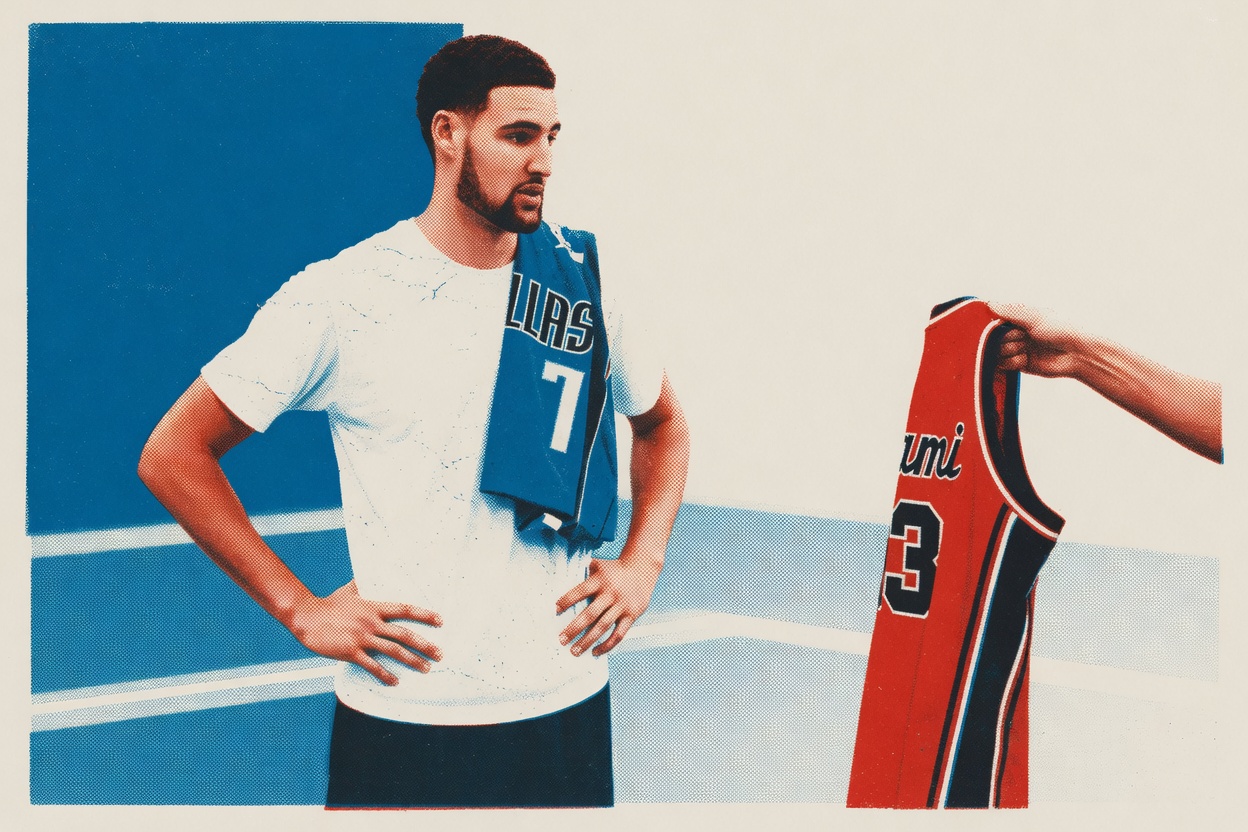
There are two ways to read the Klay Thompson buyout, and both of them are correct.
The first is that a 36-year-old wing whose game has narrowed to spot shooting wanted off a losing team and got his wish. That's true, and it's the tidy version. The second is that the Dallas Mavericks agreed to pay a player $17.5 million to not play for them, having first tried and failed to trade him for anything of value. That's also true, and it's the version that says more about how Dallas got here.
As of this writing, on August 22, 2026, none of the sequel is official. Dallas announced Friday that it was buying out the final year of Thompson's contract, and Thompson is expected to sign a two-year deal worth nearly $13 million with the Miami Heat once he clears waivers, with a player option in the second season. Until the paperwork lands, treat the Miami part as expected rather than done. But the direction isn't in doubt, and the direction is the story.
The Math Devalued Klay, Not Dallas
The people running the Mavericks now aren't the people who signed Thompson, and that distinction matters here. He came aboard in 2024, in a sign-and-trade, to stretch the floor next to Luka Doncic and Kyrie Irving on a roster built for a Finals window. That window existed. Then Dallas traded Doncic to the Lakers in 2025, Irving's season was wiped out by his ACL recovery, Anthony Davis was moved to Washington in February, and a team that had been chasing a title finished 26-56 and missed the playoffs entirely.
Into that wreckage walked Masai Ujiri to run basketball operations and Dusty May, fresh off winning the 2026 NCAA championship at Michigan, to coach. They inherited a contract that made no sense for the team they now have. Dallas is building around Cooper Flagg, the reigning Rookie of the Year, who is 19. A veteran specialist on an expiring deal doesn't move that needle, and the roster is being shaped to maximize the teenager, not to keep an aging shooter comfortable.
My read on the front office, plainly: the cleanest outcome would have been turning Thompson into an asset. Dallas shopped him and found no takers, because the $17.5 million he was owed made a trade close to impossible. When you can't trade a player and just eat the salary to let him walk wherever he wants, that's a sunk cost getting written off. The break was correct, but it was also the only move left, which is a different thing.
And the roots run deeper than this summer. Thompson's Dallas tenure carried a broken promise baked into it: he was pitched a starting job in 2024, then moved to the bench by Jason Kidd after seven games. Across two seasons and 141 games he averaged 12.9 points on 40.3/38.7/85.1 shooting, respectable role-player numbers. His final year was thinner, roughly 11.7 points in 69 appearances, with career lows in both field-goal and three-point percentage. He can still shoot. He's no longer someone you build a plan around. The people who signed him bet on a fit that evaporated within a year, and the people who replaced them had no use for what was left.
Miami's edge was patience, not luck
Flip to the other side of this, and you see a front office that knows what it's doing.
Miami reshaped its entire perimeter this offseason to land Giannis Antetokounmpo, sending out Tyler Herro, Kel'el Ware, Jaime Jaquez Jr., Kasparas Jakucionis and a stack of draft capital, while Norman Powell left in free agency. Bobby Portis and Tim Hardaway Jr. came in. What the new-look roster lacked was shooting to surround Antetokounmpo and Bam Adebayo.
The Heat identified Thompson as their answer and then did the hard part, which is nothing. They waited. Miami made him a top priority and sat on his situation for close to two months, letting the Dallas standoff resolve itself instead of overpaying to force it. When Dallas finally ate the money, Miami was there with a two-year deal for a fraction of what Thompson was owed. That's the value play: let another team absorb the cost of a mistake, then buy the useful remainder cheap.
It's not foolproof, and I'd resist handing Miami a trophy for savvy on a signing that hasn't happened yet. There's real skepticism about the Giannis trade itself given what walked out the door in Herro, Powell and picks, and Thompson at this stage is a low-risk complementary shooter, not a needle-mover. But low-risk complementary shooting is exactly what a Giannis-and-Bam team needs, and Miami got it without surrendering anything.
That's the split screen: one front office paid to erase a fit that no longer existed, while the other spent the summer waiting to buy the piece it actually wanted at a discount. Same player, same week, two organizations showing exactly where they stand.