Carlos Condit should have left Las Vegas as the UFC welterweight champion. Robbie Lawler threw the most violent five minutes of the night in round five, and two judges let those five minutes cover for a fight Condit had spent most of the evening winning.
The official result from UFC 195, on January 2, 2016 at the MGM Grand Garden Arena, was a split decision for Lawler: 48-47, 48-47 and 47-48. Tony Weeks and Derek Cleary had it for the champion. Chris Lee had it for Condit. Chris Lee was right.
The numbers are absurd
Per Fightmetric, Condit outlanded Lawler 198-78 in total strikes. In significant strikes it was 176 to 92, a gap of 84. In the fourth round alone, Condit outlanded him 42-6 in total strikes. Six. That's a champion getting picked apart for five minutes and barely answering.
Volume alone doesn't win rounds, and Lawler's backers lean hard on that. Damage matters, and Lawler's shots were the heavier ones. So give him the fifth. I would. He came out swinging wild, Condit fell violently backward into the cage off a Lawler left hand, and Condit started bleeding from the mouth. Condit was rocked and never went down, and he kept firing back on unsteady legs. One recap of the fight even has him landing more than Lawler in that round too.
But do the arithmetic. A 48-47 Lawler card needs more than the fifth. It needs the judges to hand Lawler other rounds where he was getting outworked by a man throwing far more and landing far more. Two of them did it anyway, and I think they did it because the last round was loud and bloody, and the earlier work was quiet and steady. Recency bias decided a world title.
The rewatch crowd
The strongest case for Lawler is the rewatch: score it fresh, round by round, and you land on 48-47 for the champion. theScore did exactly that in 2020, scored it 48-47 Lawler, and called it a fair scorecard. Their argument is that Condit's backers are running on nostalgia for a fighter they wanted to see wear the belt.
The people with no nostalgia to spend disagree. Dana White, president of the company paying both men, scored it for Condit. Kenny Florian said it flatly in his recap of the card: "Carlos Condit won the fight." In a tracked tally of media scorecards, 14 had it 48-47 Condit, three had it 48-47 Lawler, two had it a draw and one had it 49-46 Condit. The rewatch take is a minority view that got lucky enough to match two judges.
Even Condit undersold it. "It was close but I thought there was a good chance I was ahead," he said. He was ahead.
Leave Lawler out of it
None of this lands on Lawler. He did what he's always done: walked forward and ate punishment, swinging for the finish when the fight was slipping. You can't blame a fighter for what judges choose to reward. And he was gracious about the man across from him: "Carlos is just so tough every time he fights he proves people wrong. Hats off to him."
The blame belongs to Weeks and Cleary, and to a scoring culture that lets a dramatic finishing flurry outweigh twenty minutes of clear, sustained work.
The cage lean
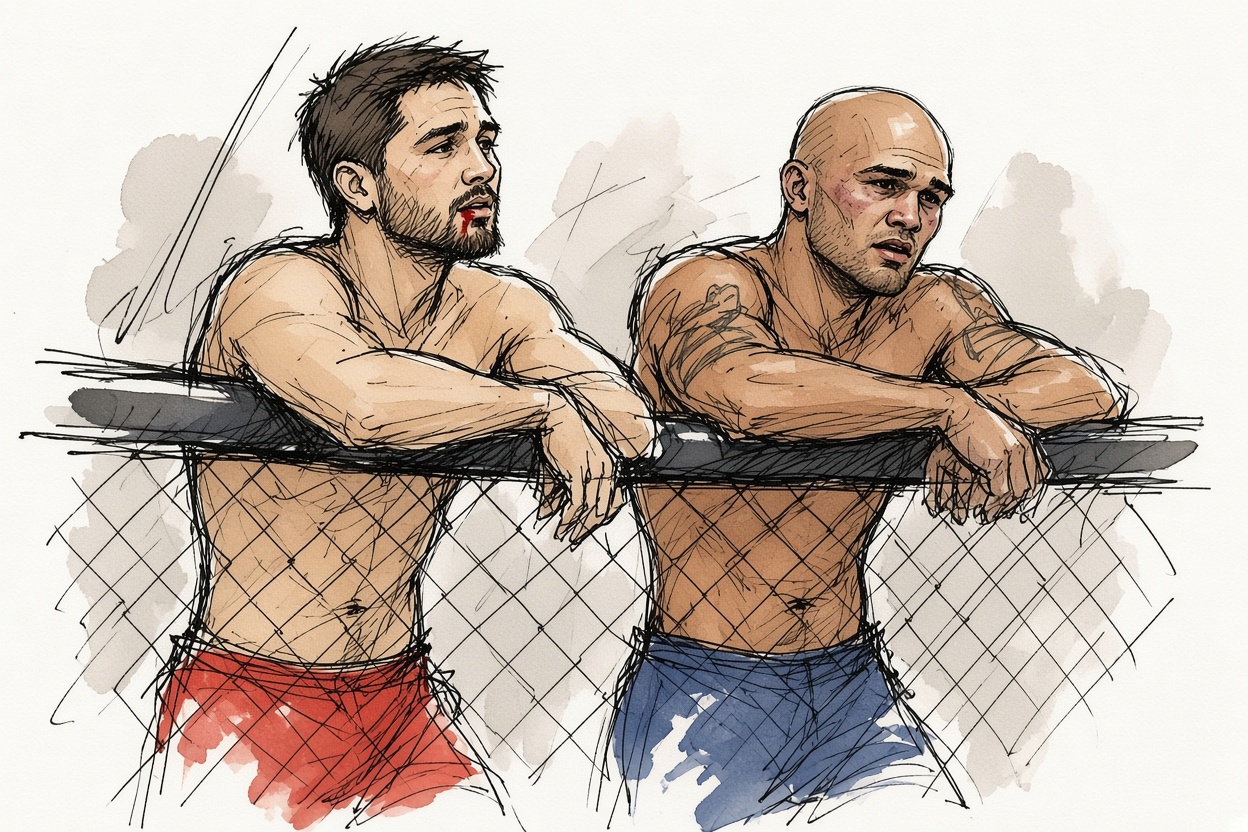
When the final horn went, both men threw their arms over the top of the fence and sagged there side by side, bruised and spent. It's one of the best images the sport has ever produced, and I love it as much as you do.
It has also done the judges a huge favor. That picture turned a bad decision into a feel-good memory, and every time it gets shared, the scorecard fades a bit further into the background. Two exhausted men holding themselves up on a fence is a story about respect. The scorecard is a separate question.
What came next doesn't change the scorecard either. Lawler lost the belt in his next fight, knocked out by Tyron Woodley at 2:12 of the first round at UFC 201 in July 2016. Condit's loss to Lawler became the first of four straight, followed by Demian Maia, Neil Magny and Alex Oliveira. The history books just say Lawler retained.
They're wrong. Tony Weeks and Derek Cleary rewarded one highlight-reel round over twenty minutes of work, and Carlos Condit was the welterweight champion of the world that night in everything except the paperwork.