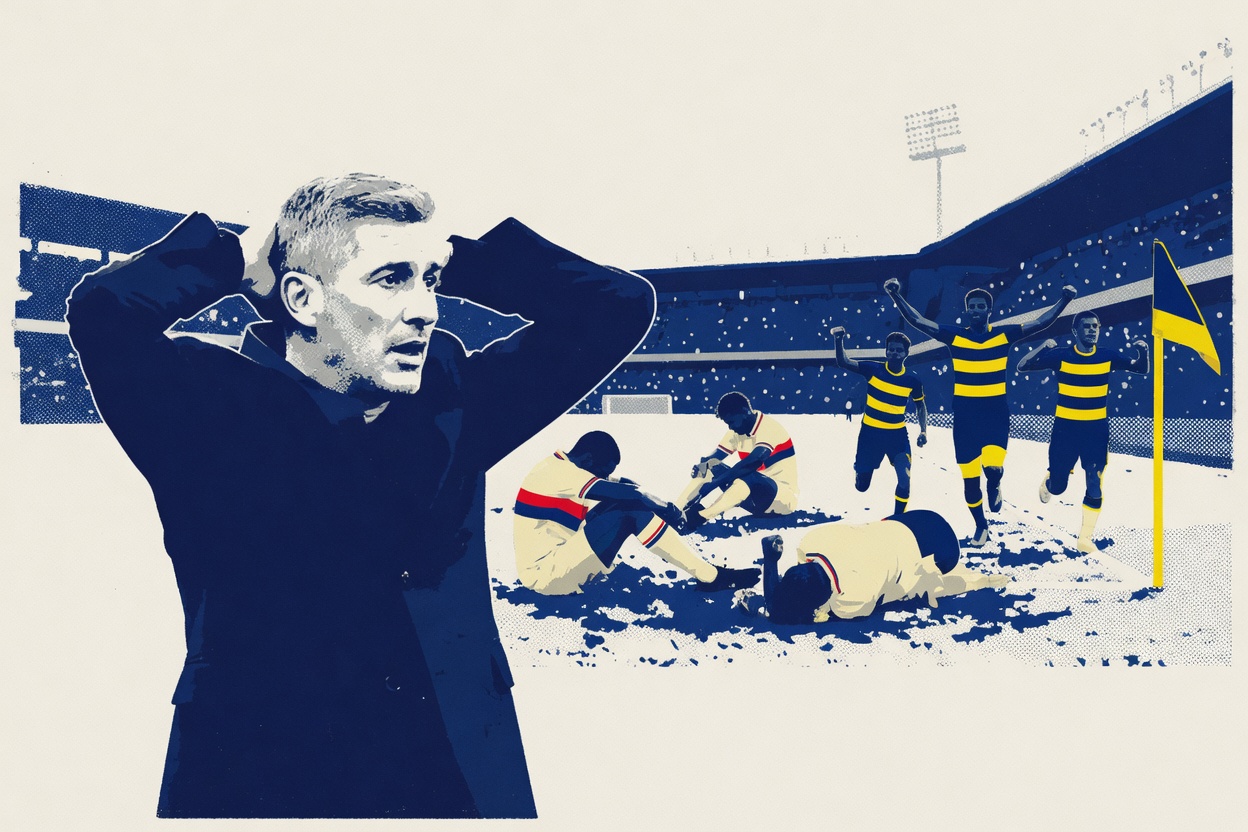
There are clubs that can afford to treat a Champions League playoff as a bonus round, a nice-to-have on top of a stable business. Lyon are not one of them. On the night of August 26 they found out exactly how much they had riding on a game they couldn't control.
A 1-2 defeat at home to Fenerbahçe, 3-2 on aggregate, ended the campaign in the playoff round. The Turkish side advanced beyond Champions League qualifying for the first time since 2008/09, and they did it the ruthless way. Vedat Muriqi finished from the middle of the box in the 24th minute, Archie Brown doubled the lead four minutes later, and by half time a tie that had come to Lyon level at 1-1 was slipping away fast. Fofana pulled one back in the 61st, curling in after Ainsley Maitland-Niles teed him up, and Lyon spent the closing stretch throwing everything forward. They found the net twice more, only for VAR to wipe out both. The season ended right there, in the space of two reviews.
On pure football terms, Paulo Fonseca's side can feel unlucky. The first leg in Istanbul had finished 1-1, Mason Greenwood cancelling out Loïs Openda's opener, and the tie was there to be won. But the on-field story isn't the whole story here.
By L'Équipe's reckoning, Lyon had already banked around €4.29m for reaching the playoffs, with roughly €23m more waiting if they got past Fenerbahçe and into the league phase. Set that against an operating budget estimated at €110m, the seventh largest in Ligue 1, and you see the problem. This isn't a club with the padding to shrug off a €23m swing. The fixed Champions League participation fee alone sits near €18.62m, against €4.31m for the Europa League. Beyond the flat fee, the projected upside they walked away from is larger still: UEFA's value pillar for a group-stage club would have been worth far more than the Europa version, and matchday and commercial income would have climbed with it. None of that was guaranteed money. All of it was money Lyon badly needed and now won't see.
The financial planning under John Textor left Lyon so thin that a single knockout tie became a load-bearing beam. That's the real indictment. Player sales are still being chased to fund incomings, the wage bill still needs trimming, and into that fragile arithmetic the club poured its hopes onto ninety minutes plus a VAR monitor. When your survival math depends on beating a Mourinho-era Fenerbahçe over two legs, you've already lost the argument about how the business was run.
And the business has been a slow-motion emergency for nearly two years now. Back in autumn 2024, the French financial watchdog, the DNCG, provisionally relegated Textor's Lyon to Ligue 2 and slapped on a transfer ban. That relegation was fought off, but the underlying rot didn't disappear with the headline. The ownership picture has since turned openly hostile: Textor is suing Michele Kang for $400m over the Lyon takeover, while Lyon have pointed to more than €700m in what they describe as suspicious transactions during his time in charge. Kang has taken control and the Textor era is over, but the litigation is still live, and lawsuits don't pay transfer fees or plug operating gaps.
History should have warned everyone how narrow this door is. Among French clubs since 2012-13, only Monaco in 2016-17 and Lille in 2024-25 have survived the playoff round. Building a rescue plan around clearing a hurdle that French teams almost never clear was less a strategy than a prayer.
So Lyon drop into the 2026-27 Europa League, the same competition as last season, with a smaller pot and a bigger hole, and a courtroom fight running in the background. The football was survivable, and Fenerbahçe were beatable. What isn't survivable is a structure that made one tie carry this much weight. The night Lyon needed to go right went wrong, and now the club has to answer for why so little stood behind it.