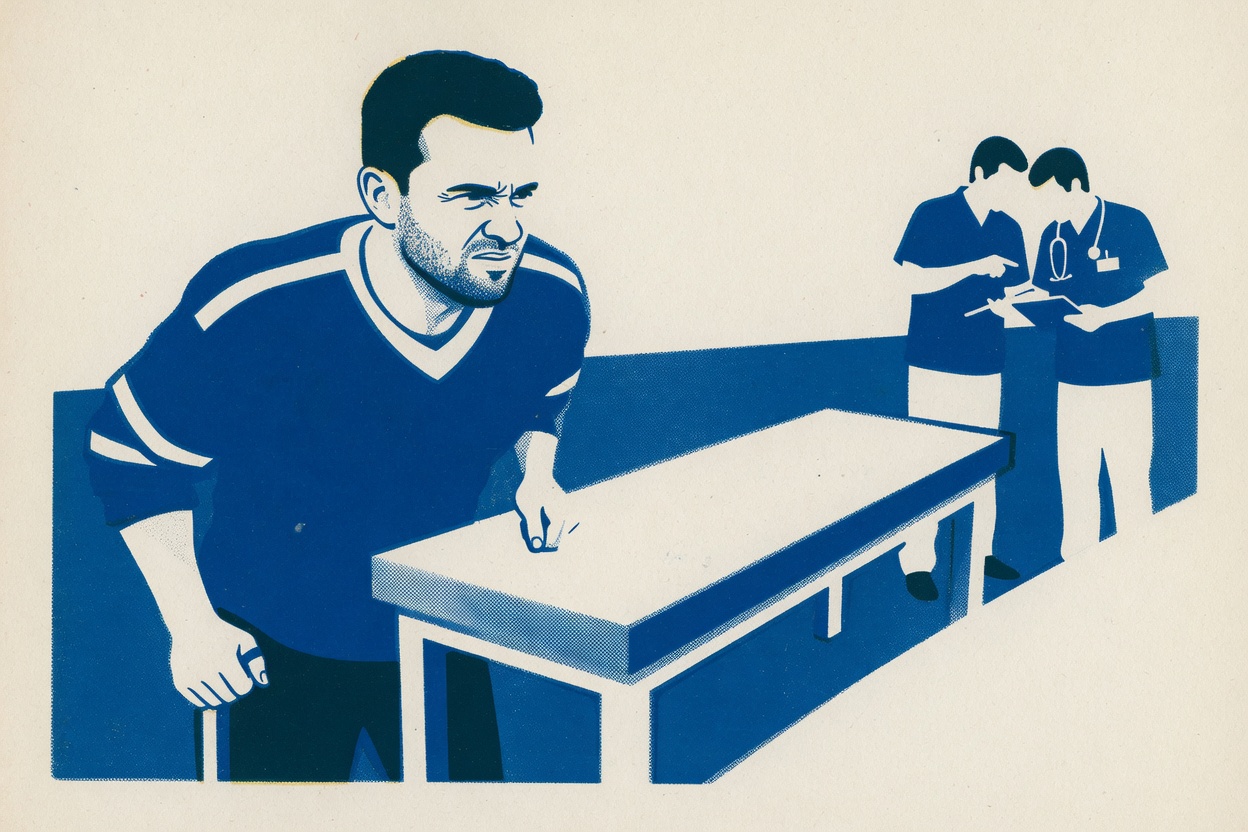
The Max Domi story is uncomfortable, and not just for one side of it.
A player exercised a right he's fully entitled to: he picked his own surgeon for an offseason back procedure instead of the one the Maple Leafs preferred. The procedure didn't go the way anyone hoped, and now, as of early August 2026, Toronto is staring at a $3.75 million forward whose availability for the 2026-27 season is very much in doubt, with an evaluation not scheduled until training camp opens.
No one broke a rule. That's the part that should keep front offices up at night.
Start with what the team actually said. Back on May 25, the Leafs announced Domi was out indefinitely with complications from offseason surgery, a procedure meant to address an issue he'd played through during the 2025-26 season. They said he'd be reevaluated at the start of camp and would keep working with the club's medical staff. That's the on-the-record version, and it's thin on purpose.
The alarming details came later, from Toronto Sun columnist Steve Simmons: Domi couldn't walk in the days after the surgery, it caused real alarm, and he'd chosen his own surgeon rather than the one the Leafs had in mind. Simmons called that kind of choice common around the league and noted it didn't affect Domi's insurance status. Toronto hasn't confirmed the specifics, and what exactly happened in that operating room still isn't public. The better news, from later reporting, is that Domi can now walk without trouble. He's still recovering, and his season is still a coin flip.
Let me separate what I'm arguing from what I'm not. I'm not saying Domi did anything wrong. He didn't. Under the current CBA, players have the right to seek a medical second opinion, they don't have to explain why, and the league keeps a list of pre-approved specialists the team is required to pay for. Choosing your own surgeon is a protected part of being an NHL player. Reporting suggests the Leafs aren't responsible for the choice of doctor, and nobody's pinned the blame on Domi either. GM John Chayka has been supportive and vague, which is exactly right: he said the procedure "didn't go as we had hoped" and that they'll assess Domi at camp.
My question is mine alone, not the team's, not the union's: is that the right balance?
Think about the asymmetry. When a player and a team disagree about a course of treatment, the CBA hands the final call to the team's doctors. That's the exact clause that kept Jack Eichel from getting the surgery he wanted in Buffalo, until a trade to Vegas set him free. Players hated it then and reportedly want it gone in the next CBA, and that's fair enough. But notice how oddly it lines up with Domi's case. If Domi had fought Toronto over what procedure to have, the team could have overruled him. Because he instead chose who would perform it, the team had no say at all, and it's the club that now eats the roster and cap consequences.
That's the loophole. The team can dictate the treatment plan in a dispute, but it can't touch the surgeon selection that matters just as much to the outcome. One decision the organization controls; the other it doesn't, even though both land in the team's lap financially and competitively.
Here's what I'd do: the NHL and the NHLPA should treat surgeon selection as its own conversation in the next round of bargaining, not lump it in with the second-opinion fight. Not to strip players of choice, players should absolutely get their own doctors, and the Eichel mess is a genuine argument for more player autonomy, not less. But there's a defensible middle: shared decision-making on the surgeon for major procedures, with the team's medical staff and the player's chosen surgeon aligned before a scalpel comes out, especially when a guaranteed contract and a roster spot are on the line. Right now the incentives are split down the middle. The player carries the physical risk. The team carries the salary-cap risk. Nobody sits at the same table making the call together.
Toronto, to its credit, has built for exactly this kind of gray area. The Leafs revamped their sports-performance group this offseason, bringing in Andy O'Brien to lead it alongside Jason Martin, Josh Crouse, Dr. Craig Slaunwhite and Dr. Jordan Shallow. Domi's rehab is their first real test, and the organization's stated posture is that his health, not the team's needs, sets the timeline. That's the right call for a human being. It's also a reminder that the humane answer and a clean cap sheet don't always point the same direction.
Don't lose the player in all of this. Domi has bounced through Arizona, Montreal, Columbus, Carolina, Chicago, Dallas and now Toronto. He's a tough kid, by Chayka's own description, who played through injury to help this team. He deserves to walk into camp on his own timeline and be met with patience. Whether he plays at all in 2026-27 is unresolved, and anyone telling you they know is guessing.
But the bigger issue outlives this one recovery. A system where a fully legal, fully routine choice can quietly torch a season and a cap number, with no shared authority and no shared accountability, is a system waiting to produce another version of this. Domi didn't break any rules. The rules themselves are what need fixing, and that's what the next CBA should address.