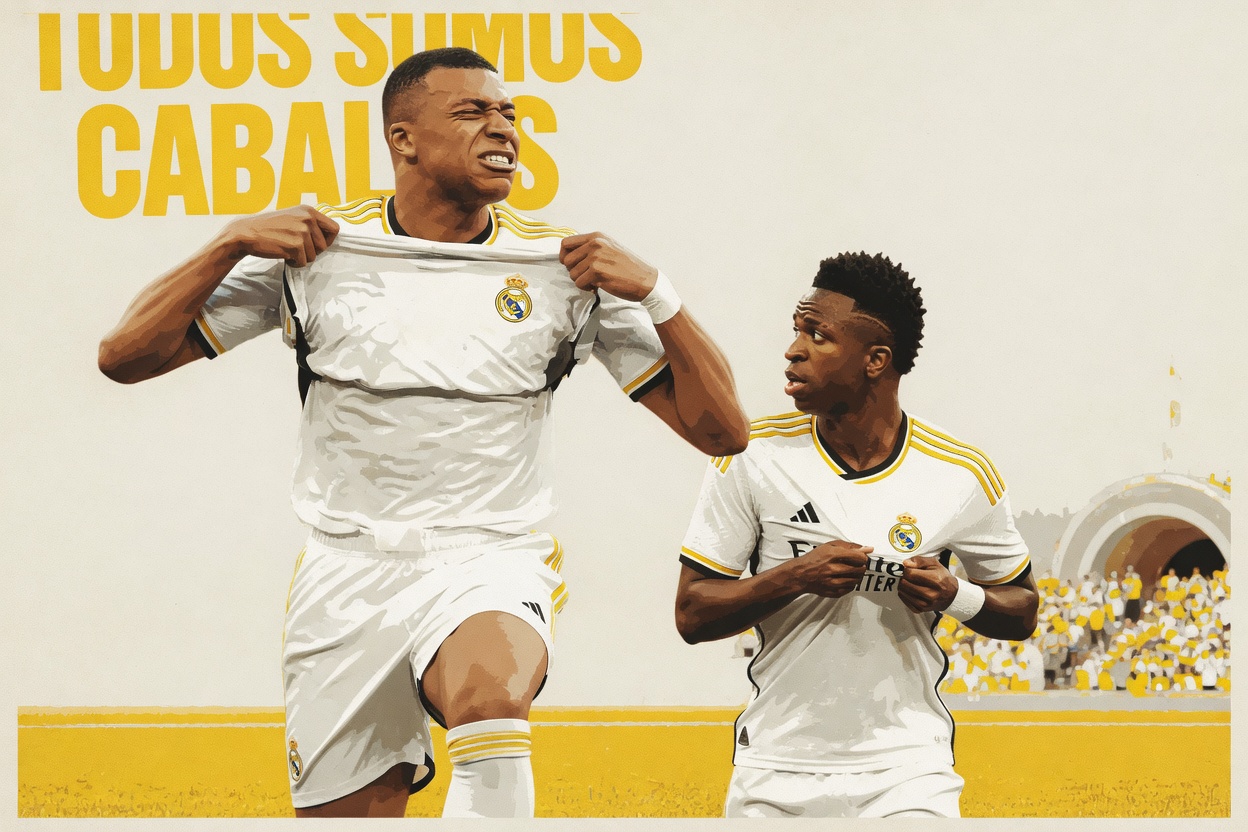
There's a version of this story where everyone looks noble. A humanitarian disaster on Spain's southern edge, and a league moved to solidarity, its players lending their fame to a good cause. That version is easy to write and easy to sell. It also skips the uncomfortable middle: a group of grown men were handed a pre-printed message and expected to broadcast it to millions before anyone asked what it meant to them.
The shirts read "Todos somos caballas," which translates as "we are all mackerels," a nickname for the people of Ceuta. LaLiga arranged the gesture across this round of fixtures, part of an initiative organized by a Valencian business association to show solidarity with the enclave after a summer migration crisis that left estimates ranging from roughly 50,000 to more than 80,000 people attempting to cross from Morocco, with a death toll still disputed between government figures and humanitarian organizations. The cause is real and the suffering is real. None of that is the argument here.
The argument is what happened at the Manuel Martínez Valero on Tuesday night, when Kylian Mbappé, Vinícius Júnior and Ibrahima Konaté walked out with their shirts rolled up to their chests, hiding the slogan, then slipped them off entirely as the teams shook hands. One account has Mbappé putting his on with a grimace, glancing at Vinícius, then quietly rolling it up to match. Konaté, by that account, carried his scrunched up in his hand. Real Madrid won 3-2, with Mbappé on the scoresheet, and the football was the least discussed thing about the evening.
That grimace was a man doing visible math on a decision that should never have landed on him. Mbappé said as much when he finally explained himself to AS. "I want to explain this properly so that people understand," he began, then laid out a genuinely impossible position. He said he didn't "want to prioritize one form of suffering over another." He said, "It was not an easy position to be in; it was difficult," because people might read his hesitation as being against the people of Ceuta, which he insisted was not the case. "The first thing I want to say is that I stand in full solidarity with Ceuta and with all the victims," he added. Put those quotes together and you get a footballer trying to hold two sympathies at once while wearing a shirt that only lets him express one.
That's the flaw in the whole model. A mandated slogan flattens a complicated situation into a binary, then hands that binary to people whose lives are anything but. Football squads field players from dozens of countries now, some of whom come from precisely the nations with a stake in whatever dispute the slogan brushes against. Drop a Spain-versus-Morocco border tragedy onto a dressing room and you're asking specific individuals to pick a lapel pin in a fight that runs through their own biographies. Nobody in the marketing meeting seems to have accounted for that.
The player who got the worst of it barely chose anything at all. Abde Ezzalzouli wore the shirt for Real Betis before Monday's 2-1 win over Villarreal at La Cerámica, alongside his teammates. Abde was born in Beni Mellal, moved to Spain with his family at seven, and, when the choice came, opted to represent Morocco internationally rather than the country that raised him. For that, a man who simply wore a shirt he was asked to wear got accused online of betraying his own people, received threatening messages, and ended up removing his only Instagram photo. His response wasn't an apology. "I want to make one thing clear: at no point was the shirt bearing a reference to the city of Ceuta used for political purposes or with the intention of offending my people, the Moroccan people," he wrote, adding, "This is not an apology to anyone, and whoever wants to use this to question my love for my country is free to do so."
He shouldn't have needed to write any of it. A winger was handed a shirt by his employer and then made to defend his patriotism because of it. That Instagram post is the clearest sign of what happens when a club doesn't think through the people it's dressing.
There's a rulebook wrinkle worth sitting with, too. FIFA's own regulations state that a player's clothing "must not have any political, religious or personal slogans, statements or images," with Rule 4.5 extending that to messages on undergarments. FIFA issued no ruling on this specific episode, and reasonable people can argue about whether a solidarity slogan counts as political. But that rule exists because the sport has already decided, in principle, that the pitch isn't the place for this. A league organizing a coordinated slogan sits in an awkward gray zone against its own governing body's instinct.
The most telling split is institutional. Real Madrid declined to discipline anyone. A club official said Madrid had accepted Elche's request but respected differing opinions and left each player free to choose whether to wear the shirt. That's the correct posture, and it validates the players entirely. Yet LaLiga president Javier Tebas later criticized the three for not wearing the shirt properly. So the players' own employer gave them a choice, and the league's boss publicly leaned on them for how they used it. When the man running the competition scolds athletes over a gesture their club considered optional, the word "voluntary" has quietly stopped meaning anything.
Give Betis credit for the aftermath. Both the club and LaLiga backed Abde once he explained himself, and manager Manuel Pellegrini said he'd spoken with the winger directly, treating it like any other conversation with his players, while stressing that football should keep its distance from political confrontation and stay a game that brings people together. That's the part the shirt initiative got backwards. You don't keep football above the fray by printing a position on every jersey and daring the players to opt out in front of a camera.
Solidarity is a good instinct. Coercion dressed up as solidarity isn't. What's worth remembering from this round is three men rolling fabric up to their collarbones, the only honest answer to a question nobody thought to ask if they wanted answered in the first place.