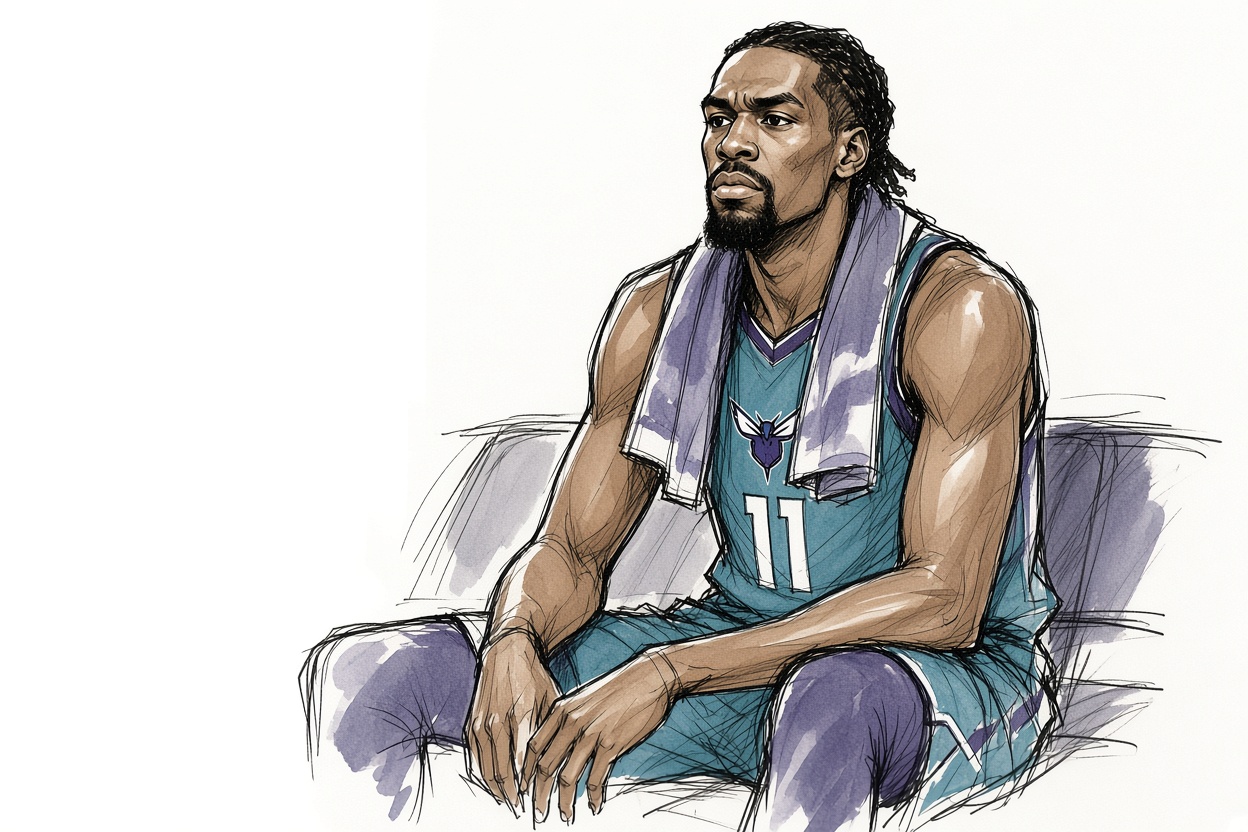
Naz Reid is just the guy on this roster Charlotte can actually trade. The real problems start somewhere else.
That's the honest read on the latest round of speculation, kicked off when The Athletic's Jon Krawczynski said on his podcast that "the possibilities of Naz Reid getting traded again are very high," and that "everything that made the Naz Reid experience special is not there in Charlotte." He's right about the second part. He's just aiming it at the wrong person. Nothing that made Reid work is there in Charlotte because the people running the Hornets never built it there in the first place.
Krawczynski was talking on a podcast, breaking down a franchise in transition. It wasn't a sourced report of a deal in the works, but it's gotten passed around as if it were, stretched well past what he actually said. The February deadline is still roughly three months out. What Krawczynski offered is analysis. Nobody has reported an actual trade in motion.
Reid spent seven seasons in Minnesota, mostly coming off the bench, as one of the most efficient low-usage bigs in the league. Charlotte acquired him last offseason in the deal that shipped LaMelo Ball and Josh Green to Minnesota, agreed around the June draft and finalized in July once the moratorium lifted. Then they handed a career sixth man the keys: full-time starter for the first time in his career, plus lead scorer and de facto playmaker. Through 11 games he's averaging 17.4 points, 8.5 rebounds and 2.1 assists in about 29 minutes a night. His efficiency has cratered, from just under 57% on twos in Minnesota to around 44% in Charlotte.
Look at what's around him. Kon Knueppel, the second-year piece who was supposed to make Reid's new role survivable, missed the first eight games with a hamstring issue, came back on November 4, lasted five minutes, re-aggravated it, and got ruled out again for weeks. Reid has effectively played this entire season without him, roughly 10 of 11 games. Coby White missed the first seven with a calf injury before returning. Dennis Schroder, the veteran backup point guard, has been out with a hamstring strain. Brandon Miller has been banged up too. The point guard room behind White is a 33-year-old on a cheap deal and a rookie. The Hornets have sat dead last in scoring offense during this stretch, winning three of their first four before dropping four straight.
So Reid has been playing center, point-forward and first option on a team with no healthy shooters or ball-handlers, the exact opposite of the context that made him good. Blaming him for the offense is like handing a man a wrench in a flooding basement and then firing him because the pipes still burst.
The benching only deepens the front office's credibility problem. On October 28 against Detroit, Charlotte led 51-44 at the half with Reid at seven points and six rebounds, and coach Charles Lee sat him for the entire second half. "Unfortunately, Naz didn't meet our standards in the first half, and at halftime we made the decision that he wouldn't play in the second half," Lee said. The Pistons then outscored Charlotte 53-38 after the break and won 97-89. Charlotte benched its import, lost anyway, and manufactured a story about standards in year one of a transition. Twelve days later Reid went for 25 points and 13 rebounds in a 124-112 win over Cleveland. The player answered. The question is whether the front office can.
That's where the heat belongs. GM Jeff Peterson and this front office blew up a core built around a 24-year-old All-Star-caliber guard, and the sequencing is damning. At the February deadline, it was Minnesota chasing Ball and Charlotte rebuffing the approach. Then, months later, Charlotte turned around and made the move itself. They traded a franchise engine for a player whose value was always tied to the shooting and spacing he was leaving behind, and they never replaced it. Thin, young, injury-prone guard depth with no real insurance. That's a plan with a hole in the middle of it.
Charlotte's roster has barely been healthy enough to show what it actually is, and that failure belongs to the front office. You can't evaluate a fit that has never once been on the floor intact, and you can't declare the new guy a failure because of it.
If the Hornets move Reid again in February, that will be on the problem they created. He was imported to patch a mess the organization built, dropped onto a broken, injured roster, and handed a workload no low-usage bench big was ever going to make look clean. Judge the men who drew up this roster, because they're the ones who should be answering for it.