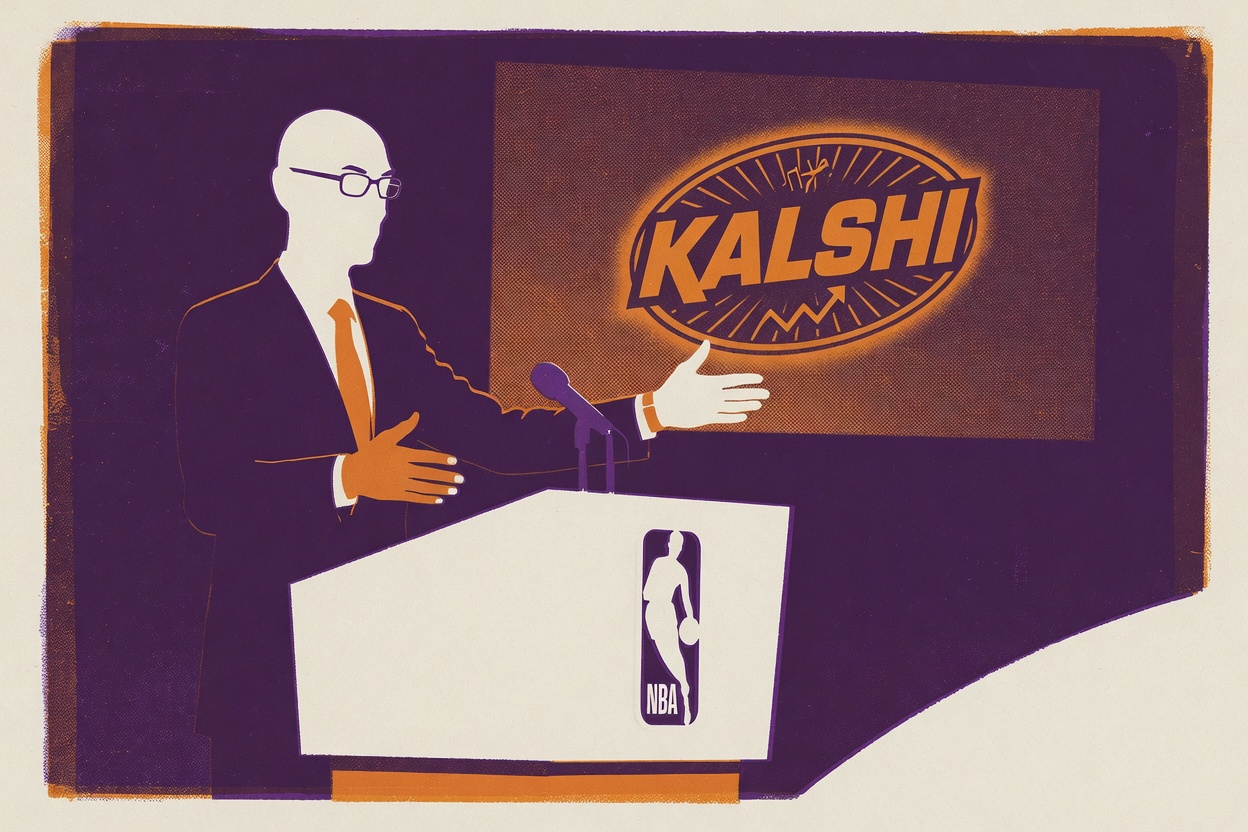
Adam Silver sold out the NBA's integrity, and he did it with the legal mess sitting open on his desk.
On October 26, the NBA named Kalshi and Polymarket its preferred prediction market platforms, giving them access to official league data and the right to put NBA marks and logos on their sites. Two days later, on October 28, Utah Attorney General Derek Brown charged Kalshi and its two co-founders, Tarek Mansour and Luana Lopes Lara, with 13 felonies plus a misdemeanor: a second-degree felony for a pattern of unlawful activity, a stack of third-degree felonies for promoting online gambling, and a Class A misdemeanor on top. That's the company the NBA just invited onto its logo.
This wasn't a surprise. The fight over Kalshi has already spread across roughly 20 states. Arizona brought criminal charges back in March, and Utah's felonies are an escalation: the second state to go criminal, and the first to make it jail-exposure serious. All of that was public record before Silver signed anything. He read the room and decided the sponsorship was worth more than the risk.
The league's defense is a page of "integrity protections": limits on which markets are allowed, a ban on league and team personnel trading NBA event contracts, and a promise to share information on suspicious trading. Fine. Stopping your own employees from betting on your own games is the bare minimum, the kind of policy any league needs to avoid a point-shaving scandal. It says nothing about whether the business the NBA just blessed is legal, and in at least two states, prosecutors are now saying out loud that it isn't.
Silver's camp does have one real argument: the CFTC says Kalshi operates lawfully as a federally regulated event-contract market, and the federal government is in court backing that position. On October 26, the CFTC and DOJ sued Utah, asking a judge to declare the state's gambling laws preempted and to stop Utah from going after CFTC-regulated firms and their partners at all. Squint hard enough, and the NBA is just doing business with a company the feds insist is legal.
But look at who's doing the insisting. The CFTC's own complaint argues "Supremacy Clause violations are always irreparable." The administration running that agency has the president's son financially stitched into this exact industry. Donald Trump Jr. is a paid strategic advisor to Kalshi who was handed an equity stake for free when the company was worth under $2 billion. His fund also put a multi-million-dollar investment into Polymarket, where he joined the advisory board. The government fighting a state on Kalshi's behalf is the same government whose first family stands to profit if Kalshi wins. "Legal because the feds say so" means something very different when the feds have money on it.
The regulatory resistance to Kalshi fell apart in a telling order. A district court ruled for the company in September 2024, before Trump Jr. arrived. The government's active fight ended after he joined and Trump took office: the CFTC dropped its appeal in 2025, and within days of the inauguration, Kalshi listed its first sports contracts, the very product its own lawyers once told an appeals court Congress meant to prohibit.
None of this is slowing Kalshi down. The company is now valued at $40 billion after a fresh billion-dollar round, and its answer to a felony prosecution was to call it "a crazy overreach" and accuse Utah of "playing politics." That's what every defendant says before trial. It doesn't clear them, and it's no reason for the NBA to lend them its brand.
Responsibility here is pretty clear. Kalshi's founders own their own legal exposure; a company doesn't get charged with a pattern of unlawful activity by accident. The CFTC has the conflict of interest baked into suing a state for a company the president's son profits from. And Adam Silver made a choice no one forced on him. He could have waited for the courts to sort out whether this entire business is legal. Instead, he chose to collect the check now, while prosecutors in multiple states call the product a crime.
Silver didn't build this mess, but he saw a felony prosecution and treated it like a marketing inconvenience, then signed anyway.