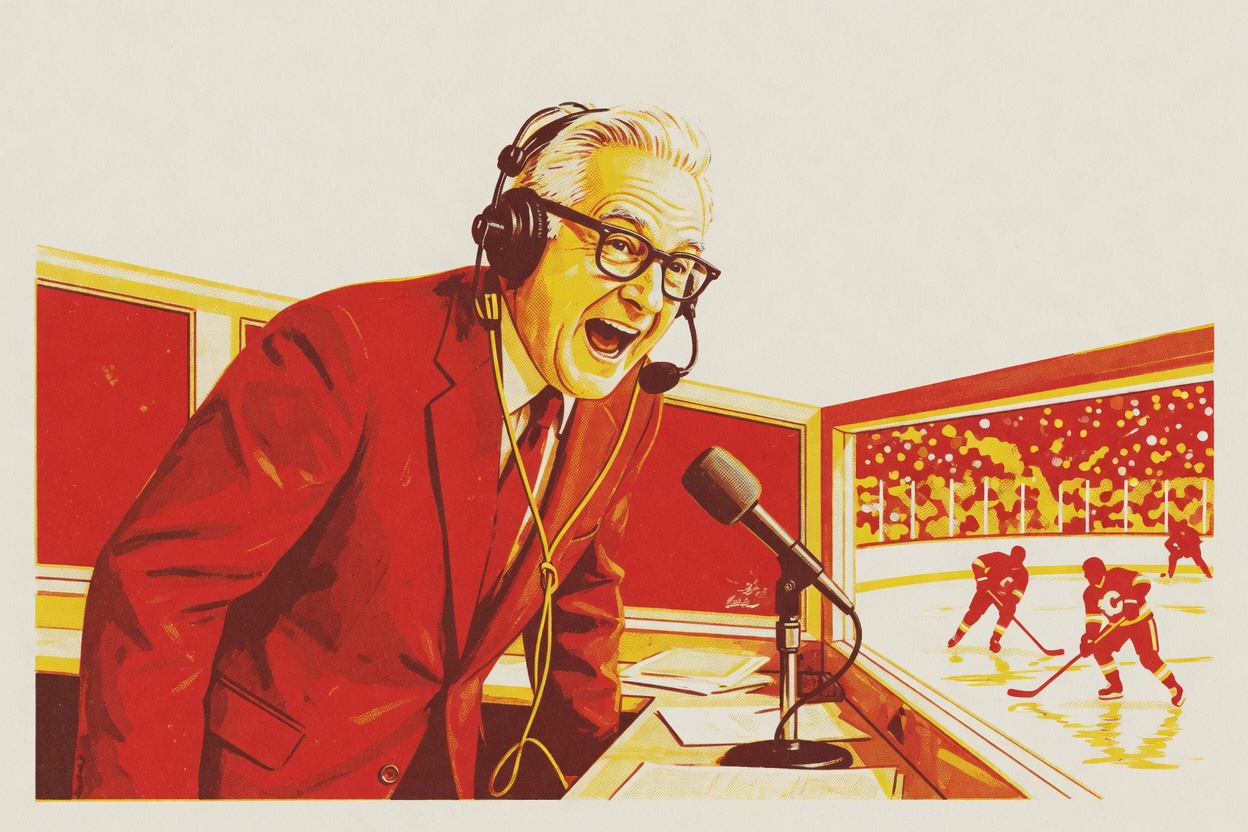
A day before the Calgary Flames announced that Peter Maher had died, he was on the radio talking about the Corral, and Lanny McDonald, and the little broadcast perch he loved because it sat so close to the ice he could read the numbers off the sweaters. It was a homecoming interview. The Flames had just signed a five-year deal to bring their broadcasts back to 770 CHQR, and there was Maher, the man who first called their games when the franchise relocated to Calgary in 1980, reminiscing about all of it.
He was 79, and the Flames confirmed his death Thursday. He never got to hear a single game on the new station, a small cruelty, and it's the kind of timing that makes you think about how we honor these voices, and when.
The soundtrack argument
The Flames' own tribute put it better than a column could: they said Maher's voice "became part of the soundtrack of being a Flames fan." For 33 years, through the 1989 Stanley Cup win and the 2004 run to the Final, Maher was the sound of the team for people who never set foot in the building. Players come and go on trades and contracts and decline curves. The voice stays. It's there for the dynasty years and the lottery years alike, narrating a franchise's whole emotional life in the same familiar cadence.
A great broadcaster is as much a load-bearing part of a team's identity as any captain. "Yeah, baby!" and "You can put it in the win column!" weren't just calls, they were shared property, phrases fans repeated to each other for decades. You don't build that in a season. Maher built it over decades, first calling Toronto Maple Leafs radio starting in 1977, then becoming the first radio voice Calgary ever had.
Calgary actually did this right
The Flames didn't wait for an obituary to celebrate him. After he retired following the 2013-14 season, they named the Peter Maher Radio Broadcast Booth at the Scotiabank Saddledome, and they created an annual award in his name for the player who best shows the qualities they associated with him: sincerity, integrity, dedication, respect. Blake Coleman won it for the 2025-26 season. They handed it out with Maher in the room, year after year.
A man got to walk into an arena and see his name on the booth where he worked. He got the flowers while he could still smell them. His broadcasting honors weren't posthumous either: he was inducted into the New Brunswick Sports Hall of Fame in 1996, and in 2006 he received the Foster Hewitt Memorial Award, the media honor given at the Hockey Hall of Fame to broadcasters who made outstanding contributions to the game.
Most franchises don't do this, or don't do it until the person is gone. The eulogies come easy. The living tributes take intention.
The open question the Saddledome raises
There's a wrinkle that makes the point urgent rather than sentimental. The Saddledome is entering its final year as the Flames' home in 2026-27, and the team is moving to a new building. That means the booth bearing Maher's name is, physically, on borrowed time.
I haven't seen anything settling what happens next, and I won't pretend I have. But it's a fair question to ask out loud: does the Peter Maher name travel to the new arena, or does it quietly stay behind with the old concrete? A named booth in a building about to be replaced is exactly the kind of tribute that can vanish through nobody's malice, just inertia. Preserving a legacy isn't a ribbon-cutting you do once, it's upkeep.
A rough stretch for the voices
Maher's death lands during a period that's been unkind to the people who called this sport for generations. The last few years have taken several of the great NHL play-by-play voices, Rick Jeanneret and Mike Lange among them, voices that made whole regions fall in love with hockey. It's reportedly been a brutal week specifically: another beloved Canadian broadcaster is said to have died around the same time. The generation that built the modern sound of hockey is thinning out.
Colleagues remembered Maher warmly this week, Rob Kerr saying he was crushed, and Sportsnet's Eric Francis calling it "impossible not to love the man." Those tributes are earned and true. But the better tribute is the one Calgary already showed us how to build: a booth, an award, delivered while the man was still around to know it meant something. His family said that to them he was "simply Dad," and that his greatest pride was always his family. The rest of us got the voice. The least a franchise can do is make sure that voice outlives the building it worked in.