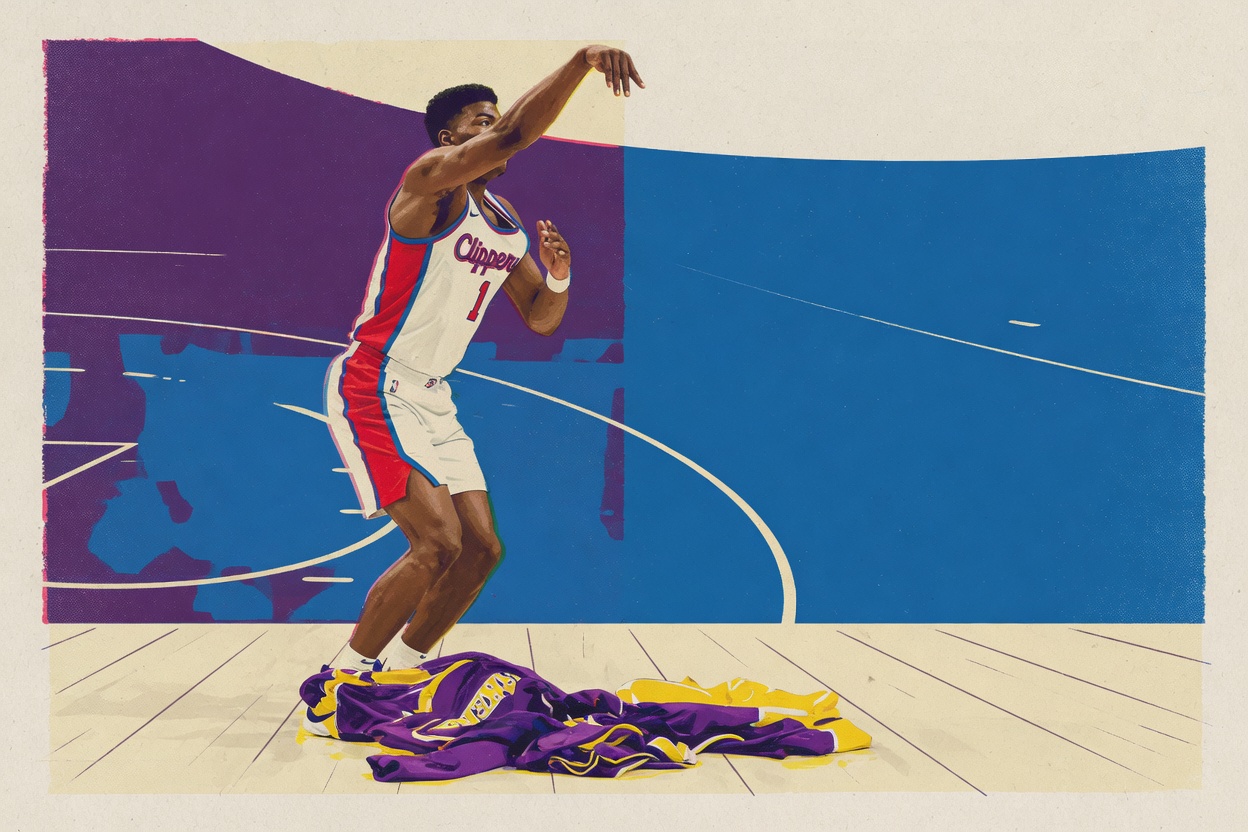
There's a version of the Rui Hachimura departure that reads as clean, sensible roster management, and the Lakers would love for you to accept that version. They spent their cap space on Walker Kessler, Collin Sexton, Quentin Grimes and Sandro Mamukelashvili, ran out of room, renounced their cap holds (Hachimura's included), and could no longer go over the cap to keep him. Every piece of that is true. It's also the kind of explanation a front office gives when it wants you to stop asking questions.
Keep asking them anyway.
Hachimura signed a two-year deal with the Clippers worth $28 million if the team option for 2027-28 is exercised, reported in the opening days of free agency in early July 2026. Jake Fischer characterized the money as roughly the full nontaxpayer midlevel exception, around $14.1 million a year. By one Spotrac-sourced projection, that's just over 8% of the Clippers' cap over the next two seasons. For a player expected to log real frontcourt minutes, that's a bargain, and it's the number the Lakers should be staring at.
Here's the thing about the player they let go. In the 2026 playoffs, Hachimura averaged 17.5 points on 54.9% from the field and 56.9% from three, first in three-point accuracy among everyone with at least five attempts per game that postseason. In his final regular season in purple and gold he shot 44.3% from deep, his best mark as a Laker. Across 228 games with the franchise he averaged 12.3 points on 51.6% shooting and 41.5% from three. That's a documented track record, not a hunch about upside: an above-average two-way forward who played his best basketball when the games got heaviest.
He did it without fuss, too. The year before his last, he started 57 of the 59 games he appeared in. Last season he was moved to sixth man and, by every account, never complained. Real production plus zero maintenance is exactly the archetype a contender is supposed to hoard, not release into the wild a few miles away.
The front office's defense leans on Mamukelashvili as a like-for-like swap. On paper the profiles rhyme: with Toronto in 2025-26 he averaged 11.2 points and 4.9 rebounds while shooting 52.3% from the field and 38.9% from three, but a spreadsheet twin isn't a playoff twin. Mamukelashvili doesn't carry Hachimura's postseason track record, his three-plus seasons of chemistry alongside the Lakers' stars, or the locker-room standing he built after arriving in the Kendrick Nunn trade back in 2022-23. The Lakers replaced a known quantity with a cheaper unknown and called it depth.
What actually stings is the sign-and-trade that wasn't. Per Shams Charania, the two sides explored one, but the Clippers offered only minimal cash while the Lakers wanted draft capital, and the deal died on that gap. Read that however you like, but the outcome is plain: rather than route Hachimura out for even a modest return, the Lakers let a rotation piece leave for nothing while their crosstown neighbor got him at a discount. Losing a good player is one thing. Losing him and the asset that could've come back is a planning failure, not a cap constraint.
Could they have kept him? I'll flag this as my own read, not fact. Hachimura had played out a three-year, $51 million extension and earned $18.2 million last season, and the market suggested he was looking north of $20 million a year. He ended up at roughly $14 million annually. Marc Stein reported he wanted the Clippers specifically, turning down suitors elsewhere to stay in Los Angeles, so this isn't airtight proof the Lakers could have won a bidding war. But the numbers point somewhere: the player took less than his asking price to stay in town, and the team that let him go never seemed to position itself as the one he'd stay with.
Hachimura, for his part, kept it warm. "Thank you Lakers Nation for the past 3 years," he wrote. "We had some great moments and I will always remember the memories we made together." Lawrence Frank, the Clippers' basketball operations president, was blunter about the value they think they got: "Rui is an elite 3-point shooter and an efficient mid-range scorer who uses his size to exploit mismatches."
The Lakers spent this offseason chasing size and defense, and there's logic in the Kessler bet. But depth isn't just about who you add. It's about who you refuse to lose cheaply, and to whom. On this one, the math added up and the plan didn't.