Picture a league so unsure of its own authority that it has to sue one of its best-known members to prove it still has any.
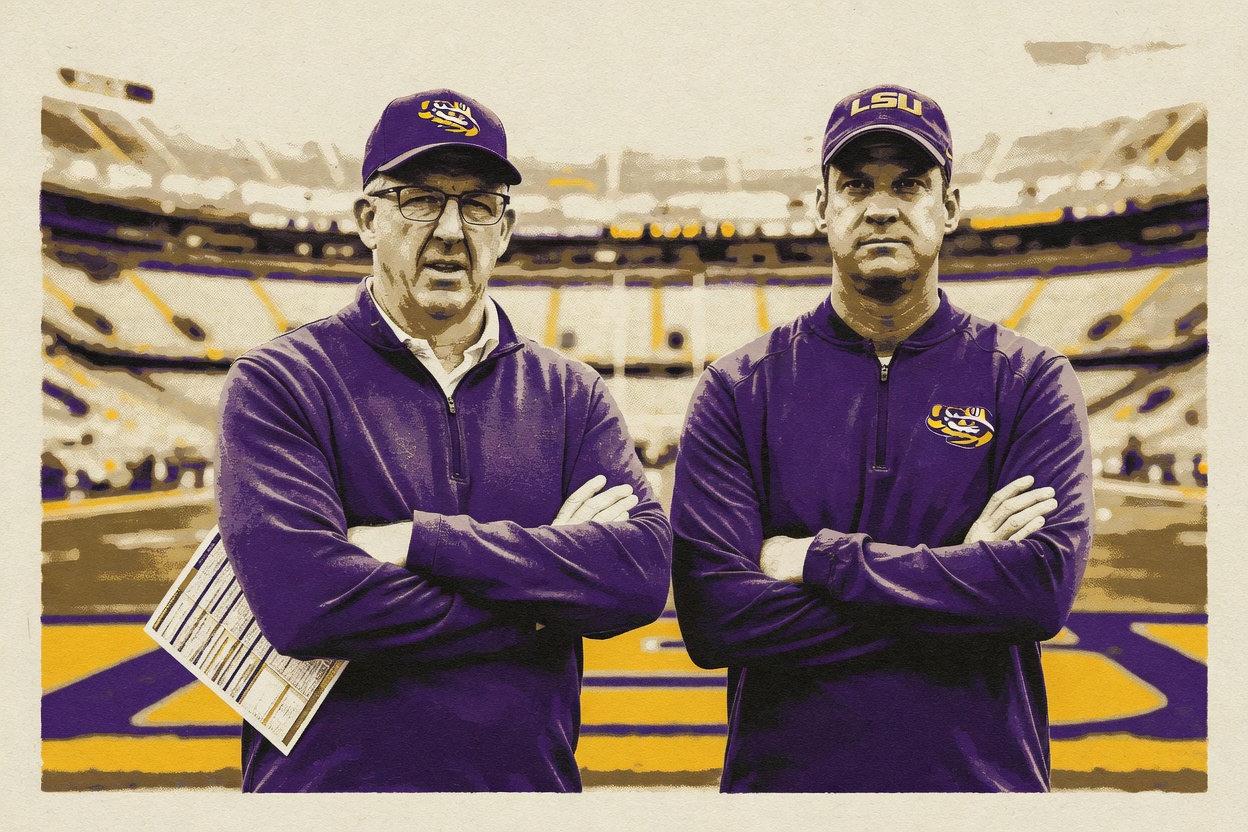
That's where the SEC landed on Thursday, September 3, when it filed a federal lawsuit against LSU, head coach Lane Kiffin, and university officials in the U.S. District Court for the Northern District of Alabama. The complaint names LSU, its Board of Supervisors, President Wade Rousse, athletic director Verge Ausberry, and Kiffin, with Rousse, Ausberry and Kiffin sued in their official capacities. The alleged offense: putting former NFL players on a college roster.
But here's the part worth sitting with. According to the SEC's own complaint, "Just days ago, on August 25, 2026, LSU (through Defendant Rousse) voted in favor of the SEC issuing a policy statement clarifying that its longstanding rules prohibit an SEC institution from having a professional athlete on its roster." On the penalty structure, the SEC passed the measure 15-0, with LSU abstaining. So the league is now suing a school over a rule that school helped bless roughly a week earlier.
There's no coherent governing body in that sequence. This is a conference that couldn't enforce its own rules through its own agreed-upon process, so it went looking for a judge in Alabama to do the enforcing for it.
The First Amendment gambit
The legal theory is where this tips from messy into surreal. The SEC is suing under the First Amendment. Its argument is that LSU is forcing the conference to "associate" its brand, media rights and games with conduct the SEC rejects, and that a member playing former pros undermines its ability "to express the values it has publicly espoused." The suit asks for temporary and permanent injunctions to let the league enforce its ban on former pros returning to the college game.
A multibillion-dollar athletic conference is casting itself as the little guy, its free expression supposedly trampled by one of its own universities, hardly the posture of an organization that governs, more like one that's run out of levers and is grabbing whatever's left.
The complaint's language doesn't soften it. "Despite the SEC's longstanding rules prohibiting professional athletes from returning to college athletics, Defendants saw this as an opportunity to be exploited," the league wrote, alleging "an orchestrated campaign to recruit professional athletes to join LSU's football roster for the 2026-27 season." The complaint claims LSU and Kiffin recruited players "who had signed NFL contracts with the Cleveland Browns, New Orleans Saints, and Tampa Bay Buccaneers."
Meanwhile, the case that actually mattered was in Baton Rouge
The best detail in all this: while the SEC was filing in Alabama, Commissioner Greg Sankey sat in a Baton Rouge courtroom that same Thursday, defending the conference's enforcement authority in a completely separate state-court proceeding. And it was that Louisiana case, not the federal one, that actually decided whether the players could suit up.
Louisiana district judge William Jorden granted a preliminary injunction Thursday allowing LSU to add tight end Dae'Quan Wright and defensive lineman Zxavian Harris after brief stints in the NFL. Both previously played for Kiffin at Ole Miss. Both were among 42 athletes across multiple sports granted an additional year of eligibility following the NCAA's pivot to a new 5-for-5 eligibility system. Wright's route is genuinely new: he signed with the Eagles as an undrafted free agent, was claimed off waivers by the Browns, then waived last week. Multiple outlets note it may be the first time a player on an NFL preseason roster has come back to play college football.
The timing bordered on comic. Jorden's ruling landed just hours before LSU had to submit its official 105-man roster to the SEC. The league's own lawsuit was barely off the printer, and a Louisiana judge had already cleared the players it was suing to stop.
One caveat, because this is still very much moving: that Louisiana ruling is a preliminary injunction, not a final decision. How many games Wright and Harris are ultimately eligible to play remains unsettled as the dual-track litigation moves through state and federal courts. LSU has three weeks to file its formal response in Birmingham federal court. Nobody should treat any of this as finished.
The bill for years of dodging comes due
Step back and the picture is bleak for anyone who wants college sports run like something other than a permanent lawsuit. The SEC issued a statement disagreeing with Jorden's ruling: "The conference and its member universities have the right to establish, through agreed-upon governance procedures, the rules under which they voluntarily compete and to expect those rules to be followed." It's a fine sentence. It also describes exactly the thing that just failed. The agreed-upon procedure produced a rule LSU voted for, and it still took two courtrooms in two states to sort out a single roster.
And the noise around it keeps building. Georgia's attorney general publicly urged the SEC to suspend or remove LSU if it rosters former pros. State attorneys general now have opinions on your two-deep. That's where we are.
My take: whatever you think of Kiffin loading up on ex-pros, and plenty of people hate it, the deeper story is that the SEC no longer has a working way to say no to its own members without hiring litigators. The penalties on the books look severe on paper: a six-game suspension for a head coach, a fine equal to 50% of the sport's annual budget, lost voting privileges. On paper. In practice, the enforcement happens in front of judges who never agreed to any of it.
College sports spent years winning fights to avoid clear rules and real structure. This is the invoice. A conference suing its own flagship, on a free-speech theory, over a rule that flagship helped pass, while the actual decision got made by a judge in Baton Rouge. If that reads like chaos, it's because the people in charge stopped being in charge a while ago, and they're only now finding out.