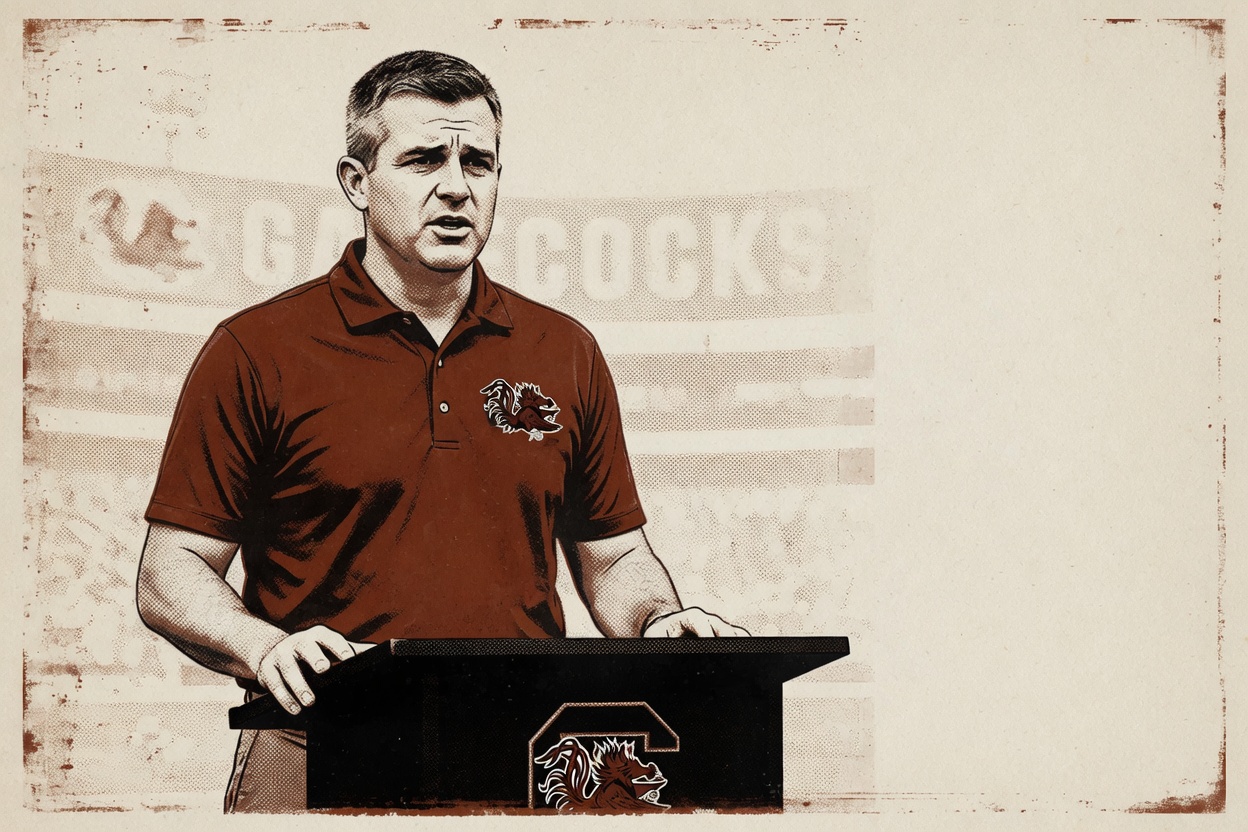
Here is the sentence that should stop South Carolina fans cold, and it has nothing to do with the SEC schedule: freshman tight end Caden Ramsey was clocked at 113 mph in a 60 mph zone in Moncks Corner early Monday, Sept. 7, and he's the third Gamecock football player arrested in 2026.
Let me lay out what we actually know here, because the details matter. According to the Moncks Corner Police Department report, an officer spotted two vehicles weaving through traffic on Highway 52 near Edelman Street shortly after midnight, clocked them at 113 mph, and hit his blue lights and siren. One car kept going; the second turned onto Cypress Gardens Road and stopped at a McDonald's. The report says the scene escalated, with people from the vehicles swarming the officer, who drew his service weapon. Ramsey, 19, was one of three people arrested. He was booked just after 4 a.m., charged with racing on a public road, and granted a personal recognizance bond.
This is a charge, not a conviction. His attorney, Seth Rose, said Ramsey "is a good young man and a dedicated student-athlete with a bright future" and that "this is a pending citation, not a finding of guilt," adding that Ramsey "was not under the influence and had no firearm." That last part is the defense's characterization, not an established police finding, and it deserves the same skepticism you'd give any lawyer speaking for his client. If convicted, the charge carries up to six months in jail, a fine exceeding $1,000, and possible loss of a license. Shane Beamer suspended him, and at his Tuesday press conference called the situation "extremely disappointing," noting Ramsey had just been named the Gamecocks' offensive scout team player of the week. "For the time being, he's suspended," Beamer said. His future is still under review.
So far, so ordinary. A talented kid did something reckless, the coach acted, the case grinds through the system. If this were the only incident, you'd shrug and move on.
It isn't the only incident. Go back to February: defensive tackle Davonte Miles was pulled over near Williams-Brice Stadium and charged with possession with intent to distribute marijuana after deputies said they found a gun and bags of marijuana in his car. Two days later, he was off the team. Then in June, running back Sam Williams-Dixon, an Ohio State transfer who'd come to Columbia in January and gone through spring practice, was arrested over a string of vehicle break-ins. Beamer confirmed he was gone, too. Now Ramsey, in September, suspended after a 113-mph street race.
Three players, three arrests, roughly seven months, one coaching staff. The charges aren't the same, a distribution case, a burglary-style case, a traffic stop, and treating them as identical would be lazy. But they don't need to be identical for the pattern to show. A program that keeps sending out the same kind of statement, that keeps holding the same kind of Tuesday press conference, has stopped being unlucky and become a program with a discipline problem.
Every college coach in America sells recruits and parents on the same promise: we build men here, we develop character, we hold your son accountable. Beamer said as much himself, that with Ramsey "we've had plenty of conversations about driving and not driving too fast and the recklessness of that." I believe him. Those conversations happened. That's exactly why the outcome is so damning: if the message is being delivered and the arrests keep coming anyway, it isn't landing.
There's a real counterargument here. In all three cases, South Carolina moved fast. Miles and Williams-Dixon were dismissed within days, Ramsey was suspended almost immediately. The athletics department said it takes "matters like this seriously." You could frame that as accountability working the way it's supposed to, a program that doesn't hide anything. Swift punishment beats the alternative, and plenty of schools have buried worse.
But cleaning up a mess fast isn't the same as preventing one. Discipline that only shows up after the arrest report is reactive by definition. The real measure is how many times in a year a program has to kick players off the team, not how efficiently it does it.
The timing makes it worse. Beamer is in his sixth season with a 33-30 record, coming off a 4-8 year in which the Gamecocks went 1-7 in SEC play. He's fighting for on-field credibility while carrying a stack of off-field failures, and the SEC schedule, which opens against Mississippi State on Sept. 19, won't wait for him to sort out the culture. South Carolina is 1-0 so far, with Towson up next. On the field, there's a season to save. Off it, there's a question the program has now had to answer three times, and "isolated incident" stopped being a credible answer somewhere around the second one.
Ramsey may well turn out to be a good kid who made a genuinely dumb decision, and I hope the case resolves in a way that lets him move on. But whether he's back or not, the larger problem doesn't ride on one freshman. It rides on the fact that South Carolina keeps producing these headlines. Fix the pattern, or keep giving these speeches.