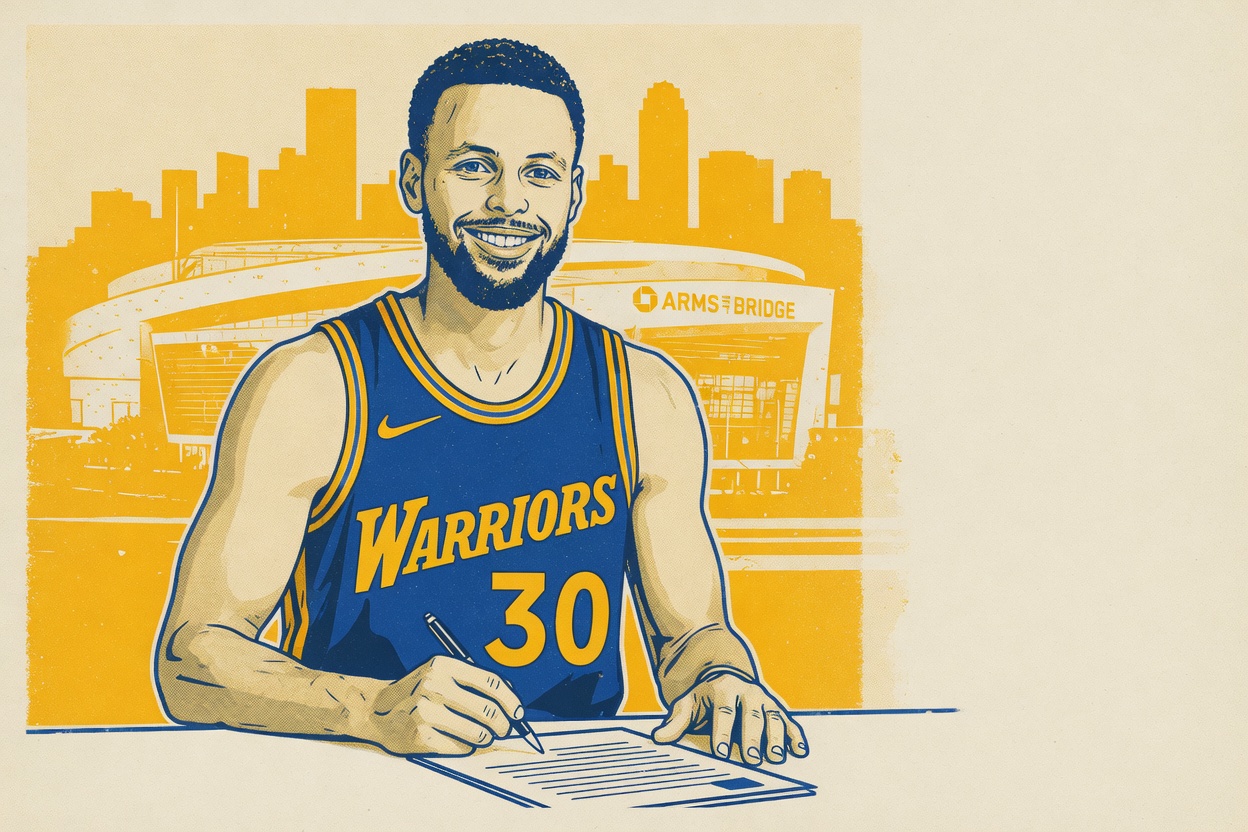
Stephen Curry took a pay cut. The mushy "loyalty" framing floating around the past day skips the only part that matters.
The deal is a two-year, $116 million extension with a player option for the 2028-29 season, keeping Curry with the only franchise he's ever known. He's 38. He became eligible on Aug. 29 for an extension worth up to two years and $136.7 million. He signed for roughly $20.7 million less than that. Nobody talked him out of the money. He looked at the max number and walked away from it on purpose.
This is a legend subsidizing his franchise, and the franchise happily accepting the check.
Look at what Golden State gets. Curry's salary drops from $62.6 million next season to $55.7 million in 2027-28, with a $60.2 million player option after that. The immediate payoff is around $10 million in extra projected cap space next summer, right as Jimmy Butler III and Draymond Green come off the books on expiring deals. Curry's discount is what lets the Warriors go shopping. By re-signing this way, he funded the roster around himself.
And who is he funding? The most valuable franchise in the NBA, valued north of $10 billion, the team that generates more revenue than anyone else in the league. This is an ownership group that could have paid the full freight and never felt it. Curry gave them a break they didn't need, and general manager Mike Dunleavy thanked him with a line about there having "never been a better face to a franchise in professional sports history, both on and off the court, than Stephen Curry with the Warriors." A lovely quote. Cheaper than $20 million.
What keeps me from screaming "they fleeced him" is that Curry isn't naive and this isn't new. He's been the entire reason the Warriors mattered for more than a decade, and he clearly values ending his career as a one-team player more than he values squeezing out the last dollar. There's a real structural first buried in here too: he'd never before signed an extension with a player option in his 17-year career. That option is the tell. He kept a door open to retire, decline, or chase a max later. He traded some money for control. Fine. It's his money and his career.
But the contract isn't fair market value. Fair market value was the $136.7 million he was allowed to sign for and chose not to. He subsidized a team that didn't need subsidizing, one coming off a 37-45 season that ended in the play-in.
The "everyone's doing it" crowd will point to the aging-star discount wave. Kawhi Leonard signed for two years and $115 million with the Raptors, a dollar figure Curry's new deal now sits a million above. LeBron James took a veteran minimum in Philadelphia, around $3.8 million for this coming season, the biggest superstar pay cut the league has ever seen. So yes, Curry is in company. But those comparisons undercut the romance. Curry's career on-court earnings are somewhere around $652 million as of this week, the most of any player. He of all people has earned the right to demand every last dollar and force the richest team in the sport to pay it. He didn't.
This is a hometown discount, chosen freely by the greatest player his franchise has ever had, pocketed gratefully by an ownership group that will keep printing money whether the team contends or not. Curry gets to be a Warrior for life. The Warriors get to keep him for life and pick up about $10 million in extra flexibility. Curry made the sacrifice here. The billionaires who own the team never felt it.