There's a version of the Phoenix Suns story where the owner learns his lesson. Mat Ishbia spent his way to a $152 million tax bill, watched it not work, then finally got out of the luxury tax in 2025-26 for the first time in four years after moving off the loaded contracts of Kevin Durant and Bradley Beal. The tidy ending writes itself: bank the flexibility, stay disciplined, build slowly.
Ishbia read that ending and torched it.
On Wednesday, the Suns agreed to a three-year, $73 million extension with Dillon Brooks that keeps him in Phoenix through 2029-30. It's the loud punctuation mark on an offseason built around one idea. Per ESPN, Ishbia made it a priority to re-enter the tax specifically to hold this roster together and add to it. He engineered an escape, looked around, and decided the door he'd just walked through was the wrong one.
The bet is on a feeling, not a star.
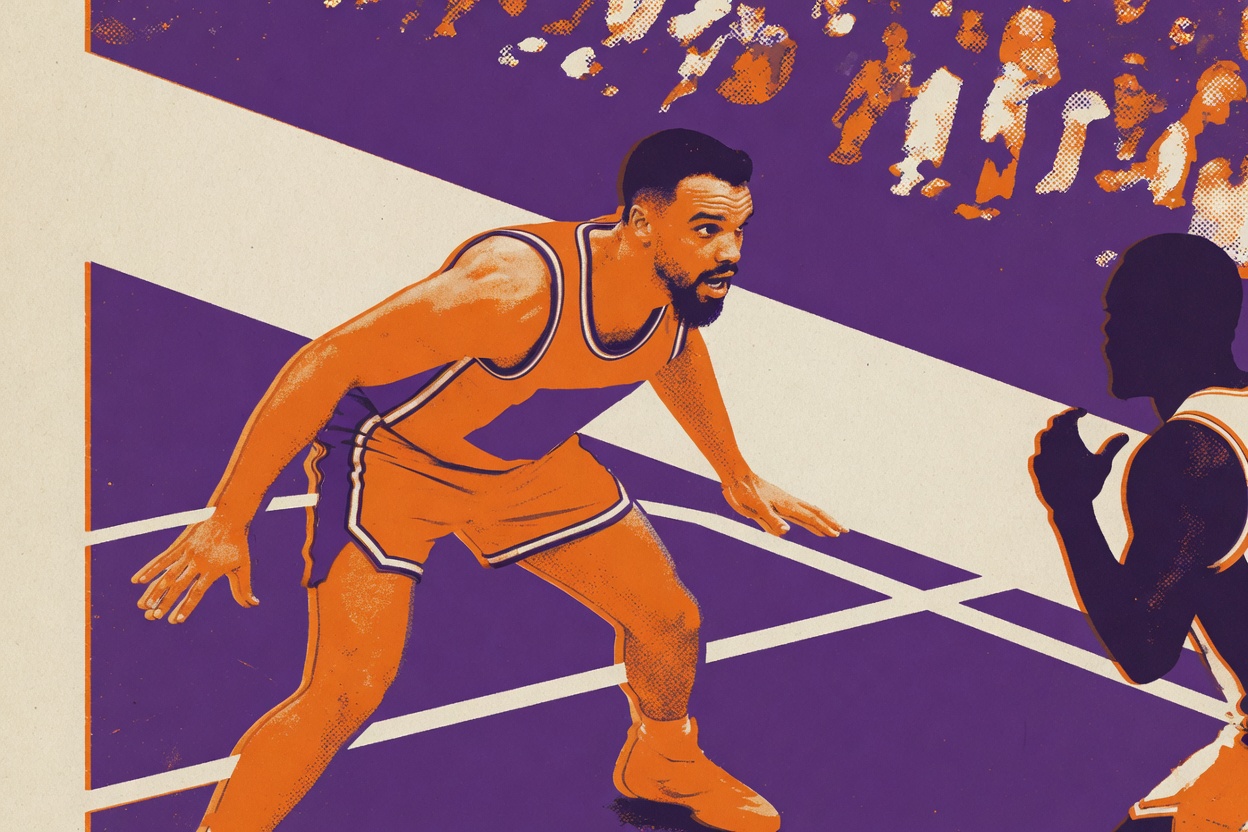
What's interesting is what Ishbia isn't doing. He's not trying to import a third star to stack next to Devin Booker. The Durant era was the star-hoarding experiment, and it ended with those contracts getting shipped out. This time the money is going toward continuity and identity. Brooks arrived last July as a piece of the seven-team Durant trade that sent Durant to Houston, and instead of treating him as a placeholder, Phoenix is building around what he does: annoy people, guard the other team's best perimeter player, make everyone around him a little meaner.
Brooks earned the check. He's coming off the best year of his nine-season career, averaging a career-high 20.2 points to go with 3.6 rebounds and 1.8 assists for a surprise 45-win playoff team, shooting better than 43% from the field. He did it despite missing real time, sitting out 18 games with a fractured left hand suffered in a February win over Orlando. He came back March 31 and was Phoenix's best player in the postseason, leading the team at 26 points a night and hitting 43.8% from three even as the Suns got swept 4-0 in the first round by Oklahoma City. A four-game exit doesn't scream "pay this man," but the tape of who actually showed up in those games did.
The value is real, at least by one accounting. Salary-cap analyst Brett Siegel reported the Suns could have offered Brooks up to four years and $125 million, an annual figure north of $31 million, while the actual deal lands closer to $24 million a year. Treat that as one analyst's math rather than gospel, but if it's in the neighborhood, Phoenix locked up its best playoff performer at a discount and kept him out of 2027 free agency in the process. Credit CEO Josh Bartelstein and GM Brian Gregory for getting it done before the market could set the price for them.
Ishbia told you this was coming
None of this should surprise anyone who was paying attention in January, when someone floated a Brooks-for-Austin-Reaves swap with the Lakers on X and Ishbia responded from his own account: "Don't bother calling... Suns aren't interested. Dillon's not going anywhere." Owners rarely tip their hand that plainly. Ishbia did, then backed it with the biggest bet available to him: paying a tax penalty to keep a guy most rival fan bases can't stand.
The extension split the room the moment it landed, one camp mocking the number and the other insisting he was Phoenix's most important player in the spring. Both camps are arguing about the same thing: whether toughness and edge are worth paying like a skill. Ishbia has cast his vote.
There's an on-court case underneath the noise, too. One analysis pegged Phoenix's jump from 27th in defensive rating in 2024-25 to ninth in 2025-26, with Brooks drawing the hardest perimeter matchups, including the theatrical, shove-and-stare battles with LeBron James and Shai Gilgeous-Alexander that made "Dillon the Villain" a brand. Defense travels in the playoffs. If a team's identity is set by its most combative player, Brooks is a reasonable guy to hand the keys to. The rest of the offseason fits the pattern: bringing back Collin Gillespie, Mark Williams and Jordan Goodwin on multiyear deals, trading Grayson Allen and Royce O'Neale to Charlotte for Miles Bridges, and adding Luke Kennard. Continuity, plus a little more grit.
The part that should keep Ishbia up at night
Here's where I get nervous on his behalf. Re-entering the tax after ducking it means Phoenix stares down the repeater penalty again, and the repeater is what turns aggressive spending into a spiral. Ishbia has never blinked at those bills before, so I don't expect him to start now. But the deeper problem isn't money. It's flexibility.
The Suns don't fully control their own first-round pick until a frozen 2032 selection, and to unfreeze it for a trade they need to stay out of the second apron for two of the next three seasons. Every dollar committed to this core makes that math harder. So the continuity bet carries a hidden cost: the more Ishbia doubles down on keeping the band together, the more he risks losing the draft capital that could fix things if the band doesn't play well. With the tax line living somewhere north of $200 million and the aprons stacked above it, there's very little room for error.
There's also the off-court asterisk. This extension arrives roughly five months after Brooks was arrested in Scottsdale on suspicion of DUI, taken in around 1 a.m. and released a couple of hours later. It doesn't undo the basketball logic, but it's a reminder that the villain persona and actual off-court trouble aren't always cleanly separable, and Phoenix is committing years to the whole package.
My read
I like the conviction more than I love the ceiling. Betting on continuity and identity instead of chasing another expensive star is a defensible reaction to how badly the star-stacking approach burned this franchise. A 4-0 sweep is a hard thing to build faith on, but Brooks was the reason those games were competitive at all, and paying your toughest, most reliable playoff performer below max rate isn't the crazy part of this plan.
The crazy part is doing it while the draft-pick clock is ticking and the apron rules are waiting to punish exactly this kind of spending. Ishbia is wagering that a group with a clear personality can outrun the accounting. If Brooks keeps guarding stars and hitting shots in April, it'll look visionary. If Phoenix bows out early again, the same owner who just escaped the tax will have talked himself right back into it for a team that couldn't get out of the first round. That's the bet. I'd have made a smaller version of it.