The frustrating thing about the Mark Williams news isn't that he got hurt. Big men get hurt. The frustrating thing is how predictable this particular flavor of bad luck was, and how little Phoenix did to guard against it.
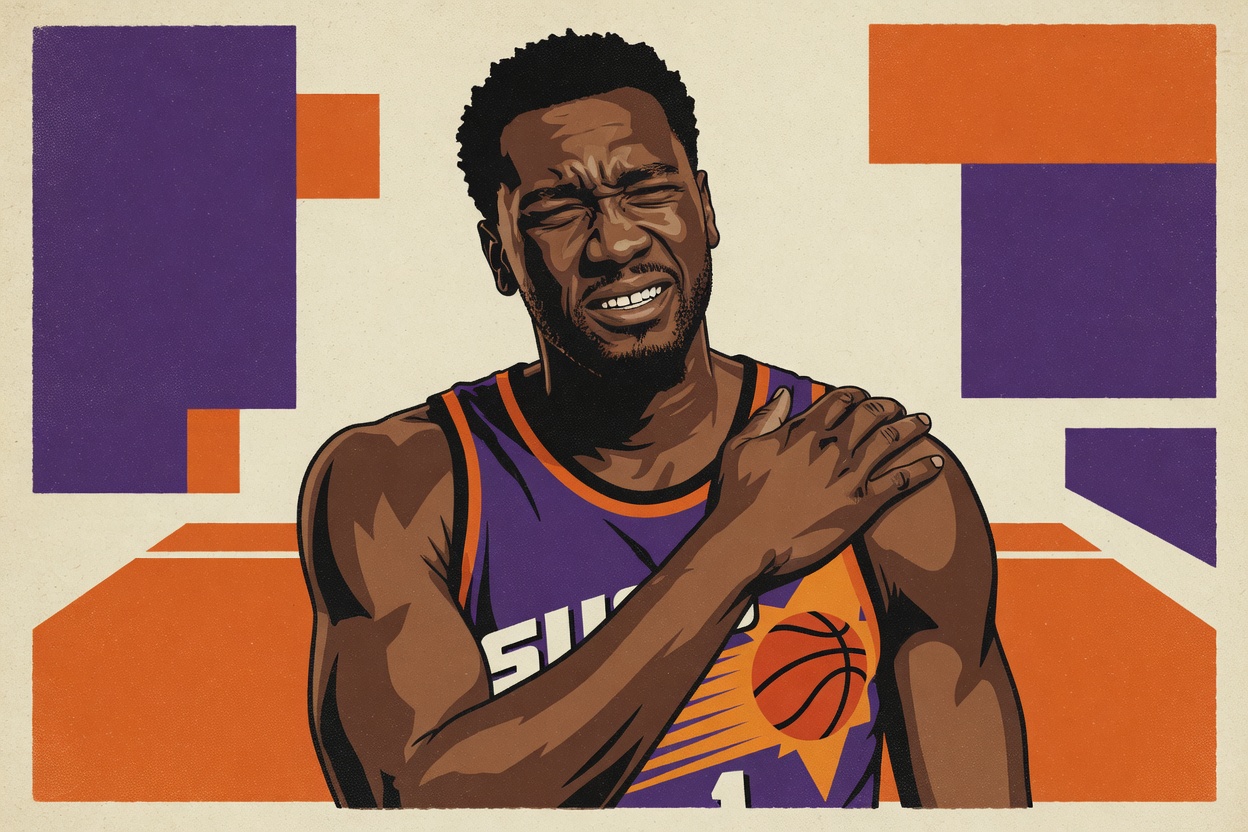
On Friday the Suns announced that Williams had surgery the day before to repair a torn labrum in his left shoulder, an injury that happened during an offseason workout. He's expected to miss several months, though the team's own statement was more cautious, saying the fifth-year center has no set timetable to return. Either way, Phoenix opens the season without the center it just paid to keep.
And it did pay. Williams, 24, signed a fully guaranteed three-year, $38 million deal that became official on July 7. Per Spotrac, all $38 million is guaranteed, an average of just over $12.6 million a year. In year one, his cap hit and his dead-cap figure are identical, right around $11.7 million. In plain terms: if Williams never plays a minute this season, the Suns eat the entire salary with no relief mechanism. They wrote a check with no stop-payment on it.
The file was right there
This is where the front office deserves the questions. Williams didn't arrive in Phoenix as a mystery. He came over in a 2025 draft-night deal from Charlotte, and even that trade had a prequel: the Hornets' first attempt to move him got rescinded at the trade deadline. His injury history is basically the headline of his career so far.
Start with the raw availability. Across his first three seasons he played only 85 games while missing 127. He lost the majority of the 2023-24 season to a lower back injury. By November 2024, his layoff had stretched past 330 days, at the time the longest active stretch on the shelf in the league. He also dealt with ankle trouble as a rookie and a torn thumb ligament that needed surgery.
Then there's the single most damning entry, the one every skeptic should have flagged: in February 2025, a trade that would have sent Williams from Charlotte to the Lakers fell apart. It was contingent on both Williams and Dalton Knecht passing physicals, and the Lakers backed out over concerns about his long-term health after their exam. Another team's medical staff looked at him, got nervous, and killed the deal. That happened roughly a year and a half before Phoenix guaranteed him three years.
Even the season Phoenix is presumably paying for, the "healthy" one, came with an asterisk. Williams appeared in a career-high 60 games and put up 11.7 points and 8.0 rebounds in 23.6 minutes on efficient shooting, and he was a real part of a group that beat preseason expectations and grabbed a playoff spot. But a foot problem, described as a stress reaction in his left foot, cost him roughly ten games and nearly all of March, and he missed Phoenix's entire first-round series, a sweep at the hands of Oklahoma City. His best year still topped out at 60 games.
Back, foot, ankle, thumb, and now a shoulder. This is a pattern, not a fluke.
What a smarter deal looks like
None of this means Williams shouldn't have been re-signed at all. When he plays he's a legitimately useful center, and $12.6 million a year for that production is a fair number in a vacuum. The problem is the structure, not the price.
Medically flagged players usually get medically flagged contracts. Non-guaranteed years, injury-triggered team options, games-played bonuses that convert money from guaranteed to earned, offsets that reward availability: these tools exist precisely for a profile like this one. Phoenix, staring at a résumé that already spooked another team's doctors, chose the cleanest, most player-friendly version available: everything guaranteed, dead cap equal to the cap hit, no exits. That's the choice that looks worst this morning.
The counter-argument, taken seriously
There's a real defense floating around, and it's worth engaging rather than waving off. Some Suns writers have argued the guarantee was calculated optionality: the money is modest enough that if Williams plays well you've got a quality starter on a team that doesn't need to run everything through its center, and if he struggles or gets hurt you're holding a tradable contract. One piece written before the ink dried argued the durability risk "seems to be priced into the contract, as it should be."
Maybe. But "tradable" assumes he's playing and other teams believe in the body, and we've already watched a trade collapse over exactly that. And "priced in" is doing a lot of work for a deal that carries full dead cap from day one. A contract that's genuinely priced for injury risk usually has structural protection to match. This one has a fair salary attached to no safety net, which is a different thing.
The fallout is real, if unsettled
Credit where it's due: Phoenix isn't naked at the position. Oso Ighodaro has system reps, including a stretch of playing time late last season when Williams went down. And Khaman Maluach, entering his second year after a small rookie sample of 46 games, was genuinely eye-catching in the 2026 Summer League, where across four games he averaged 19.5 points and a league-high 12.8 rebounds. Local beat writers have spent the past day debating which of the two should start. That's a real question now, not a settled one.
So the season isn't sunk. But that depth is almost the point. If the room was deep enough to survive Williams missing months, it was deep enough to justify demanding protection on his deal. Phoenix took on the downside risk of a big guarantee even though the roster reality made that unnecessary. That's the gamble, and right now it isn't paying.