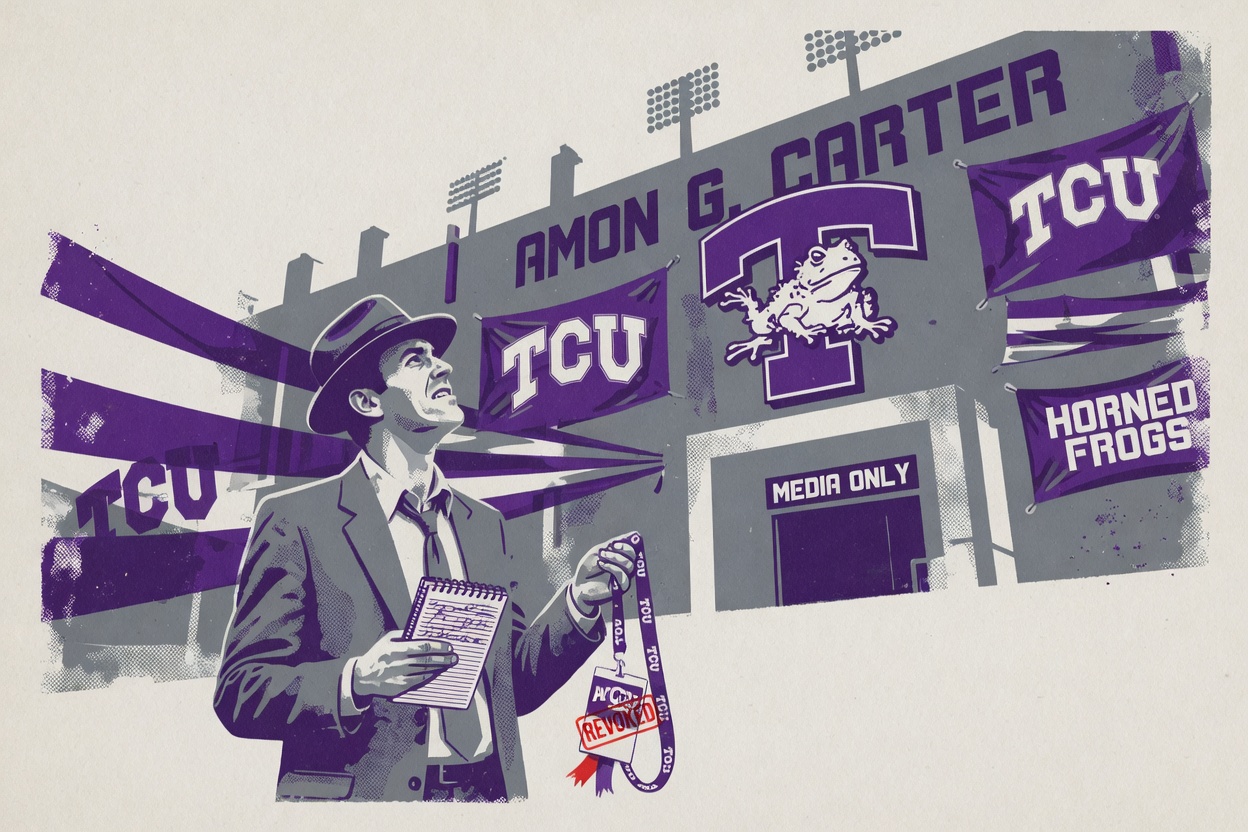
There's a name carved into TCU's football home that the school would rather you not think about this week. Amon G. Carter Stadium, dedicated in 1951, honors the publisher of the Fort Worth Star-Telegram, a man who bankrolled and campaigned for the building TCU still plays in. The paper he ran is the only outlet that covers TCU athletics full-time. And that same paper's beat writer just had his credential pulled for doing the job the stadium's namesake would have expected him to do.
Steven Johnson had his credential pulled on Sunday, days after the Star-Telegram reported on a locker-room altercation that ended with safety Jacob Fields dismissed from the program for what TCU called a violation of team rules. Johnson was set to travel to Dublin for the season opener against Bill Belichick's North Carolina team, part of the Aer Lingus College Football Classic. He's going anyway, minus a seat in the press box. As of this writing, the game hasn't been played and the dispute isn't resolved.
The stated reason doesn't survive the timeline
Here's TCU's version, from athletic director Mike Buddie's statement on Tuesday: "Our primary focus is the health and well-being of our student-athlete. Unfortunately, an unnamed source without first-hand knowledge of the incident provided inaccurate information cited in initial reporting by the Fort Worth Star-Telegram, which we strongly disputed. The inclusion of the misinformation advanced a narrative that endangered a student-athlete and resulted in threats to him and his family."
Player safety is serious, and threats against anyone are indefensible. But look at what the Star-Telegram actually published. Its August 18 report on Fields's dismissal did not name the receiver involved. The paper only named Dozie Ezukanma after Ezukanma himself came forward in a since-deleted social-media video roughly three days later and described being struck. The most graphic claims that TCU seems to object to, that the player was knocked unconscious and kicked in the head afterward, came from an unidentified adult man in that same video who referred to Ezukanma as his son. The Star-Telegram couldn't verify the man's identity, and by every account those allegations weren't the paper's own reporting.
Follow the timeline. The player revealed his own identity. The inflammatory details came from a self-published video the paper didn't originate. And the underlying record wasn't invented by a reporter: TCU's own general manager, Ryan Dorchester, contacted campus police, and the school's crime and fire log listed an aggravated assault in the locker room. Johnson reported that log. You can dispute a source's account. Reporting the existence of a police log entry isn't the same as manufacturing a narrative.
"Until additional conversation" is its own tell
Buddie's statement says the credential is withheld "until additional conversation can be held between athletics and the sports reporting team." TCU hasn't publicly spelled out what the Star-Telegram must do to get the credential back. That vagueness is the part that should bother anyone who cares about how programs and the press coexist. A school that leaves the terms of reinstatement blank is telling a newsroom that access is now contingent on TCU's comfort with the coverage. That's leverage dressed up as concern.
The leverage reached further than a home game in Fort Worth. An Aer Lingus College Football Classic spokesperson confirmed that TCU, as the designated home team, controls the U.S. media credentials for a neutral-site game played in another country. So a Texas athletic department reached across the Atlantic to keep a Texas reporter out of a press box in Ireland.
This isn't a fringe voice getting swatted
Johnson is an award-winning reporter who came to the Star-Telegram after bylines in Memphis, Rochester and Fulton, Missouri, and he entered his fifth season on the TCU beat. By all accounts, he's covered this program day in and day out with a steady hand. The Football Writers Association of America didn't hedge: its president wrote that he "strongly disagree(s) with TCU's decision" and that Johnson "has covered TCU with class for years and his credential to cover the game in Ireland should be reinstated immediately."
That reaction is the right one, and TCU has the causation backwards. If threats were made against a player and his family, the response should point at the people making the threats, not at the reporter who declined to name a player until the player named himself. Punishing accurate, uncomfortable reporting doesn't make a locker room safer. It just makes the next uncomfortable story harder to tell.
There's a real dispute underneath all of this, and it's worth laying out plainly: a person close to Fields has said he "didn't face bullying or mistreatment" and that the tension came from "competitive football and some questionable plays in practice," which conflicts with earlier reporting of Fields feeling targeted in fall camp. That fog is exactly why you want a full-time beat reporter in the building, not exiled from it.
The most fitting detail is the one TCU can't relocate. The building is named for a Star-Telegram publisher who believed enough in this program to help pay for its stadium. Seventy-five years later, the school is keeping his paper's only full-time TCU writer outside the ropes for reporting a police log. If TCU wants that to look like anything other than retaliation, the fix is simple: give Steven Johnson his credential back.