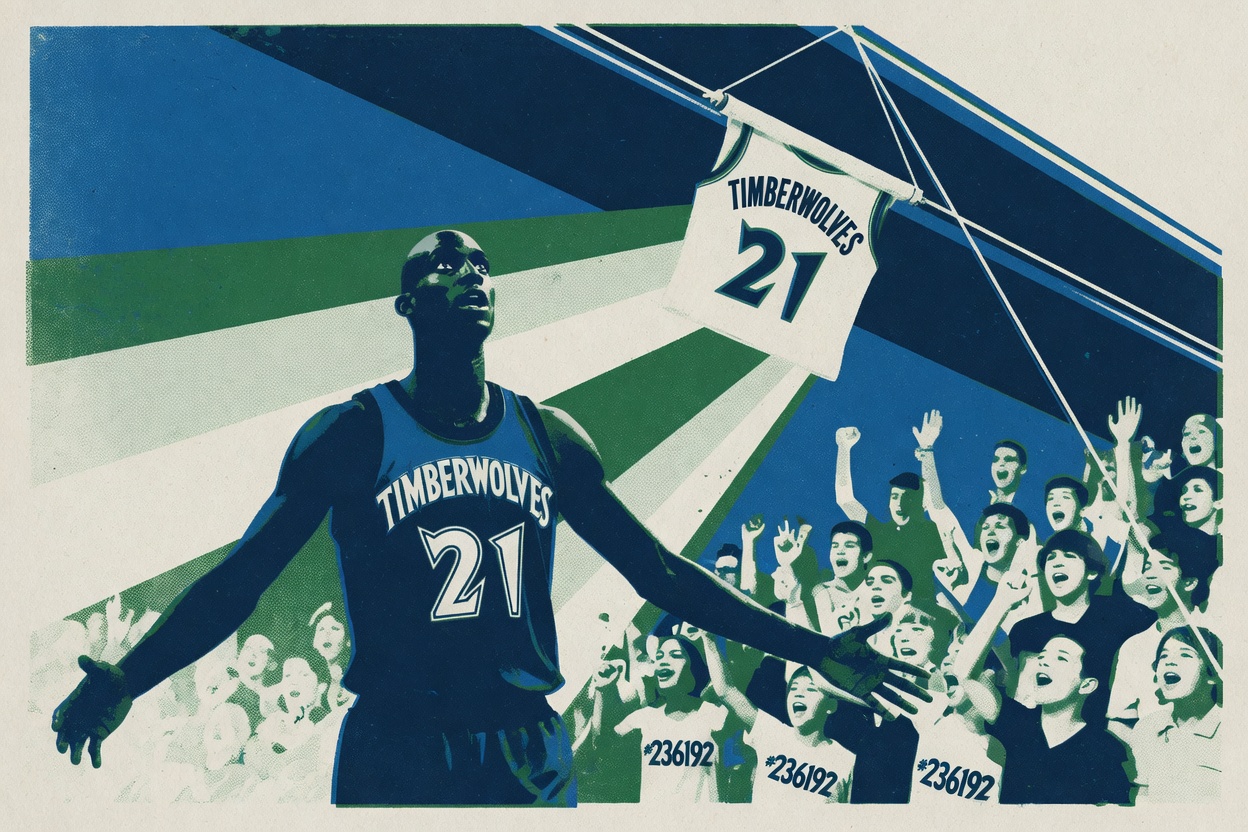
On Aug. 14, 2026, the Timberwolves announced they'll retire Kevin Garnett's No. 21, with the banner going up at Target Center on Feb. 28, 2027, after a game against the Boston Celtics. The opponent is a wink at history, since Garnett won his only championship in Boston. Everything about the plan is thoughtful: a season of "KG Theme Nights," commemorative giveaways, a night for the 2003-04 MVP season, a night for that scorer's-table run to the Western Conference Finals. It reads like a franchise that finally understands what it has.
Which is the part worth sitting with, because for the better part of a decade, the franchise acted like it didn't.
Start with the resume, since it settles any argument about whether this honor is earned. Garnett is the Timberwolves' all-time leader in points, rebounds, assists, steals and blocks. He's the only player in NBA history to lead a franchise in all five of those categories. He's the only MVP in team history, taking the award in 2003-04. He led Minnesota to eight straight playoff appearances between 1996-97 and 2003-04, and that last season produced the only playoff series win in franchise history until the 2024 run to the West finals. Drafted fifth overall in 1995, the first prep-to-pro player since 1975, he became the face of the whole operation and stayed that for fourteen seasons. He'll be just the second player in team history to have his number retired, after Malik Sealy's No. 2 was hung following his death in 2000.
So how does a player like that go from franchise cornerstone to persona non grata? Slowly, and pettily.
The relationship soured when Minnesota traded Garnett to Boston in 2007. It curdled after his 2016 retirement, when, by his own account, he believed he had a spoken agreement with then-owner Glen Taylor to take on an ownership stake and a role running the franchise. Garnett has said Taylor reneged. That's Garnett's version of events, not something Taylor has conceded, and it's worth keeping the distinction clean. What isn't in dispute is what came next. Garnett joined a group that tried to buy the team, that bid collapsed in 2021, and he vented on Instagram: "Sooo, just got the news that this process in trying to acquire the TWOLVES IS OVER for me n my group. Thx Glen for being yourself n what I Kno you to be!!"
The fallout was total. Garnett didn't set foot in Target Center from 2018 onward, and multiple reports describe him as having refused to let the team retire his jersey while Taylor owned it. Think about how strange that is. The greatest player in franchise history said no to being celebrated by that franchise because of a dispute with the man signing the checks. A jersey retirement is supposed to be the one thing everybody agrees on. Taylor couldn't get his own best player to agree to be honored.
I want to be careful here, because the easy version of this column overstates things. Taylor has not publicly admitted fault. The one on-record comment attributed to him about Garnett's return is mild: "I always thought he should be there." That's not a mea culpa, and I'm not going to invent one. It's also worth separating two storylines that happened to resolve around the same time. The years-long legal fight between Taylor and the incoming owners was about payment deadlines and contract language, not about Garnett. An arbitration panel ruled in February 2025 that Taylor had to cede control to Marc Lore and Alex Rodriguez in the disputed final phase of the $1.5 billion sale, and Taylor dropped his challenge that April. Different fight, different substance.
But a pattern is still a pattern. Under the old regime, one of the most valuable relationships a franchise can have, its bond with the Hall of Famer who defined it, sat broken for years, and nobody in charge fixed it. Under the new one, it got fixed almost immediately.
That's the case for Lore and Rodriguez, and it's a real one. After taking full control in 2025, they made mending things with Garnett an early priority. In December 2025 he agreed to return as a team ambassador. Then came the moment that showed the tone had changed: on April 12, 2026, Garnett walked back into Target Center for the first time in eight years, escorted with his two daughters to courtside seats by Rodriguez and Lore themselves, to a standing ovation and a video tribute. You don't stage that image by accident. The new owners walked him back through the door the previous ownership let close.
Garnett framed it forward-looking in the team's release: "Minnesota is home. That's never changed. This is where it all started for me... But I don't see this as the end — I see it as a new beginning."
I'd stop short of canonizing the new owners. Reconciling with a beloved legend is also good business, and the season-long celebration is, among other things, a marketing plan. But good business and good stewardship aren't opposites here. Bringing your greatest player home is the obvious move. It's so obvious that the striking thing is how long it took, and how much of that delay traces back to a grudge that never needed to last this long.
Come Feb. 28, 2027, No. 21 goes into the rafters next to the Celtics number Boston retired back in March 2022, and Garnett will have his jersey hanging in both buildings he defined. It's the right ending. It just should have happened years ago. The reason it didn't is simple: legends don't stay estranged on their own. Someone has to choose to fix it.