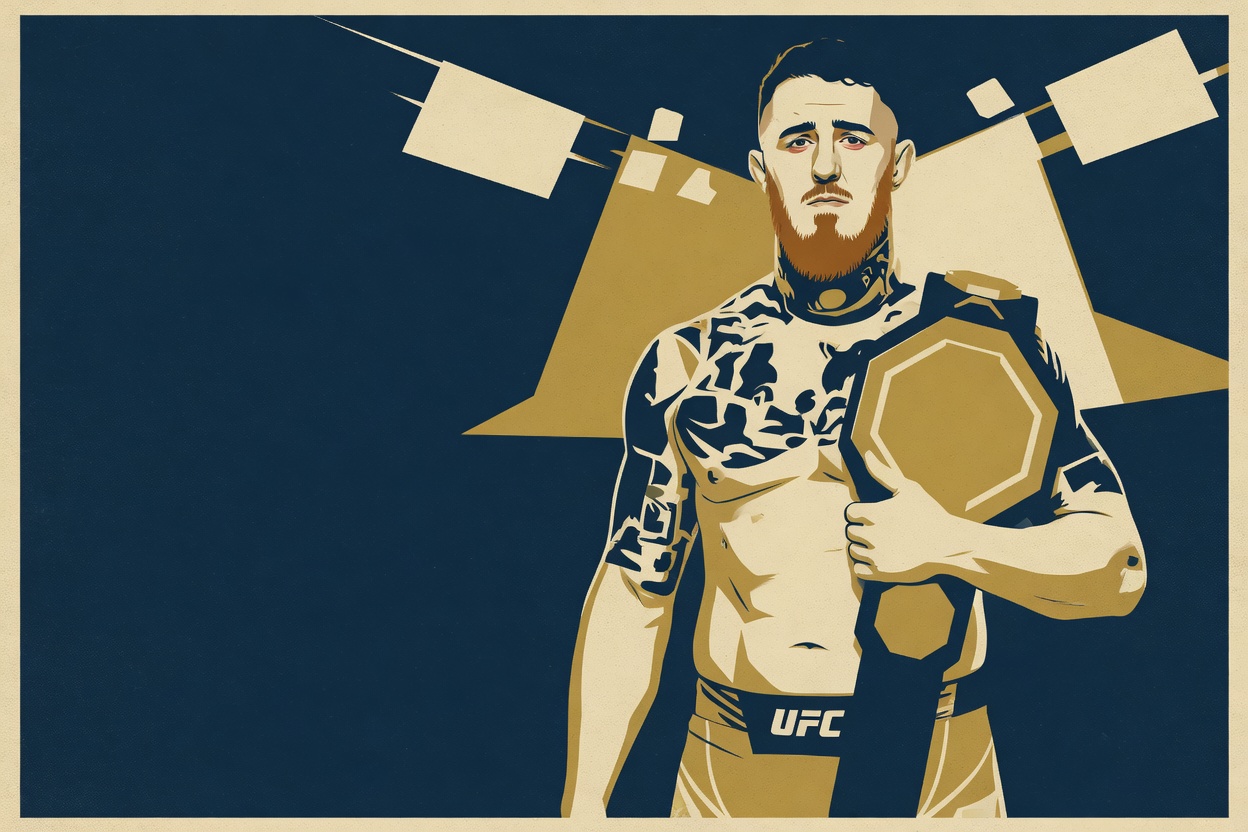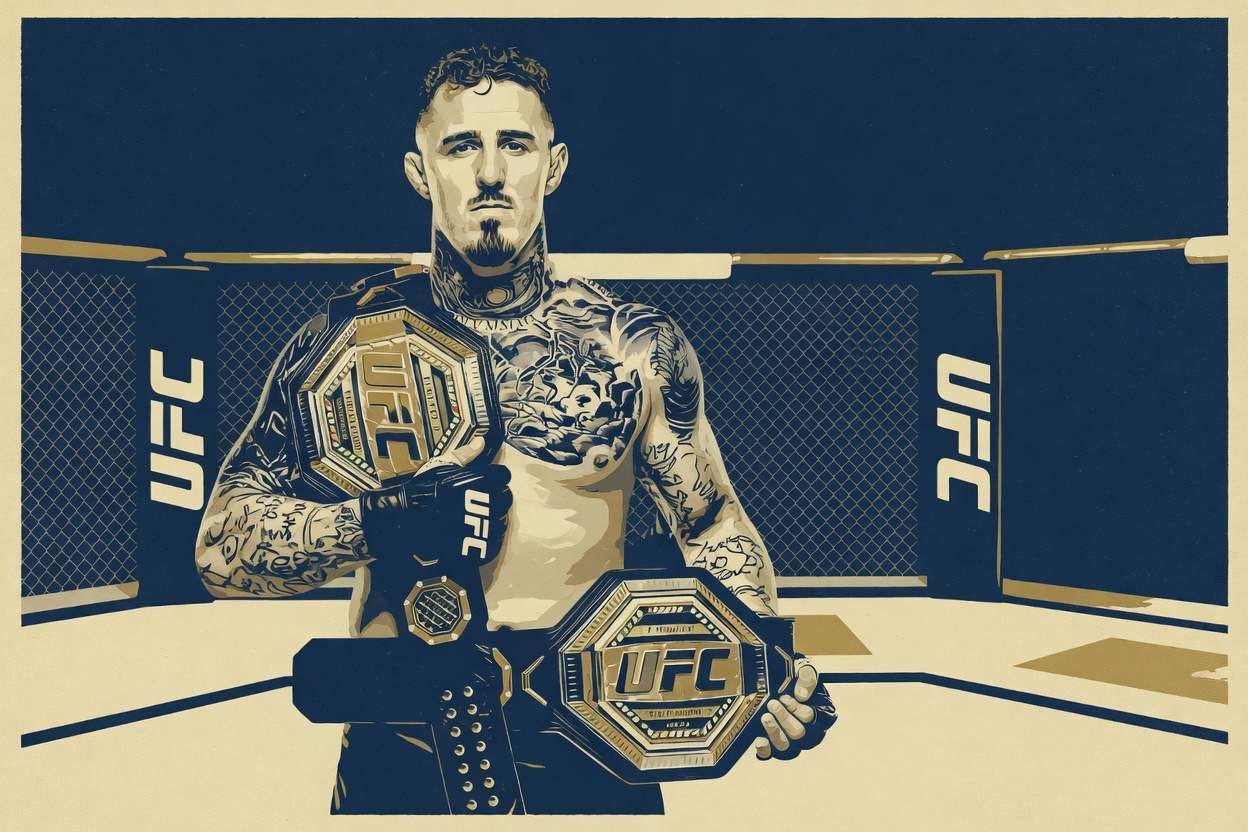
There is a version of this story where Tom Aspinall is a champion who did everything right and still lost his belt to a calendar. There is another version, the one the UFC would prefer, where a decent boss gently helped an injured fighter make a sensible call. Both are partly true, and what matters underneath them is timing.
On Saturday, September 12, at the post-fight press conference after the Ryan Garcia-Conor Benn Zuffa Boxing card in Las Vegas, Dana White was asked whether the UFC would handle Aspinall's long absence the way it had just handled Valentina Shevchenko. His answer: "We'll definitely be talking about that (Aspinall vacating). It's one of those, like, Valentina doesn't want to tie up the division. And I'm assuming Tom feels the same way. I don't know personally where he is healthwise with everything, but we should clear that up soon."
Two days later, on Monday, September 14, Aspinall posted a statement on Instagram and vacated the heavyweight title himself.
He wasn't stripped. That's the whole trick.
The order here is the point. White didn't announce a stripping, he floated one. He put the word "vacating" in the air, attached an assumption about what Aspinall "feels," and let it hang in front of the entire MMA press. Then, before the UFC had to formally do anything, Aspinall did it for them and framed it as his own call.
That's a fighter reading the room correctly, not being generous. Once the CEO says out loud that the promotion will "definitely be talking about" your belt, the outcome is already decided. The only thing left up to you is whether you get to narrate it or whether it gets narrated at you. Aspinall chose to narrate.
And he narrated well. "Anything you read in the media is simply noise. People are creating their own narratives," he wrote. "This is the truth: Ongoing complications with my eyes mean I cannot get medically cleared to fight right now. I've had multiple surgeries, accidents and infections, and done everything possible to get back to competing." He was careful to say this is not retirement: "Stepping away from the title is not stepping away from the sport or the dream."
Here's what makes it worse: Aspinall didn't sit out because he wanted to tie up the division, which is exactly what White's framing implied. He had a fight booked. The plan, according to his own statement and Ariel Helwani's reporting, was a rematch with Ciryl Gane at UFC 334 this November. "I had previously agreed to a fight date and was back sparring, feeling great and ready to compete when an accident caused further damage to my right eye," Aspinall wrote. Helwani has reported that doctors have told him to come back in January, to rest, not to get hit or scraped, and that a failure to heal could mean a fourth surgery on his right eye.
This is a man who had four surgeries this year, went back to practice in late June after Gane called him out at UFC White House, and was in the gym trying to make a November date. He described the ordeal in language that can't be printed in full. The injury is a rare condition, diagnosed as bilateral traumatic Brown's syndrome, dating back to when he was poked in both eyes in the no-contest with Gane at UFC 321 last October, nearly eleven months before he vacated. None of that reads like a champion who wanted to sit on a belt.
The double standard is right there in recent history
If you want to know how much the public framing depends on who's wearing the belt, look at Jon Jones. For roughly two years the UFC refused to strip an inactive Jones while a superfight with Aspinall was built and rebuilt and never delivered. Jones defended the heavyweight title once between March 2023 and June 2025, then retired late one Friday rather than take the fight. That's a far longer stretch of inactivity than Aspinall's, and it was met with none of the "we'll be talking about stripping him" energy that White aimed at Aspinall inside of a year.
Aspinall knows this better than anyone, and he said so, slyly, in his own goodbye: "I know what it's like to have your career put on hold, and I want the other fighters to have the opportunity to compete for the title." He spent the Jones era as the man being kept waiting. Now he's the man handing the belt back so the next fighter doesn't have to wait on him. The symmetry is almost too neat, except the treatment he got was the opposite of what Jones got, and both men were, technically, inactive champions.
Bloody Elbow's reporting from the same week notes that Aspinall's camp had been saying for months that his return timeline was, in his words, a decision for the UFC and its medical process, not a matter of the champion's willingness to give up gold. White's public version reversed that: in his telling, Aspinall simply "wouldn't want to hold up the division." The champion's own prior comments say the ball was in the UFC's court. When those two stories collide, the promotion's version gets a microphone at a press conference. The fighter's version gets posted to Instagram after the damage is done.
What a champion actually controls
Strip away the sympathy, the eye surgery, the Jones parallels, and you're left with a fairly cold lesson about power in this sport. A champion controls his training, his mouth, and the timing of his own announcement. He does not control the belt. The moment a promotion decides publicly that a title needs to "get sorted," the title is functionally gone. Aspinall's only real move was to get out in front of it and keep his dignity, which he did.
The Shevchenko comparison White reached for actually proves the point rather than softening it. Shevchenko vacated the women's flyweight title during the UFC Paris broadcast on September 6 after her camp disclosed shoulder and back ligament damage, and the UFC immediately booked Natalia Silva against Wang Cong for the undisputed flyweight belt at UFC 332. The machine does not slow down for an injured champion. It reroutes. Aspinall watched exactly that happen a week earlier and understood he was next in line to be rerouted.
What happens to the heavyweight division now isn't settled. The near-universal expectation as of this writing is that interim champion Ciryl Gane gets elevated to undisputed, though the UFC had not formally announced that at the time of Aspinall's statement. Gane's reaction has been cold, a curt two-word response, and Bloody Elbow summed up his mood as not feeling sorry for Aspinall. Rising contender Josh Hokit is already lobbying for a shot, promising to be "the most active champ in the company." This is also the third heavyweight title in a few years to be either stripped away or handed back, after Francis Ngannou and Jones. A division that can't keep a belt on a body for long isn't exactly a place that inspires confidence in how it treats the men who hold it.
There's a business subplot lurking too. Aspinall's manager Eddie Hearn has suggested the champion is underpaid and floated questions about whether he fights again on his current deal, which is Hearn's characterization and separate from the medical facts. Keep it separate, but don't ignore it: it colors why a fighter might want to control his own exit rather than let the promotion write it for him.
Aspinall made the smart, self-respecting move available to a man with almost no leverage. He gave the belt back on Monday so nobody could announce on Tuesday that they were taking it. He spent two years watching Jon Jones and learned exactly how these stories get told, and decided that this time he'd hold the pen. In this sport, sometimes the pen is all you get.