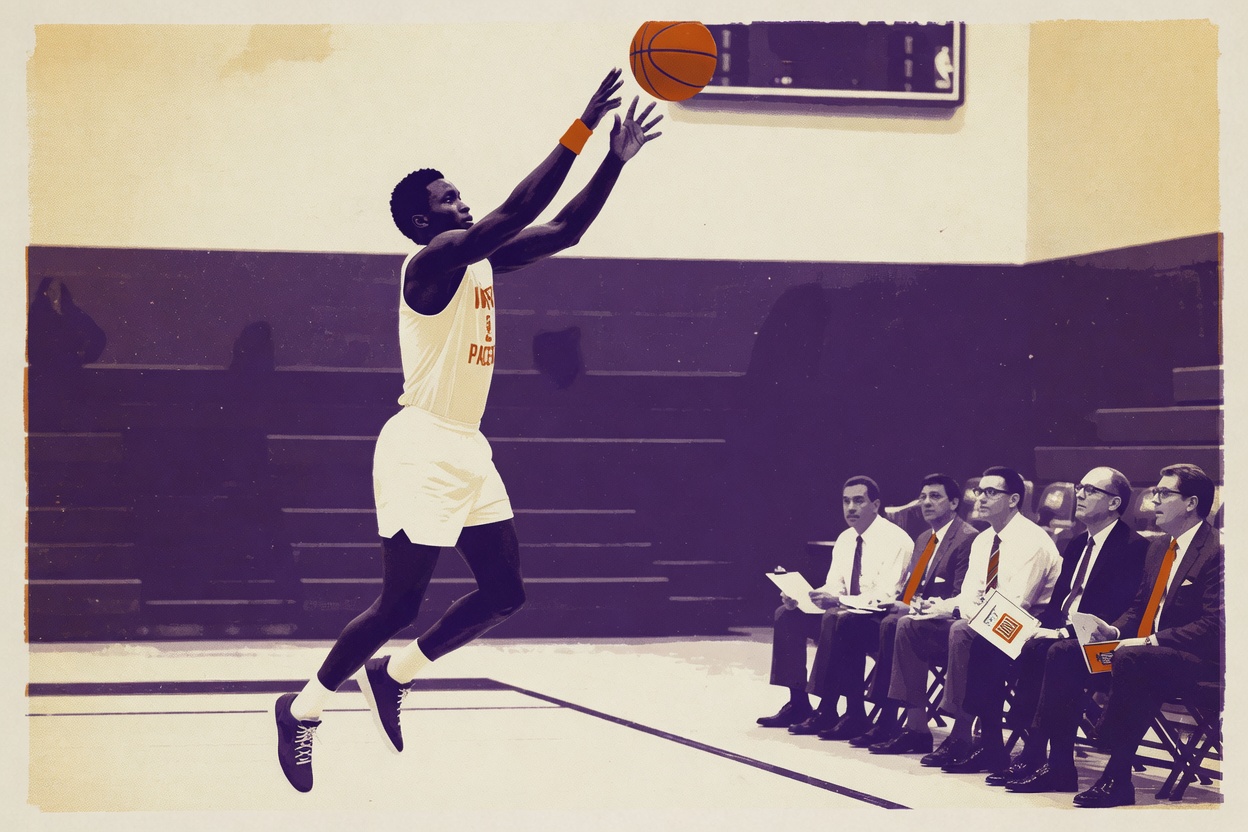
Victor Oladipo shouldn't have needed to write an open letter to NBA general managers.
A player with his resume shouldn't have to ask publicly, in the Players' Tribune, for someone to just call him. This is a guy who knows the league quietly moved on and is trying to shout his way back into a conversation he got dropped from.
And the league moved on fast, which is worth sitting with.
Go back to 2017-18. Oladipo averaged 23.1 points and 4.3 assists for the Pacers, won Most Improved Player, made the All-Star team, made an All-NBA team, made an All-Defensive team. That wasn't just a nice season, it was a genuine two-way star, the kind of player franchises build around. He'd been the No. 2 overall pick in the 2013 draft, and for one full year he looked like he'd justify every bit of it.
Then his body started betraying him. He ruptured the quadriceps tendon in his right knee in 2019 and hasn't played more than 42 games in a season since. In April 2023 he tore his left patellar tendon with the Heat. He hasn't appeared in an NBA game in three seasons. He's 34 now.
That's the arc: All-NBA to open letter, in the span of a knee, then another knee.
My argument is simple. The silence around Oladipo says more about how the league treats damaged goods than about what he can still do. A team willing to spend a minimum roster spot on a low-risk, high-character reclamation project is probably getting a better deal than the quiet suggests.
Start with the receipts, not the sentiment. He put in real work last season, appearing in 26 G League games with the Wisconsin Herd and averaging 13.5 points, 4.6 rebounds and 3.8 assists. Nobody with his history plays a full G League slate for fun. That's a 34-year-old former All-Star riding buses to prove the knee holds up. His shooting numbers down there were middling, and a guard auditioning for a job needs the efficiency to match. But the counting stats hold, and the tape exists. He also hosted a private pro day for front office personnel during Summer League in Las Vegas this July, specifically to answer the health questions, and reportedly broke down in tears afterward.
Read the letter and you understand why. "I believe my body is finally right," he wrote. "I believe I still have GREAT (and more importantly WINNING) basketball in front of me. I believe I can be a valuable contributor to an NBA locker room. And what I'm asking for right now is an opportunity to prove it." He frames the whole thing around his young daughter, Nomi, writing that "it's this version, right now that I want Nomi to see."
You can be moved by that and still treat it as a cold basketball decision, because it is one. A minimum deal for a former All-NBA wing who defends, has been through the fire, and would run through a wall for a locker room isn't a gamble that sinks a franchise. Worst case, it doesn't work and you move on. Best case, you found a rotation piece for the price of a folding chair.
The obvious landing spot got more complicated. Sacramento spent much of the summer linked to a veteran guard to mentor rookie Darius Acuff Jr., the No. 7 pick. Oladipo and Kings GM Scott Perry go back to 2013, when Perry helped draft him second overall in Orlando. In a Yahoo Sports Daily appearance in mid-August, Oladipo said the Kings had "shown some interest" and that "the feeling is mutual." That's one quote from one interview, not a done deal, and as of now it isn't one.
Because on Sept. 4, Sacramento signed Ben Simmons to a one-year deal to fill that exact veteran role. That doesn't shut the door on Oladipo everywhere, but it narrows the Kings path considerably. Reporting around the Simmons signing notes Sacramento still has one open roster spot, though the odds of it going to Oladipo now look slim.
Forget Sacramento specifically. The point isn't which team. The point is that a two-time All-Star had to publish a letter to get anyone to pick up the phone. As of this writing, he remains unsigned.
Maybe the body really is done. Maybe the workouts and the G League grind don't translate. Those are fair questions, and no letter answers them. But someone should be willing to find out on a minimum contract before the answer defaults to nothing. He closed the letter like a man who already suspects it might: "Maybe a team out there will give me a chance. Maybe no team will. That's really up to you all."
It shouldn't be this hard for one of them to say yes.