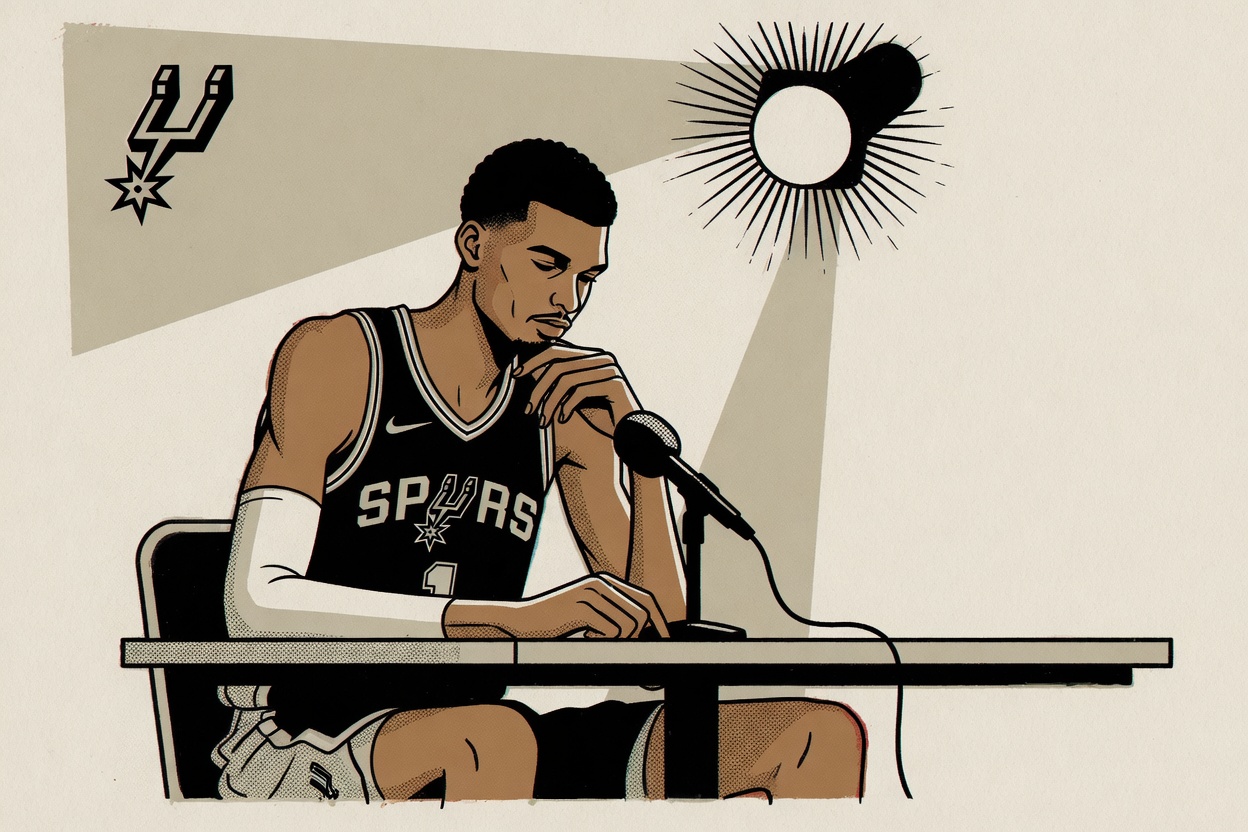
The story that Victor Wembanyama has turned his back on American media is built on exactly one sentence, said once, on a podcast. Treating it as a boycott is lazy. ESPN's Michael C. Wright told the Hoop Collective, "He's locked in... As a matter of fact, I was told he's not even talking to any American media outlets except for 60 Minutes." That's it. That line got aggregated across a dozen sites as a snub. Nobody re-reported it. Everybody just ran with it.
Read Wright's words closely and the boycott shrinks fast. The more careful write-ups made clear he was only describing long-form sit-down interviews. Wembanyama stood at Spurs media day this fall and answered questions about the Finals loss. He talks after games. He talks after practice. The man who supposedly won't speak to Americans spent a session telling American reporters he's had "a few sleepless nights, maybe not sleepless nights, but hard to find sleep sometimes" over it.
The premise that he's icing out the press is junk. A 22-year-old deciding he'd rather do one real conversation than repeat the same three answers to thirty outlets is just good time management. Sports media exists to turn a shrug into a headline, and he clearly knows it. Good for him.
The outlet he picked is what deserves scrutiny.
60 Minutes is a prestige stamp. For decades the name meant you were sitting for the most serious interview on American television, but the name and the newsroom aren't in the same place they used to be. Bari Weiss, a longtime critic of legacy journalism, now runs CBS News after Paramount bought her outlet and installed her at the top. She walked into the 60 Minutes operation and asked the staff why the country thinks they're biased. Correspondents have been pushed out, and the brand is in the middle of a public identity crisis, with its own leadership asking whether anyone still trusts it.
That's the show getting Wembanyama's one big American sit-down. He almost certainly didn't wade into the CBS newsroom turmoil to land there; the name still carries the aura of what it used to be. He's buying the old reputation. Whether the current product lives up to the badge is the exact question Weiss herself put to her own staff.
None of this is Wembanyama's doing, and he doesn't owe the American sports press a weekly therapy session about a Finals defeat that clearly gutted him. San Antonio went 62-20 last season, finished second in the West, reached the Finals for the first time in his career and lost to the Knicks in five. He was the league's Defensive Player of the Year. If he'd rather process that in one controlled setting than in forty ambushes, that's his right.
The ones who turned this into a story are the aggregation machine that took a single secondhand line and inflated it into a scandal, and a once-untouchable program that has made its own credibility the running headline. Wembanyama made the smart, obvious choice to protect his time. The gamble is whether the institution he handed it to is still worth the trust its name implies.