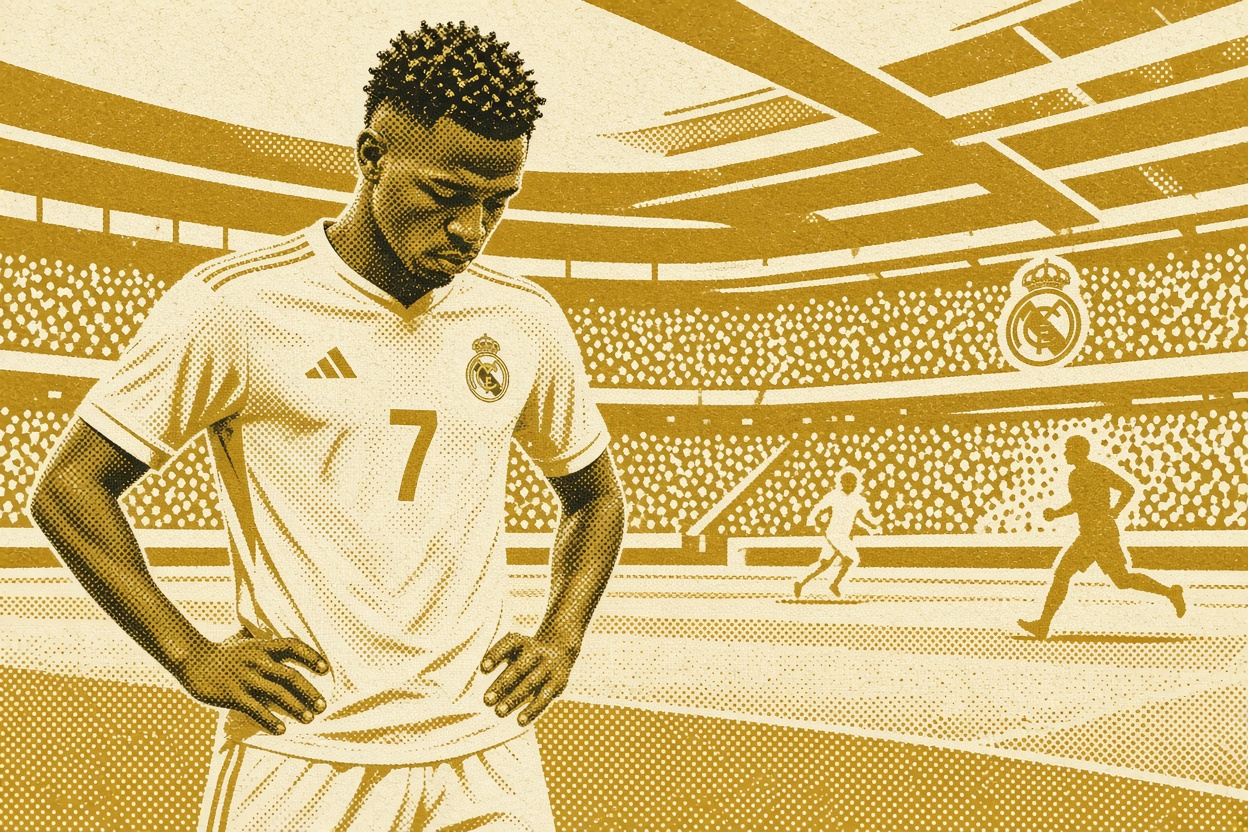
Vinícius Júnior still has it in him. He's 26, he's won the Champions League twice, and players with his legs and his ceiling don't simply stop being good at football over eighteen months. What he's in is a dip. A bad one, a self-inflicted one, but a dip you can climb out of. The only reason anyone's holding a wake is that he's behaving like a man who's already mentally left, and right now nobody around him is forcing him to stop.
The alarm is real, to a point. By late September he had scored one goal in his first eight appearances of the 2026-27 season. By early October, his shots per 90 had slipped to 3.31 from 3.54 the season before, shots on target down to 0.83 from 1.49, chances created down to 1.79 from 2.12. The eye test matches the numbers: predictable and heavy, a yard short of the version that used to terrify a full-back the instant he received it.
But across whole seasons, his output hasn't collapsed. He put up 22 goals and 19 assists in 2024-25, then 33 goals and 14 assists in 2025-26. Those are the numbers of a forward still near his peak. The same stretch that showed his per-90 drop also showed Real Madrid's average La Liga possession falling from 59.4% to 52.5%, which means some of what gets pinned on him is a team that gives him the ball less, and in worse spots. Both things are true at once. His week-to-week involvement this autumn has cratered, and his full-season ledger still reads like an elite forward's.
What broke is in his head. The hinge everyone agrees on is the 2024 Ballon d'Or, which went to Rodri when half the planet assumed it was Vinícius's to lose. He let that snub curdle, and the sulk bled into his football. Then Real Madrid made it worse. The contract saga has run roughly a year: a bump toward €20 million offered back in May, rejected by his camp, who wanted another €10 million in bonuses, with the standoff dragging through a stretch of flat form that did nothing to strengthen his hand. He's played like a man already negotiating his way out the door, and the board let the whole thing fester in public.
The backdrop didn't help either. Xabi Alonso was fired on January 12, 2026, seven months into the job, a day after a 3-2 Supercopa final loss to Barcelona, with reserve coach Álvaro Arbeloa promoted in his place. There was no stable system and no coach who trusted him through a cold spell, until Arbeloa, who has said openly that getting Vinícius back to his best is one of his aims. That's a lifeline. He has to take it.
The doom argument reaches for history: Brazilian wide men who fade in their mid-twenties, Ronaldinho and Kaká tailing off around 27 and 28, Robinho earlier still. Fair pattern. Doesn't make it destiny. Raphinha, Brazilian, 29, turning 30 in December, had his breakout at an age when the burnout theory says he should be declining, 34 goals and 22 assists across 57 games in 2024-25 under Hansi Flick, with a league title, a Spanish Super Cup and a Copa del Rey. Attitude did this to him.
Compare him to his peak and it's easy to assume he's cooked. But writing off a 26-year-old after one rough patch is premature. That's why this is reversible. The talent's still there. The focus isn't. End the sulk, and either sign the deal or walk away. Then play like the shirt matters. He can do it tomorrow. He just hasn't decided to.