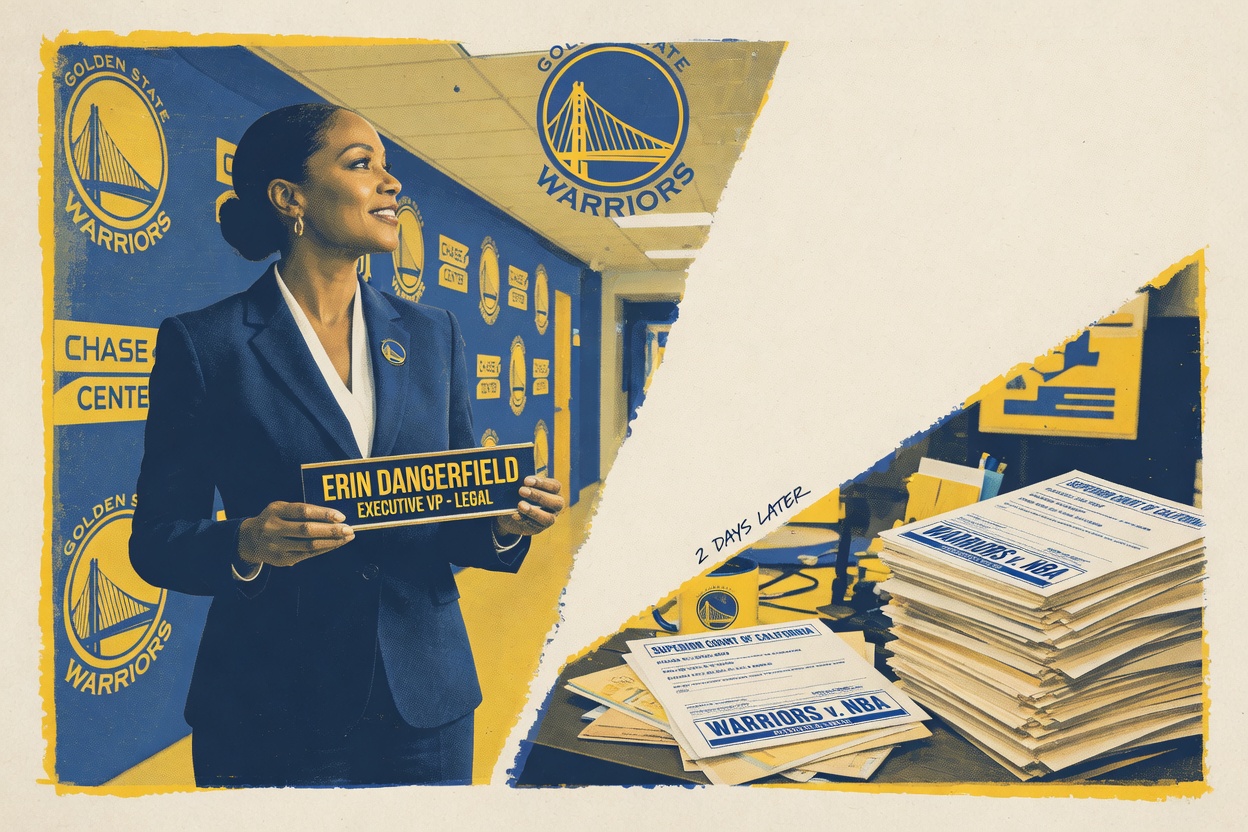
The lawsuit against the Golden State Warriors is a set of allegations, not proven facts. Nobody's been found liable of anything. The Warriors deny all of it and say they'll fight it in court.
Still, you don't need a verdict to raise an eyebrow at the timeline. And the timeline here is a problem.
On Aug. 25, two former Warriors employees, Lisa Shelley (who worked professionally as Lisa Meyer) and Jennifer Vasquez, filed a joint complaint in San Francisco County Superior Court alleging discrimination, hostility, and retaliation under California's Fair Employment and Housing Act. Shelley had been the team's associate general counsel and director of business and legal affairs and risk management, and joined in 2021. Vasquez was the vice president of diversity, equity and inclusion, and joined in 2022.
The person named most pointedly in that complaint is Erin Dangerfield, the team's senior vice president of people and culture. Two days after the filing, the Warriors announced that Dangerfield had been promoted to chief people officer.
Two days. That's the one detail in this whole story nobody disputes.
What the complaint says about her
According to the lawsuit, Dangerfield "regularly criticized female employees' bodies, physical appearance, and wardrobe choices." The complaint alleges that early in Vasquez's employment, during a one-on-one meeting, Dangerfield told her that women who wanted to work in professional sports often did so because they were "jersey chasers." The plaintiffs also allege the whole dispute traces to a 2025 employee survey that was supposed to be anonymous, after which an executive tried to identify and personally question employees who had submitted critical responses.
Again, these are allegations. The Warriors say they're "false, misleading, and unsupported by credible evidence."
There's a part of this that complicates the easy version of the story, and it's worth laying out plainly. The complaint itself says the Warriors ran an internal investigation into Dangerfield's conduct and found she hadn't done anything wrong. This isn't a team that blindly ignored a red flag; there was a review, and by the complaint's own account, it cleared her. The plaintiffs dispute that finding, but it exists.
Fine. So the Warriors looked into it and were satisfied, and that's a defensible position, though the silence around the optics isn't.
The gap the Warriors won't address
The Warriors issued a firm statement. "Golden State prides itself on its commitment to maintaining an inclusive environment grounded in mutual respect and professionalism," it reads, adding that "we take all workplace concerns seriously" and that the team "intends to vigorously defend against these baseless claims."
The statement doesn't touch on why the promotion landed 48 hours after the complaint. The Warriors haven't offered any public rationale for the timing. That silence isn't proof of anything, but it's a hole in the record big enough to drive a team bus through.
Here's where the facts end and my opinion starts. There are two ways to read what Golden State did, and neither one looks good.
One: they're tone-deaf. Nobody in that building stopped to ask whether elevating the lawsuit's most-named figure, the same week the lawsuit dropped, might look terrible to their own workforce. If that's what happened, it says something about how seriously a team that markets itself on "culture" actually handles a culture complaint.
Two: they meant it. The promotion was a deliberate signal, a way of telling everyone inside the building that the organization stands behind Dangerfield and considers the matter closed. That's the more coherent read. Big organizations don't usually promote someone by accident. If the internal review cleared her, a promotion is the loudest possible way to say we believe our own investigation.
But think about what that signal does to the next employee who fills out an anonymous survey honestly. The lawsuit's whole origin story is about people being punished, allegedly, for critical feedback. Whether or not that allegation holds up, promoting the person at the center of it two days into the litigation tells every current staffer that complaints don't slow anybody down here.
Where this goes
The legal process is just getting started. The plaintiffs' attorney, Justice Ojo, filed a judicial summons on Thursday, which starts a roughly 30-day clock for the Warriors to formally respond. The complaint also references ten unidentified defendants who could be named in an amended filing later. None of that has played out yet, and I won't pretend to know how it ends. This could settle quietly, the Warriors could win outright, or it could get uglier. All three are on the table.
What I do know: lawsuits get won in courtrooms, but trust gets won everywhere else. The Warriors are lawyering up to protect the first thing. The two-day promotion looks a lot like they weren't thinking about the second.
Maybe there's a clean explanation. The promotion was in the works for months, the paperwork just happened to clear that week, pure coincidence. If so, say it. Right now the team has said plenty about the lawsuit and nothing about the timing, and without an answer, people are going to fill the gap with the least generous version. That's on Golden State to fix, not the reader.