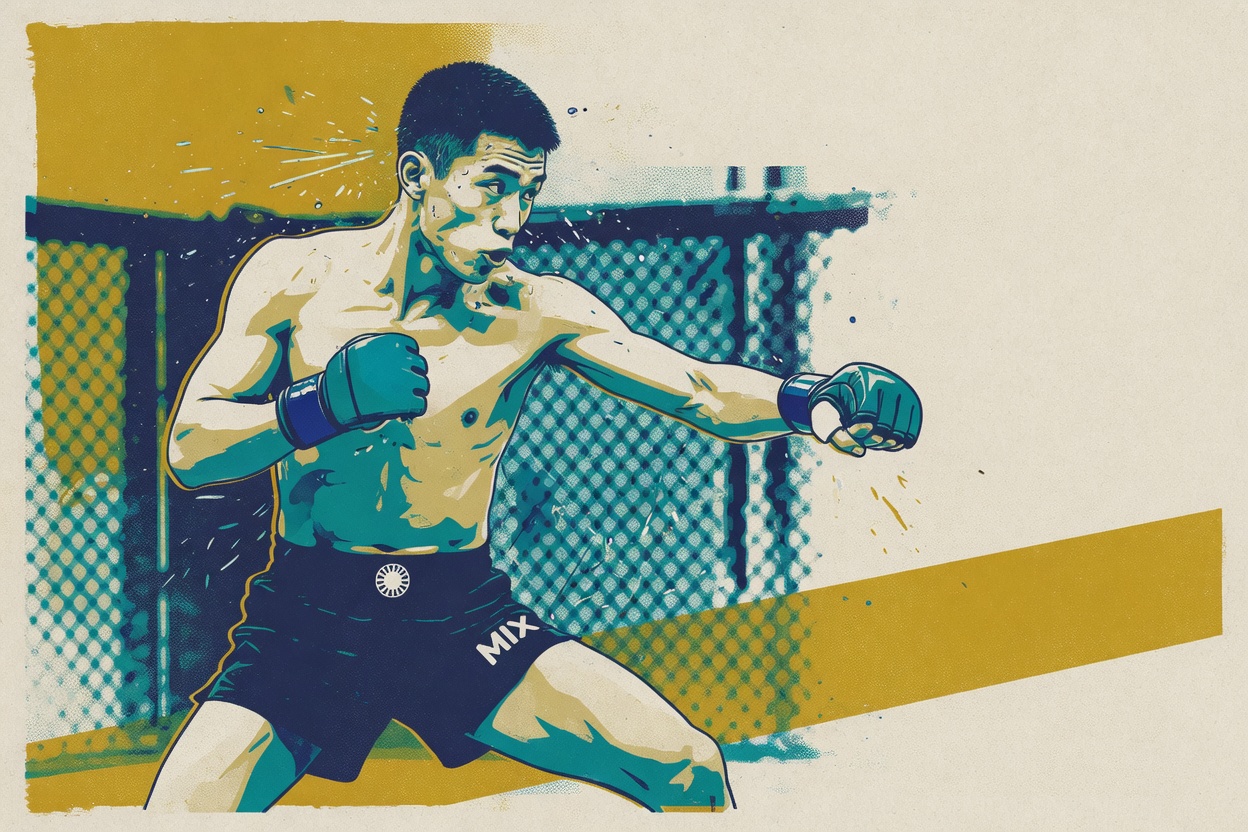
Every few months the same argument comes back around: why do so many Japanese and Korean fighters stand there and eat punches with their chin parked in the pocket, no slip, no roll, no head off the center line? And every few months the same answer gets handed out like it settles something. Karate. Taekwondo. Culture. Honor. The ancestors.
It's a cop-out. The stylistic explanation is true, and it explains almost nothing about why the problem never gets fixed.
Start with the part that's real. Traditional point-karate and the kumite formats underneath it don't reward slipping a punch to the head the way Western boxing does. They reward distance, timing, whole-body movement, and scoring touches from kicking range. A lot of those systems restrict head punching outright. A fighter raised in that world shows up to MMA with elite timing and a stance built for a different problem. Fine. That's a starting point. It doesn't have to stay that way forever.
Kyoji Horiguchi ends the argument by himself. He came out of that exact point-karate background and turned himself into one of the sharpest strikers the lighter weights have produced, a guy who moves his head, boxes in combination, and does it while carrying all the karate footwork that made him dangerous in the first place. He fought at the top in the UFC, in Bellator, and back home in Japan. He kept the karate and added the thing it skipped, proving the stance is fixable.
So the real question is why so many of these fighters are never taught to move their heads at all. That falls on the gyms. Japanese MMA has never fully rebuilt the coaching infrastructure it lost when Pride collapsed. For a stretch, that promotion was the center of the sport's universe, and when it fell, the development pipeline fell with it. What grew back leaned on grappling heritage and raw toughness and imported very little of the defensive boxing culture that Western gyms treat as table stakes. You can't learn to slip a jab from a coach who was never drilled in slipping one himself.
The promotions aren't helping. Rizin's whole appeal is pressure, exchanges, finishes, and for most of its life that's played out in a ring rather than a cage, a format that pushes fighters forward and punishes anyone who chooses to fight cautiously. Build a star system that pays off aggression and spectacle, and you get fighters who train to trade. Defense doesn't trend. A slick layer of head movement doesn't sell a ticket in Tokyo. The incentives run straight against the skill, and the matchmakers and bookers built those incentives on purpose.
The strongest pushback: most MMA fighters on earth have ugly defense next to a real boxer, because the second you commit to bobbing your head you're inviting a knee up the middle or a leg kick that folds you, and that tradeoff exists for everyone regardless of passport. All true. But "everyone's defense is a bit rough" and "an entire regional scene treats head movement as optional" are different sizes of problem. The sport's built-in tax is universal. A regional training culture that never bothered to pay down the difference is a separate problem, one built on a flattering excuse about heritage so nobody had to admit the corner dropped the ball.
That's the move I can't stand. Call a coaching gap a cultural quirk and you've made it sound unsolvable. Nobody can retrain a bloodline, but a gym can retrain a stance, and Horiguchi did it in front of everyone. Every time a Japanese or Korean prospect walks to the cage with his chin up and his feet planted and gets picked apart, his gym sent him in half-built and called it tradition.