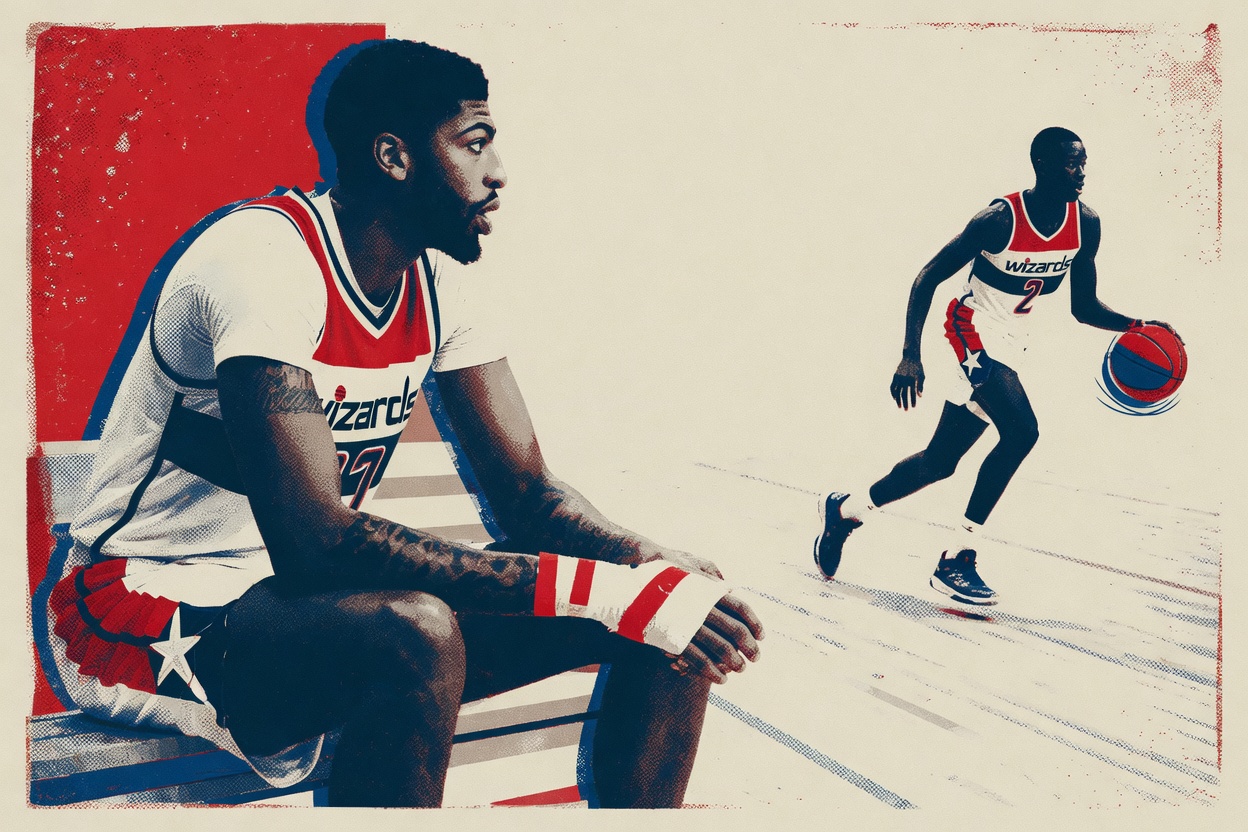
There's a version of the Anthony Davis situation where waiting is the smart, patient move. Both sides have questions, so they take a breath and revisit it once the season's underway. That's the story Washington and Rich Paul are selling, and the reporting actually backs the calm version: the Wizards and Davis's agent mutually agreed to hold off on extension talks until after the season begins, giving everyone what one source described to Shams Charania as the first 20 or so games to marinate on a possible deal.
But marinating has a problem: the longer this sits, the more likely it curdles.
Davis became eligible on August 6 to sign an extension worth up to roughly four years and $273 to $275 million, depending on which projected cap figures you trust. The first year of that deal would replace a $62.8 million player option for 2027-28. That's a genuine max commitment to a player heading into his age-34-through-37 seasons, and the case against it isn't hard to make. Davis is productive when he's on the floor: career averages around 24 points, nearly 11 rebounds and better than two blocks a night. The catch is "on the floor." Since playing a career-high 76 games in 2023-24, he's appeared in 71 games total across the last two seasons combined. Last year he suited up for only 20, all with Dallas, and never once took the court for Washington after February's eight-player trade brought him in, sidelined by hand and finger injuries. Only three times in 14 seasons has the 6-foot-10 forward reached 75 games.
So the bet Washington is weighing is whether to hand a fragile 33-year-old the biggest kind of contract the league allows, banking on his body doing something it's mostly refused to do for years. That's the honest framing, and it's why even the sympathetic coverage keeps circling back to the same skepticism.
Now layer the money. The Wizards already gave Trae Young a four-year, $212 million extension this summer. CBS Sports notes that if Davis gets a max that replaces his option, Washington would owe close to $550 million in guaranteed salary to Young and Davis alone through 2030-31. Forbes puts the same math in terms that should keep the front office up at night: a Davis max stacked on Young's deal would tie up roughly 65% of the cap in two aging, injury-prone stars, potentially choking off the ability to build around AJ Dybantsa. Forbes even reaches for the Celtics, who moved Jaylen Brown amid cap constraints, as its own cautionary parallel. Treat that comparison as analysis, not gospel, but the underlying worry is real.
This is where I part ways with the "patience is wisdom" reading: delaying doesn't shrink the risk, it reschedules the confrontation for the worst possible moment. The 20-game checkpoint isn't a contract deadline, just an informal point to re-engage, but the calendar math puts this squarely back on the front burner around December, tangled up with live evaluations of both Davis's health and a young team's record. If Davis is healthy and the Wizards are respectable, his camp's leverage spikes. If he's hurt again or the team is losing, the whole thing sours in public. There's no quiet outcome baked into the timing.
The leverage angle is what turns a delay into a potential saga. Kevin O'Connor of Yahoo Sports reported in late July that there are "rumblings" Davis is seeking the full max from Washington but would sign for less if he were traded to a contender, adding that "not every source is convinced the Wizards will ultimately keep him." That's sourced speculation, not an ultimatum, and it deserves that caveat. Davis hasn't demanded a trade. On the other side, when trade chatter first surfaced on the eve of free agency, the Wizards moved fast to kill it, with a source telling Andscape the team had "no interest" in trading him and was "not listening to offers." Both positions are real as reported. They also point in opposite directions, which is exactly the kind of gap that widens the longer nobody signs anything.
My read: Washington has boxed itself into a standoff where every honest answer is uncomfortable. Pay the max, and you mortgage Dybantsa's supporting cast to a player whose availability is a coin flip. Refuse it, and the trade drama you spent the offseason denying comes roaring back. Dragging it into midseason just means the story follows the rookie into every locker room.
None of this happens in a vacuum. Washington finished 17-65 last season, the worst record in the league and among the worst in franchise history, the third straight year of losing at least 64 games. The reward for that misery was the No. 1 overall pick, the team's first since John Wall in 2010. Dybantsa is supposed to be the reason the tank ends, the centerpiece next to Alex Sarr, Bilal Coulibaly and Kyshawn George. "I want to be a piece of the puzzle that is part of the rebuild," he said after arriving. "Obviously, Wizards fans have been waiting for a long time."
They have. Which is why hitching that rebuild's flexibility to a 33-year-old's leverage play, then hitting snooze on the alarm, feels less like patience and more like hoping the hardest question answers itself. GM Will Dawkins has stayed deliberately vague, saying only that the conversation would come "in the middle of August when we can officially have that." The middle of August arrived, and the conversation got postponed anyway. My guess is it doesn't get easier in December, and Dybantsa is the one who'll feel the fallout either way.