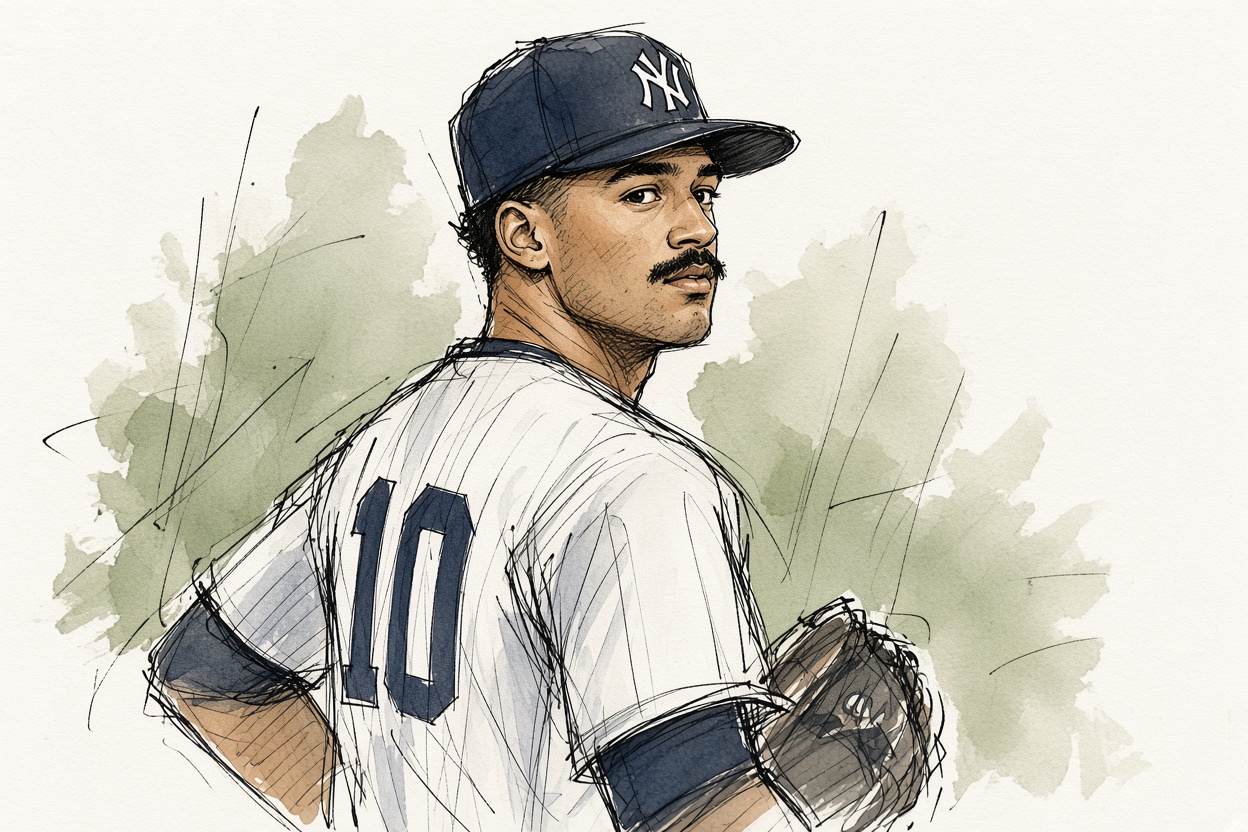
If you want to see how thin the 2026-27 center field market is, start here: Baseball America's top available free agent center fielder hit .211/.308/.395 in 2026. That's Trent Grisham, the consensus No. 1, and the ranking around him is really measuring who's least broken.
The "weak class" label isn't hype. Baseball America and MLB Trade Rumors landed on the same verdict working separately, and MLBTR put it bluntly: there are "no slam-dunk everyday options" in the group. When two shops that don't share a spreadsheet agree the shelf is empty, it's empty. Teams that already have a steady center fielder dodged something, because the alternative this winter is real money and a lot of hoping.
Now look at the ranking itself, since that's where the real argument sits. Grisham over Varsho over Robert only makes sense as a measure of scarcity.
Grisham is a free agent again because he accepted a qualifying offer after a real career year in 2025, when he posted a 124 OPS+ with 34 home runs and 3.5 WAR in 143 games. He bet on himself for one more season instead of testing a thin market, and the bet didn't pay off. In 2026 he played 121 games, lost time to a grade two right hamstring strain in early September, and hit .211/.308/.395 with 18 homers and 59 RBI. Baseball America's own write-up admits he's "really hard to project" and is "perhaps better suited to a corner outfield slot." He's still the No. 1 center fielder on the board. Grisham can hit when healthy; the problem is everyone ranked behind him.
Daulton Varsho sits at No. 2, and here's where the ranking asks you to overlook the scouting reports. His defensive calling card was the arm, and the arm is the problem. His throwing has slid from roughly the 40th percentile before shoulder surgery to the bottom fifth after it. Multiple independent reports have tracked the same collapse, and as recently as the 2026 trade deadline he was being described as merely above average in center, down from excellent before the surgery. Putting him second bets on recovery and name recognition. His 2026 season doesn't back it up.
No. 3 is Luis Robert, the tools-over-production case that never ends. Over the last three seasons he's parked in the 90th percentile for sprint speed and bat speed with 70-grade raw power, and he's turned all of that into an 87 wRC+. Three straight years of a below-average bat is a track record. The glove keeps his floor up, but ranking him this high on "the potential is still tantalizing" is hope with a tie on.
Further down the list are Tyrone Taylor and TJ Friedl. Friedl hit .172/.255/.255 in 2026. Some of that is a brutal .214 BABIP, sure, but when a line like that makes the top ten, the pool is a puddle.
Somebody has to rank first, and in a class this shallow, tools-over-production is a reasonable tiebreaker when actual production is scarce everywhere you look. Grisham at a healthy peak is a legitimately good hitter, and the order roughly tracks the alternatives. The crowd mocking this list is really mocking the idea that this counts as a market.
Baseball America should have led with this: it's a bad class, the order is about as good as any, and nobody should write a big check expecting an above-average everyday center fielder to arrive in 2027. The projected deals floating around, three years and $42 million for Grisham chief among them, are analyst guesses. I'd be nervous spending close to that on any name here.
Jarren Duran just had the worst offensive year of his career, a .207/.266/.361 line with a 69 wRC+, and he's not even a free agent. Even that version of Duran would reshape this market if he were in it. He isn't in it, and that's how thin the pickings are.
The ranking works fine; it just needs a different name. Stop calling it a "best available" list and start calling it a triage chart, because that's what shopping for center field looks like this winter.