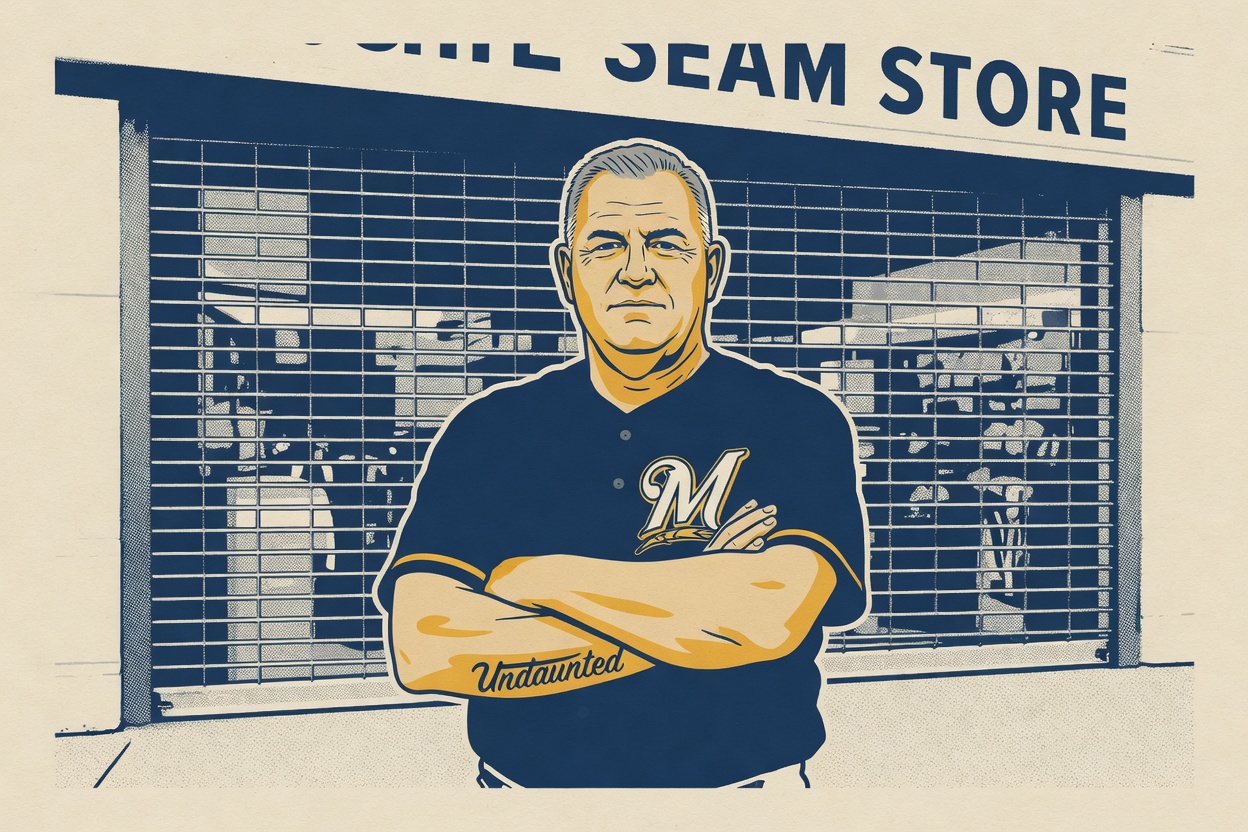
The Brewers closed both of their American Family Field team stores on Thursday, in the middle of the biggest week Milwaukee baseball has had since 1982, because there was too much demand. A team that just won its first National League pennant couldn't keep shirts on the racks for a fanbase that's been waiting decades for exactly this, so the answer was to lock the doors and catch up.
The Brewers aren't to blame for this.
They did the honest, boring thing. They announced the closure in advance. Both stores, at the Left-Field Gate and the Home Plate Gate, went dark Thursday and stayed closed Friday morning as scheduled, with a plan to reopen to ticketed fans the moment the ballpark gates opened for Game 1. Their explanation was that staff needed time to restock and replenish. That's a team managing a supply problem it doesn't control. If you want to be mad at someone for the closed sign, aim higher up the chain.
Aim it at Fanatics, the company MLB handed the keys to. Fanatics holds exclusive retail and fan-apparel licensing rights across the NFL, NBA and MLB, the product of long-term deals that let one company design, manufacture and distribute the gear for nearly every major league in the country. When a league hands the entire pipeline to one company, that company becomes the only point of failure. This one has failed before, loudly, at the exact worst moment. Ahead of Super Bowl LX, Fanatics publicly apologized after Seahawks and Patriots fans couldn't get jerseys, admitting it couldn't keep up with demand even though it ordered more than ever. Fans ran an #endfanatics hashtag over it. A monopoly on merchandise logistics means nobody else is racing to be faster, and there's no backup when a run like this shows up.
A run of this size didn't sneak up on anyone. The Brewers swept the Dodgers, winning the clincher 6-4 on October 15, to reach their first World Series since 1982. That's a full week of warning that demand was about to detonate. Resale tickets for Game 1 were going for thousands, the cheapest around $2,300 on Thursday morning. One Wisconsin tourism official pegged the economic impact at an estimated $10 million to $12 million per home game. Everyone involved knew a wave was coming. The supply chain that's supposed to meet it answered by closing the store to restock.
Maybe this was planned housekeeping: a short, scheduled closure to swap old inventory for new World Series stock before the gates opened. The Brewers' statement reads that way. The closure was bounded and communicated, announced ahead of time with a clear end point. That only makes the bigger point worse. If the system worked, you wouldn't need to shutter two stores for most of two days in the middle of the single highest-demand window the team has seen in four decades. A store that has to close to keep up is proof the supplier behind it is overwhelmed.
Milwaukee's fans waited 44 years to buy a World Series shirt at their own ballpark. The Rays are in this too, and neither team has ever won a title, so these are the diehards, the ones who stuck around for nothing. They earned a stocked store. They got a locked door and a promise to reopen later. Blame the company that built a pipeline which buckles every time the moment actually arrives, and the league that decided competition wasn't necessary.