Most fans never learned Alex Gimenez's name until the Boston Bruins announced he was gone.
That's the part worth sitting with. The Bruins shared his passing on social media on Friday, September 18, and as of this writing they haven't disclosed a cause of death. Nobody covering the story has reported his age, either. So this isn't a column about how or why. There's no reporting to support any theory, and there won't be any invention here. This is a column about what his brief run tells us about a corner of the sport almost nobody watches.
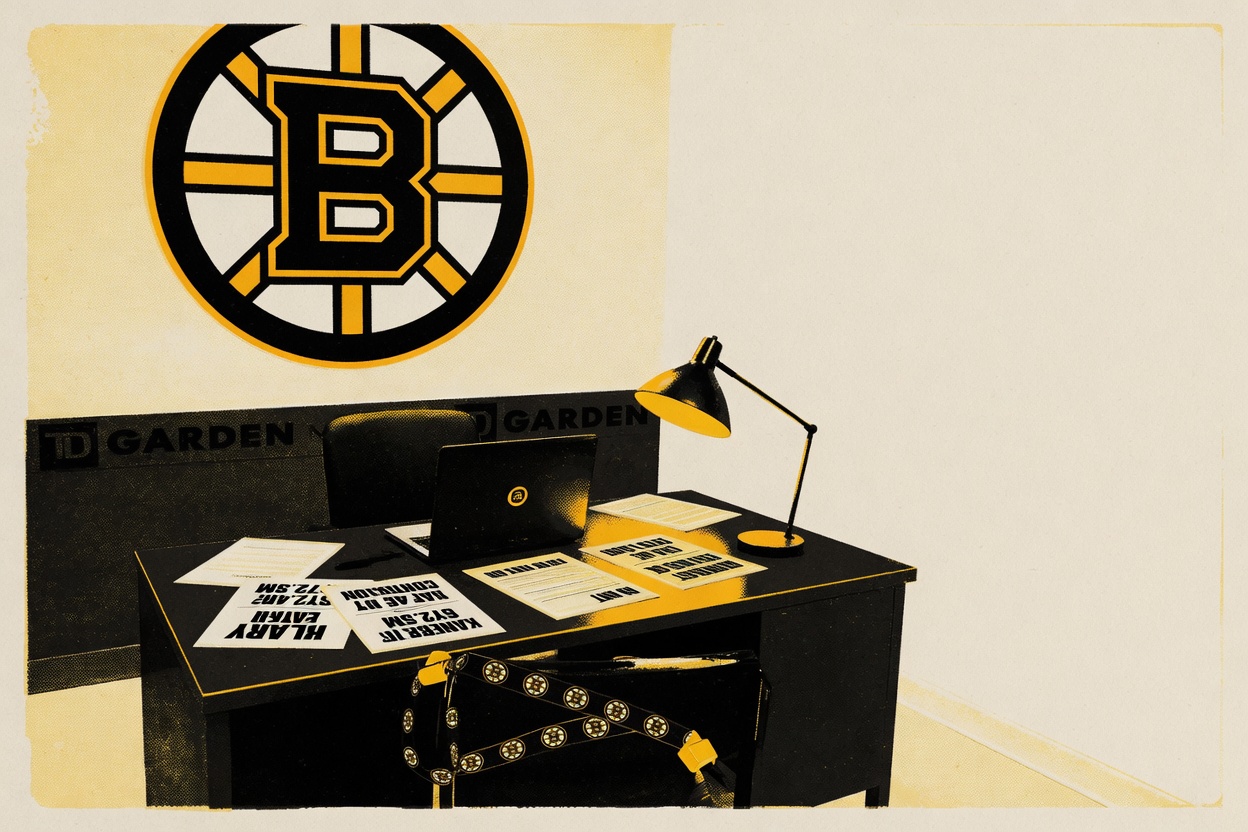
Gimenez was hired on July 14, 2026, into a title the Bruins had just created: Director of Hockey Operations, Collective Bargaining Agreement. That title alone captures how specific the job had gotten. It covered contract negotiations, salary cap management, CBA compliance and player acquisition strategy, and it came as part of a broader reshuffle of Boston's hockey operations department, alongside Kevyn Adams as Senior Advisor to the GM, Dennis Bonvie as Assistant GM of Player Personnel, and Jeremy Rogalski as Assistant GM of Analytics and Strategy.
My own read on this, and it's an opinion, not a reported fact: the NHL is quietly borrowing an idea baseball worked out years ago. You don't just draft and trade your way to a contender anymore. You hire specialists in the fine print, the cap math, the labor agreement itself. Gimenez was exactly that kind of hire. He was a 2015 Cornell graduate who started in sports media, interned in labor relations for Major League Baseball, then spent more than a decade inside the Red Sox front office, rising to assistant director of Major League operations and pro scouting in November 2023. He also taught as an adjunct professor at Cornell's School of Industrial and Labor Relations. A former Red Sox executive, Zack Scott, said in one account of Gimenez's move that the Bruins "were always the dream," and that Gimenez was "the happiest he'd been professionally in several years." Take that as one person's memory rather than confirmed fact, since it comes from a single account. But it fits the shape of a career built on patience.
When a star winger signs an eight-year deal, we credit the roster. We rarely credit the person who structured the money, mapped the cap for half a decade out, and made sure the whole thing survived contact with the collective bargaining agreement. Those people work in departments that are thin, sometimes a handful of names, sometimes fewer. They don't get camera time or bobbleheads. Most of them you'd walk past in the arena concourse without a second look.
Gimenez had barely started. Sweeney's own words for it were "far too brief." He grew up cheering for this team, came to it after a short stint with the Professional Women's Hockey League that he began in January 2026 as manager of hockey analytics and strategic projects, and he'd been in the Bruins building maybe two months. GM Don Sweeney's statement called him a "colleague" and said his "intelligence, thoughtfulness and character were evident from the moment he joined us." Sweeney added that Gimenez "earned the respect of all who knew and worked with him throughout his career and, most importantly, he was a wonderful person who will be greatly missed." The Red Sox, where he spent the bulk of his career, said he was "forever a part of our Red Sox family" and that they were "absolutely heartbroken."
I'm not going to pretend I knew him, and I'm not going to reach for meaning that isn't there. What I'll say is this: the modern front office is a machine, and machines make us forget there are people inside them. Innovation in hockey operations gets sold as a competitive edge, a smarter way to build a roster, an org chart flex. It's also a group of people grinding through spreadsheets and CBA clauses that will never trend. We only found out about one of them because he was suddenly gone.
If there's a small thing the sport can do, it's remember that the next groundbreaking hire isn't a title. It's a person. Gimenez chased a dream job and got to hold it for a moment. The least the rest of us can do is notice that the job, and the people who do it, were always there.