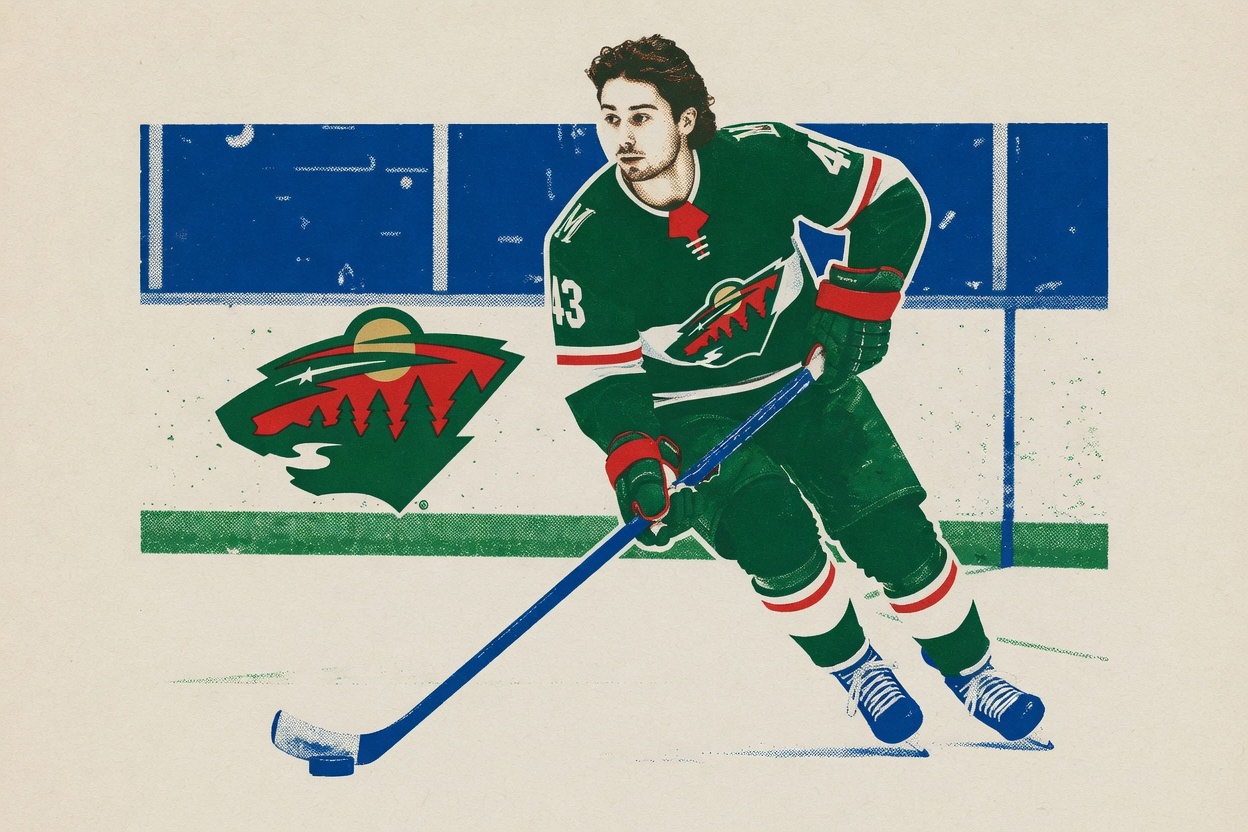
Vancouver just handed a defenseman with fewer than 80 NHL games on his resume the kind of contract you give a proven top-pair anchor. Eight years. $75.04 million. A $9.38 million cap hit that runs from 2027-28 all the way into the 2035 off-season. And the Canucks did it a full year before they had to.
This is a franchise-defining bet on where Vancouver thinks it's headed.
They didn't have to do this
Zeev Buium is entering the final season of the three-year entry-level deal he signed with the Wild in April 2025. He plays out 2026-27 on that contract before a dollar of the new money arrives. The Canucks could have let this ride, watched him for another full season, and still held his rights as a restricted free agent afterward. RFA leverage is the cheapest, safest card a front office holds. Vancouver tore it up early.
That's conviction, not caution, and the tab attached to it is enormous. The deal even includes a full no-movement clause and a modified no-trade clause across its final three seasons, so the Canucks have already given up future flexibility on a player whose NHL body of work fits on a napkin.
That body of work: in 76 career NHL games split between Minnesota and Vancouver, Buium has six goals and 26 points. After arriving in the Hughes trade, he put up three goals and 12 points in 45 games with the Canucks, skating just over 20 minutes a night and finishing at minus-24. Vancouver read the tape and decided this was the guy to build around.
The number I'd defend Buium with
Before you torch the minus-24, know that the analytics community has already waved you off it. Buium was more sheltered in Vancouver than he'd been in Minnesota, and his even-strength on-ice save percentage cratered after the trade, dragging his raw plus-minus into ugly territory. His expected plus-minus with the Canucks was only about minus-five. Scouting reports still frame him as a top-four defenseman with real offense and a legitimate chance to run a top power-play unit.
The talent case is honest, too. He was selected 12th overall in 2024, and the same rival executive who watched Vancouver pry him loose called the trade return something no other team could match. Buium was seen as the centerpiece of that haul. GM Ryan Johnson called him "a key member of our young core and a player we will build around moving forward." Buium said the choice was "pretty easy" and that he wanted the full eight years, not something shorter.
I believe all of it. And I still think this is a gamble that reveals where Vancouver's head is at.
This is a bet on the trade, not on a player
When you commit eight figures of future cap to someone this early in his career, you're not paying for what he's done. You're paying to be right about the entire premise of moving your captain. The Canucks dealt Quinn Hughes to the Wild in December 2025 for Buium, Marco Rossi, Liam Ohgren and a first-round pick they turned into Adam Novotny at 24th overall in the 2026 draft. President Jim Rutherford steered a franchise headed into a rebuild, with Hughes set to reach free agency in the summer of 2027, toward the biggest possible return.
Locking up Buium now is Vancouver planting a flag on that decision. It's the front office telling its fans: judge us not on the player we lost, but on the package we got back. The extension is the emotional and financial center of the whole rebuild.
Which is a bold place to stand, because the man they traded didn't fade. He got better.
The inconvenient man in Minnesota
Over the completed 2025-26 season, Hughes played 48 games for the Wild and racked up five goals and 48 assists for 53 points, setting a Wild franchise record for assists by a defenseman. In the 2026 playoffs he helped push Minnesota past the Dallas Stars in a first-round series that went to Game 6, contributing eight points in the round including a three-point night to close it out, and ending a long postseason drought for his new team.
That's the shadow hanging over every dollar of Buium's contract. Vancouver needs Buium to become enough of a star that nobody remembers the All-Star the Wild are building around.
I don't hate the player, and I don't hate the ambition. I question the timing and the cost. Paying a 45-game Canuck like a cornerstone, a year early, with trade protection baked in, only makes sense if you've already decided the return is the story. Vancouver has decided. Now it has eight years to be right.