Ask whether the proposed 10-Power-4-games rule kills scheduling access for the Group of Six, and the answer is yes. It does, and it was built to do it. The only people pretending otherwise are the ones who wrote it.
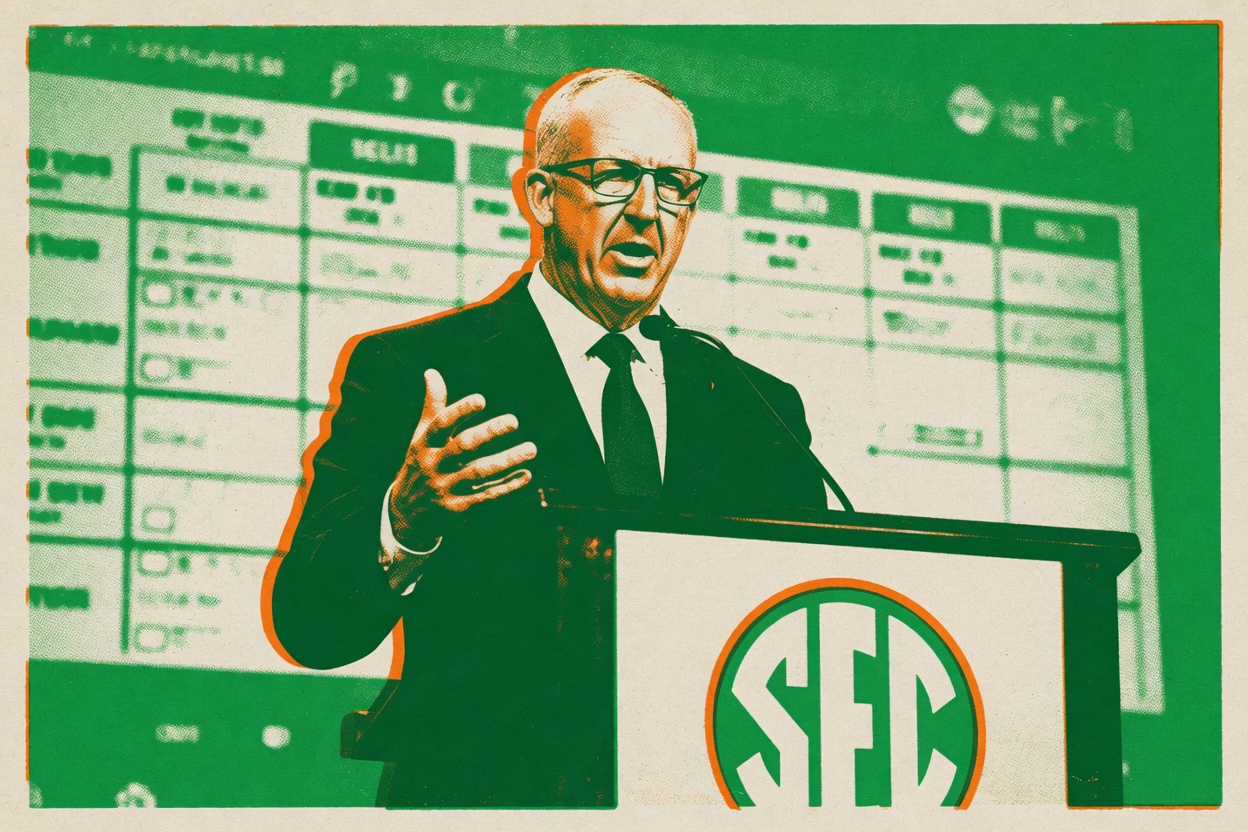
Start with where this came from, because it matters. Greg Sankey wrote this rule, in a memo laying out what the SEC would demand in exchange for backing a 24-team playoff: offset the SEC's lost conference-championship-game money, and require power-conference teams to play 10 games against power-conference opponents or Notre Dame to be eligible. The American, Conference USA, the MAC, the Mountain West and the Sun Belt had no say in it, and neither did a selection committee worried about schedule integrity. The Big Ten doesn't carry that requirement, but Tony Petitti has said his league would adopt it if the SEC does. So two leagues that just torched their title games for a bigger playoff check now want a scheduling mandate to help fill the hole, and they've decided everybody should live inside it.
Follow the money and the integrity argument falls apart. Conference title games were worth something like $80 to $100 million. The SEC and Big Ten are the ones giving that up for a fatter postseason payday. Sankey's 10-game rule is the price tag he's stapling to his yes vote. The SEC, ACC and Big 12 already run a model of nine conference games plus a 10th power opponent, so for them this changes almost nothing. The people it changes everything for aren't in the room.
The part that should terrify every athletic director outside the big two is which way the fix goes. One idea under discussion is forcing Group of Six schools to drop FCS opponents so they only play FBS competition. Translation: strip away the buy games that keep Group of Six athletic departments funded, while the Power 4 fills its mandated 10 largely with each other. They're pulling the ladder up and handing the Group of Six a bill.
You don't have to guess at the effect, because it's already showing up on schedules being built years out. Oregon's 2027 nonconference slate is Eastern Washington, Coastal Carolina and Western Kentucky, none of them Power 4. The Ducks got there by canceling a home-and-home with Baylor, a real power-conference road trip, and replacing it with home buy games to protect a seven-home-game gate. Indiana canceled its series with Virginia and its series with Notre Dame and now has one of the weakest nonconference slates in the country, none of it Power 4. On the West Coast, Washington State is hanging onto a home-and-home with Arizona while marquee nonconference dates for that whole region have gone nearly barren.
Now run the logic forward. If every Power 4 school is contractually told to stack up power-conference games, they start calling each other to fill those dates instead of Boise State, Memphis or James Madison. This rule guarantees the Power 4 circles the wagons. The Group of Six team that goes on the road and beats a ranked power program, the single result that's supposed to vault them into the conversation, won't get the phone call to try, because the power program isn't allowed to waste a slot on them.
Forcing power schools to quit scheduling cupcakes could mean more real games, and more real games are better television and better preparation. But look at who's actually eating the cupcakes. Oregon's answer was two more buy games after canceling Baylor. The incentive here is to schedule power-brand home games and hit the quota against people on your own tier. More P4-on-P4 games is fine. Fewer doors open for the Group of Six is the cost, and nobody negotiating this deal is volunteering to pay it.
And the numbers already embarrass the rule. By one Power 4 scheduling source's count, there are 11 Power 4 teams that wouldn't meet this requirement in 2027, all of them from the SEC, Big Ten or Big 12. The leagues demanding a 10-game standard can't currently clear it themselves. They'll sort that out by trading dates with one another, which is exactly the problem.
None of this is signed. The CFP's exclusive window with ESPN lapsed in early October without a deal, talks are still going, and there's a December 1 deadline to lock in any change for 2027. If nothing gets finalized, the field stays at 12 and this rule dies with the deal. So it can still collapse. But if it goes through as described, it makes a signature nonconference game harder to get for the exact programs that need one most, and it does so to solve a problem the SEC and Big Ten created on purpose. Sankey built the hole. He shouldn't get to make the Group of Six fill it.